
Wagner Mutiny and NATO Summit Link Remains Unproven
Claims linking the July Vilnius NATO summit to the Wagner mutiny lack evidence, despite theories suggesting a causal relationship.
English · Original discussion in Spanish · Published
The Theory Linking the Vilnius NATO Summit to Wagner
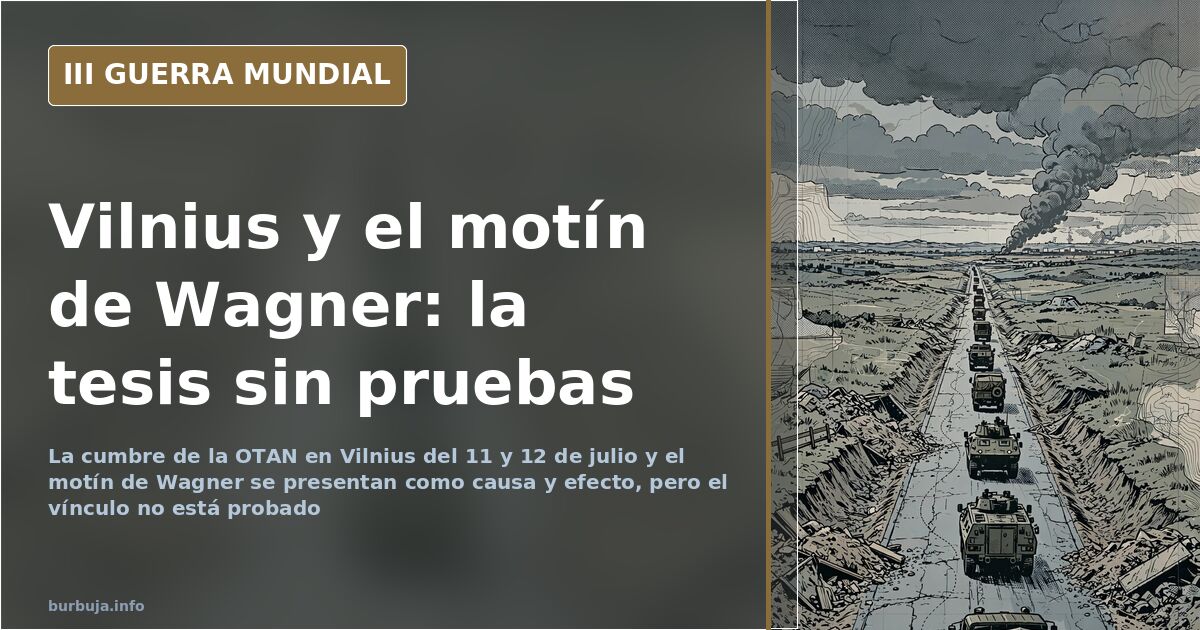
A convoy of armored vehicles heading toward Moscow, construction trenches dumped on road shoulders—useless against a tank—and kilometers-long traffic jams as the highway crumbled under their weight. This is the scene captured in videos of the Wagner Group mutiny. It is also the starting point for the prevailing theory: that the spark was not an internal Russian dispute, but the announcement at the July summit that Ukraine could join NATO. The hypothesis rests on three elements: news of the fast-track accession, membership conditions set in 2008, and a convention allegedly altering the Alliance's statutes. None of these, individually, proves the link.
The Alleged February 2023 NATO Convention
According to the narrative initiating this debate, NATO defense ministers met in Brussels and signed a convention modifying the Alliance's statutes. From there, this version argues, NATO could enter war without invoking Article 5—meaning without any member being attacked—and decisions would no longer require unanimity, passing instead by majority vote. The convention is dated February 18, 2023, with its alleged goal being to transform the alliance into a "coalition of the willing" targeting Russia and China.
The problem is that this element is presented as a closed fact when it actually serves as the premise for the entire structure. Without the convention, the rest of the narrative loses its scaffolding.
Why the July 11-12 Vilnius Summit Is Targeted
The second pillar is the meeting in Lithuania. Reference information published by Sky News on June 21 places the discussion on Ukrainian accession during the Vilnius summit of July 11 and 12. The United Kingdom and France supported approving a fast-track mechanism, assuming the Ukrainian army had met most required conditions.
The French Foreign Minister stated clearly: «Perhaps we won't require the Membership Action Plan mechanism - perhaps not, I say, perhaps not - which was planned in 2008». She added, «We are a long way from 2008. Time has passed, the situation is quite different». Translated: rules from fifteen years ago are considered obsolete, challenging the Membership Action Plan previously demanded.
From Rostov-on-Don to the 'March for Justice'
The account of events on the ground is more confusing. A detailed version claims Rostov housed the Southern Military District command, mercenaries were summoned near barracks, and orders were issued to advance toward Moscow in what was called a March for Justice, echoing the March on Rome. Columns, according to this reconstruction, avoided cities, faced no resistance, and alleged clashes were merely intoxication incidents.
Upon retreating, the Wagner chief reportedly uttered a phrase that became ammunition for all theories: «Всё по плану» (Everything according to plan). For some, proof of a coordinated setup with power; for others, a graceful exit by someone forced to halt.
Obstacles Conflicting with the Express Accession Thesis
The most repeated argument against the main hypothesis is procedural: NATO membership requires approval from all current members, and one veto blocks it. With an open war ongoing, it is argued that no partner would accept direct involvement due to nuclear risks.
Additionally, there is debate over who truly controls the button. Contrary to the image of a solitary leader deciding alone, some note that neither in the US nor in Russia does the president have individual capacity to order a nuclear attack: broader institutional and military backing would be needed. The conclusion is uncomfortable: if an attack were launched, it was not a personal impulse, but because broad sectors of the state agreed.
The Plane, DNA, and an Open Ending
The case's resolution remains incomplete. Russia officially reported the Wagner chief died in a plane crash, identified via DNA from remains. Part of the analysis rejects this, arguing the entire leadership was on that flight, making total elimination illogical; the alternative hypothesis suggests he was given a new identity.
Meanwhile, the fate of mercenary troops became another piece of the theory: their presence in Belarus, just kilometers from Kyiv, is interpreted as a maneuver disrupting NATO's timeline. This is an interpretation. No verification is possible.
With the July summit now past in the chronology, the link between Vilnius and the mutiny still lacks supporting evidence. And the disorienting data point is this: the most cited element to explain everything—the February convention—relies on a date, place, and statute change that no one has substantiated beyond the narrative itself.
A convoy of armored vehicles heading toward Moscow, construction trenches dumped on road shoulders—useless against a tank—and kilometers-long traffic jams as the highway crumbled under their weight. This is the scene captured in videos of the Wagner Group mutiny. It is also the starting point for the prevailing theory: that the spark was not an internal Russian dispute, but the announcement at the July summit that Ukraine could join NATO. The hypothesis rests on three elements: news of the fast-track accession, membership conditions set in 2008, and a convention allegedly altering the Alliance's statutes. None of these, individually, proves the link.
The Alleged February 2023 NATO Convention
According to the narrative initiating this debate, NATO defense ministers met in Brussels and signed a convention modifying the Alliance's statutes. From there, this version argues, NATO could enter war without invoking Article 5—meaning without any member being attacked—and decisions would no longer require unanimity, passing instead by majority vote. The convention is dated February 18, 2023, with its alleged goal being to transform the alliance into a "coalition of the willing" targeting Russia and China.
The problem is that this element is presented as a closed fact when it actually serves as the premise for the entire structure. Without the convention, the rest of the narrative loses its scaffolding.
Why the July 11-12 Vilnius Summit Is Targeted
The second pillar is the meeting in Lithuania. Reference information published by Sky News on June 21 places the discussion on Ukrainian accession during the Vilnius summit of July 11 and 12. The United Kingdom and France supported approving a fast-track mechanism, assuming the Ukrainian army had met most required conditions.
The French Foreign Minister stated clearly: «Perhaps we won't require the Membership Action Plan mechanism - perhaps not, I say, perhaps not - which was planned in 2008». She added, «We are a long way from 2008. Time has passed, the situation is quite different». Translated: rules from fifteen years ago are considered obsolete, challenging the Membership Action Plan previously demanded.
From Rostov-on-Don to the 'March for Justice'
The account of events on the ground is more confusing. A detailed version claims Rostov housed the Southern Military District command, mercenaries were summoned near barracks, and orders were issued to advance toward Moscow in what was called a March for Justice, echoing the March on Rome. Columns, according to this reconstruction, avoided cities, faced no resistance, and alleged clashes were merely intoxication incidents.
Upon retreating, the Wagner chief reportedly uttered a phrase that became ammunition for all theories: «Всё по плану» (Everything according to plan). For some, proof of a coordinated setup with power; for others, a graceful exit by someone forced to halt.
Obstacles Conflicting with the Express Accession Thesis
The most repeated argument against the main hypothesis is procedural: NATO membership requires approval from all current members, and one veto blocks it. With an open war ongoing, it is argued that no partner would accept direct involvement due to nuclear risks.
Additionally, there is debate over who truly controls the button. Contrary to the image of a solitary leader deciding alone, some note that neither in the US nor in Russia does the president have individual capacity to order a nuclear attack: broader institutional and military backing would be needed. The conclusion is uncomfortable: if an attack were launched, it was not a personal impulse, but because broad sectors of the state agreed.
The Plane, DNA, and an Open Ending
The case's resolution remains incomplete. Russia officially reported the Wagner chief died in a plane crash, identified via DNA from remains. Part of the analysis rejects this, arguing the entire leadership was on that flight, making total elimination illogical; the alternative hypothesis suggests he was given a new identity.
Meanwhile, the fate of mercenary troops became another piece of the theory: their presence in Belarus, just kilometers from Kyiv, is interpreted as a maneuver disrupting NATO's timeline. This is an interpretation. No verification is possible.
With the July summit now past in the chronology, the link between Vilnius and the mutiny still lacks supporting evidence. And the disorienting data point is this: the most cited element to explain everything—the February convention—relies on a date, place, and statute change that no one has substantiated beyond the narrative itself.
Summary of a discussion on Burbuja.info - Foro de economía, actualidad y política., translated from Spanish and reviewed before publication. Read the full discussion (164 replies).
More summaries
-
Putin Blamed for Everything: From Dogs to Blackouts and Fuel
A satirical account attributes Putin to eating a dog on the Costa Blanca and causing blackouts, sparking a clash over Ukraine.
-
Putin: Russia's Most Divisive Statesman or Tyrant?
Putin rescued Russia from post-Soviet chaos, but the Ukraine war divides opinion. Is he the century's greatest statesman or a tyrant?
-
Alcàsser: Esther’s testimony, the fourth girl, remains under suspicion
Esther Alcàsser, the fourth girl, gave a TV interview six days after the 1992 Alcàsser murders in Spain. Her account and timeline discrepancies fuel ongoing controversy.
-
Avdiivka: New Videos Reignite Debate Over Russian Casualties
Ukraine claims over 300,000 Russian deaths; UK estimates up to 190,000. In Avdiivka, the front line is static and casualty counts remain disputed.
-
Russian Propagandist Tatarsky Killed in St. Petersburg Cafe Blast
Vladlen Tatarsky, a Russian propagandist with 600,000 Telegram followers, died after an explosion at a cafe in St. Petersburg.
-
Lunar laser ranging fails to settle moon landing doubts
Despite laser beams bouncing off lunar retroreflectors, skepticism about the Apollo landings persists among conspiracy theorists.