
Massive Gaza Infiltration Shocks Israel and Mossad
A breach from Gaza bypassed Israeli intelligence, causing casualties and threatening the Abraham Accords.
English · Original discussion in Spanish · Published
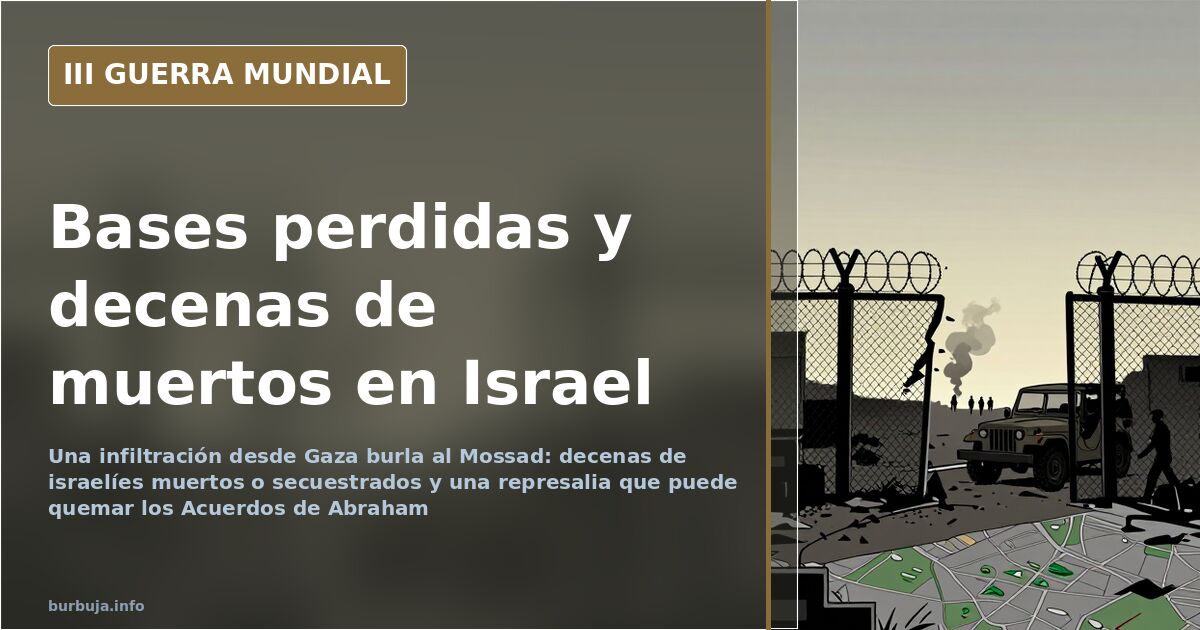
Dozens dead and bases lost: The blow Israel didn't see coming
A massive infiltration operation from Gaza, undetected by the Mossad, has left barracks and entire bases in the hands of Palestinian militias, dozens of Israelis killed in their own homes, and an unspecified number of hostages. The first consequence, the most visible, is one of prestige: the intelligence service considered the world's most efficient and armed forces presented as best prepared for rapid action were exposed simultaneously. Everything else trinc this double slap: the psychological warfare on a population unaccustomed to this, the future of the Abraham Accords, and the real cost of the retaliation being prepared in Gaza.
Why didn't the Mossad foresee the infiltration?
Because there are two possible readings, neither favorable to those who hold them: either intelligence knew nothing about an operation of that scale, or they knew and entered into a more complex calculation. The data that admits no interpretation is the result on the ground: bases seized by a force no one classifies as a conventional army and a population watching the spectacle from the other side of the border. For decades, Israeli superiority was taken for granted in every exchange of blows, and that presumption is exactly what has been shattered. Some add a third leg to the argument, that of interest: an operation of this magnitude would also serve as an alibi to justify unlimited punitive operations. That, today, is a suspicion without provided evidence.
The psychological blow: Killed at home and families fleeing
Israelis have lived for years with a macabre lottery: a rocket falling, an infiltrator stabbing or running someone over. This plays in another category. Dozens dead in private homes, people kidnapped, and hundreds of citizens fleeing their houses on foot through the fields, some with only what they wore. The difference is not in the number, it is in the framework: a society accustomed to its coups always resolving with a decisive victory found itself without immediate response and with combat inside its own territory. The panic and sense of helplessness described are not an emotional detail, they are a calculation variable. A public opinion that feels naked tolerates long and expensive operations worse than one that feels protected.
What happens to the Abraham Accords?
They are exposed, and not by chance. Normalization with several Arab countries was Israel's biggest diplomatic bet of the last decade, and a retaliation resulting in thousands of deaths puts it in question before the public opinions of those same countries, even if their governments look the other way. Here lies the trap of the matter: if the attack precisely sought to force a disproportionate response, the objective was not military, but diplomatic. It is even pointed out that it would not be strange to see Arab countries openly criticizing the Palestinian action, which in turn would weaken that common front. With the death toll still open, the result of that pincer is an unknown.
How much would entering Gaza by land cost?
Much more than air superiority suggests. The circulating reasoning is simple: Palestinians have been preparing for decades, and urban combat is especially burdensome in men and material for the attacker. The cited precedent is Lebanon, where the last incursion left armored vehicles abandoned in the desert and a sense of wear that Israel rarely acknowledges. Added to this is that the Israeli army rarely sustains long and bloody conflicts at home: its method is to move the board outside, crush quickly, and not measure the civilian cost. It is a scalpel when it wants to be and an elephant in a china shop when it suits it. The problem is that Gaza is not a distant board.
The regional fuse: Aircraft carriers, Iran, and who wins from the mess
The Pentagon mobilized the aircraft carrier strike group USS Gerald R. Ford toward the eastern Mediterranean, along with the cruiser USS Normandy and several destroyers, plus reinforcements of F-35, F-15, F-16, and A-10 squadrons. Some read that deployment as a show of force and others as biting the hook: opening a front with Iran while the Ukraine front remains open leaves the Chinese flank neglected, and part of the analysis argues that China benefits from any prolonged distraction. Russia appears in several hypotheses as a background actor, without anyone providing proof. The only verifiable thing is the movement of naval and air assets, and the hanging question: why deploy so much if the response is intended to be local?
Retaliation is taken for granted and expected to be massive, with warnings that it will translate into thousands of deaths. No one disputes the capability. What remains unresolved is the price: how much international legitimacy and how much diplomatic ground is Israel willing to burn so that the next generation does not see hundreds of its citizens fleeing on foot through the countryside again.
A massive infiltration operation from Gaza, undetected by the Mossad, has left barracks and entire bases in the hands of Palestinian militias, dozens of Israelis killed in their own homes, and an unspecified number of hostages. The first consequence, the most visible, is one of prestige: the intelligence service considered the world's most efficient and armed forces presented as best prepared for rapid action were exposed simultaneously. Everything else trinc this double slap: the psychological warfare on a population unaccustomed to this, the future of the Abraham Accords, and the real cost of the retaliation being prepared in Gaza.
Why didn't the Mossad foresee the infiltration?
Because there are two possible readings, neither favorable to those who hold them: either intelligence knew nothing about an operation of that scale, or they knew and entered into a more complex calculation. The data that admits no interpretation is the result on the ground: bases seized by a force no one classifies as a conventional army and a population watching the spectacle from the other side of the border. For decades, Israeli superiority was taken for granted in every exchange of blows, and that presumption is exactly what has been shattered. Some add a third leg to the argument, that of interest: an operation of this magnitude would also serve as an alibi to justify unlimited punitive operations. That, today, is a suspicion without provided evidence.
The psychological blow: Killed at home and families fleeing
Israelis have lived for years with a macabre lottery: a rocket falling, an infiltrator stabbing or running someone over. This plays in another category. Dozens dead in private homes, people kidnapped, and hundreds of citizens fleeing their houses on foot through the fields, some with only what they wore. The difference is not in the number, it is in the framework: a society accustomed to its coups always resolving with a decisive victory found itself without immediate response and with combat inside its own territory. The panic and sense of helplessness described are not an emotional detail, they are a calculation variable. A public opinion that feels naked tolerates long and expensive operations worse than one that feels protected.
What happens to the Abraham Accords?
They are exposed, and not by chance. Normalization with several Arab countries was Israel's biggest diplomatic bet of the last decade, and a retaliation resulting in thousands of deaths puts it in question before the public opinions of those same countries, even if their governments look the other way. Here lies the trap of the matter: if the attack precisely sought to force a disproportionate response, the objective was not military, but diplomatic. It is even pointed out that it would not be strange to see Arab countries openly criticizing the Palestinian action, which in turn would weaken that common front. With the death toll still open, the result of that pincer is an unknown.
How much would entering Gaza by land cost?
Much more than air superiority suggests. The circulating reasoning is simple: Palestinians have been preparing for decades, and urban combat is especially burdensome in men and material for the attacker. The cited precedent is Lebanon, where the last incursion left armored vehicles abandoned in the desert and a sense of wear that Israel rarely acknowledges. Added to this is that the Israeli army rarely sustains long and bloody conflicts at home: its method is to move the board outside, crush quickly, and not measure the civilian cost. It is a scalpel when it wants to be and an elephant in a china shop when it suits it. The problem is that Gaza is not a distant board.
The regional fuse: Aircraft carriers, Iran, and who wins from the mess
The Pentagon mobilized the aircraft carrier strike group USS Gerald R. Ford toward the eastern Mediterranean, along with the cruiser USS Normandy and several destroyers, plus reinforcements of F-35, F-15, F-16, and A-10 squadrons. Some read that deployment as a show of force and others as biting the hook: opening a front with Iran while the Ukraine front remains open leaves the Chinese flank neglected, and part of the analysis argues that China benefits from any prolonged distraction. Russia appears in several hypotheses as a background actor, without anyone providing proof. The only verifiable thing is the movement of naval and air assets, and the hanging question: why deploy so much if the response is intended to be local?
Retaliation is taken for granted and expected to be massive, with warnings that it will translate into thousands of deaths. No one disputes the capability. What remains unresolved is the price: how much international legitimacy and how much diplomatic ground is Israel willing to burn so that the next generation does not see hundreds of its citizens fleeing on foot through the countryside again.
Summary of a discussion on Burbuja.info - Foro de economía, actualidad y política., translated from Spanish and reviewed before publication. Read the full discussion (164 replies).
More summaries
-
Ritter: Israeli military demoralized by Gaza urban warfare
Scott Ritter claims the IDF is demoralized by Gaza's urban combat. Interceptor costs against thousands of rockets open a new front.
-
Gaza Infiltration: Mossad Faces Scrutiny
The Gaza breach exposes Mossad gaps, reigniting tensions with Iran and Hezbollah amid unproven theories on the attack's origin.
-
Israel's Missile Shield Falters as Gaza Incursion Deepens
Israel's anti-missile shield is faltering as infiltration from Gaza exceeds 40 km, testing military doctrine and US influence.
-
Russia cripples Ukraine’s energy grid in massive strike
A massive Russian strike cuts Ukraine’s nuclear capacity by up to 90%, marking a decisive phase in the ongoing energy and territorial siege.
-
Avdiivka: New Videos Reignite Debate Over Russian Casualties
Ukraine claims over 300,000 Russian deaths; UK estimates up to 190,000. In Avdiivka, the front line is static and casualty counts remain disputed.
-
Russian Propagandist Tatarsky Killed in St. Petersburg Cafe Blast
Vladlen Tatarsky, a Russian propagandist with 600,000 Telegram followers, died after an explosion at a cafe in St. Petersburg.