
Zamora gender violence prosecutor dies in head-on crash
Evaristo Antelo, deputy prosecutor at Zamora's Provincial Court and gender violence specialist, died in a head-on collision on the N-631 near Perilla de Castro.
English · Original discussion in Spanish · Published
Zamora gender violence prosecutor dies in head-on crash
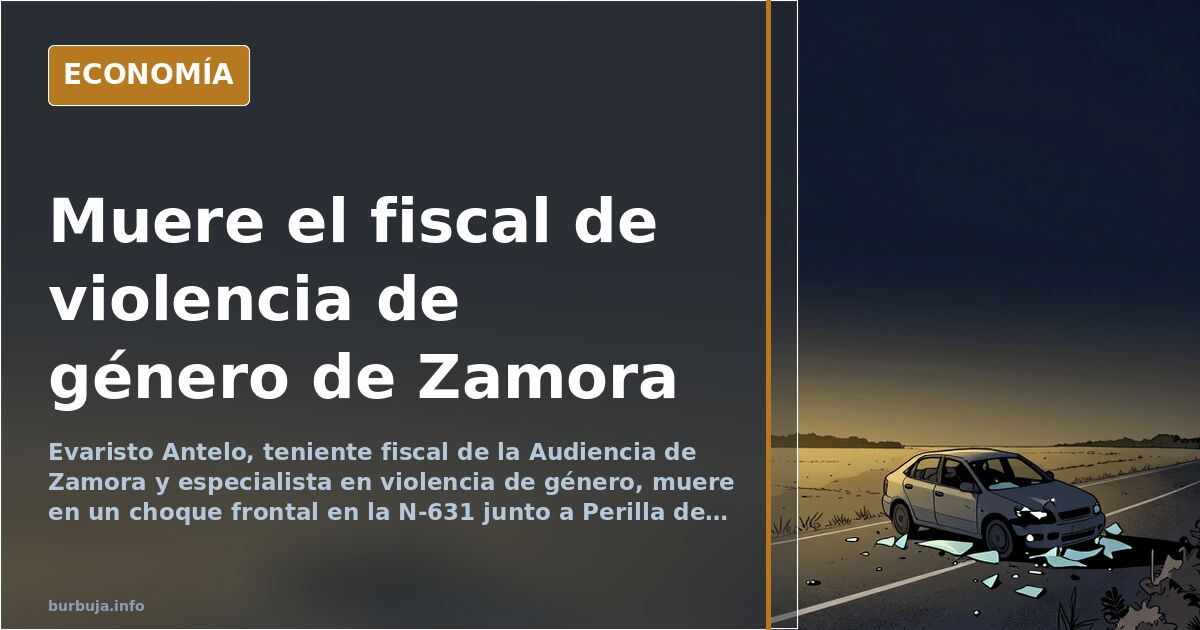
Evaristo Antelo, deputy prosecutor at the Zamora Provincial Court (Audiencia Provincial) and a specialist in gender-based violence, died this Friday in a head-on collision between two cars and an SUV. The accident occurred at 1:45 PM at kilometer 7 of the N-631 highway, within the municipality of Perilla de Castro. The crash left one other person dead—an octogenarian man—and several injured. According to online discussions, among the injured was the prosecutor’s 18-year-old son, a law student who was traveling with him. Antelo, aged 65 and a resident of Salamanca, had been working in Zamora for nearly two decades. Reports indicate he was heading to a funeral with his vvife, a town hall secretary, when the impact peine.
The news sparked uncomfortable debates about the deceased’s profession, the structure of specialized courts, and the human cost of legislation that has lacked consensus for twenty years.
What is known about the Perilla de Castro accident
The Civil Guard reported a head-on collision involving two cars and an SUV on a straight stretch with wide visibility, according to discussion participants. The prosecutor, traveling in one of the cars, was the only fatality from his vehicle. The second victim, an elderly man, was driving either the second car or the SUV, depending on conflicting accounts circulating online. Several people were injured.
Antelo’s career developed almost entirely in Zamora, where he served as deputy prosecutor at the Provincial Court and specialized in gender-based violence. Official statements described him as "a highly respected figure in the judicial community." The detail that he was en route to a funeral with his vvife added an element of everyday tragedy that quickly became part of the public discourse.
From condolences to reckoning: how the tone shifted
Initial reactions were sympathetic. Within hours, however, the tone turned harsher, suggesting the prosecutor’s death was a form of karma, divine justice, or a settled debt. "Karma is ruthless," one user summarized. Another called it "karma" and laughed, labeling the deceased a "necessary accomplice." The most twisted hypothesis—unsupported by any evidence—was that the other driver, the octogenarian, might have been the father of a man ruined or driven to suicide by a gender violence case, using the steering wheel for revenge. No data supported this theory, yet it circulated as a release valve for frustration.
It must be stated clearly: none of this is proven. The Civil Guard classified it as a traffic accident, not an act of vengeance. However, the fact that such suspicions spread unchecked reveals the extent of the deterioration in public debate surrounding this issue.
Why are there specialized gender violence prosecutors?
One participant posed the core question: "I can’t understand why there are gender violence prosecutors. By that logic, there should also be prosecutors for traffic crimes or commercial document forgery." The technical answer is that specialization exists in many jurisdictions—juvenile cases, immigration, environment, anti-corruption—to concentrate expertise in complex areas. The political answer is that the gender violence law created specific courts and prosecution units, which some argue breaks the principle of equality before the law.
The most repeated argument involved "exceptional courts." "Since 2004, there has been no equality before the law," one participant claimed. "There are first-class citizens, women, and slaves, men, who are judged in special courts when accused by these first-class citizens." This thesis is not supported by the legal framework—gender violence courts try offenses defined in the common Penal Code—but it expresses real discontent with perceived asymmetry.
Prosecutors who demand maximum sentences then negotiate
One of the most technical exchanges concerned procedural practice. "Most prosecutors tend to always request the lowest possible sentence, partly because they aren’t as corrupt as you think, and partly to reach a plea agreement," wrote one participant. The rebuttal was sharp: "CATEGORICALLY FALSE. They demand the super-maximum, then force plea agreements by negotiating reductions." The discussion drifted toward eventual intent, free evaluation of evidence, and judicial discretion. "Even proving your innocence with exculpatory evidence, you still get convicted," one argued. Another, with experience in ordinary jurisdiction, clarified: "I’ve seen dismissals and acquittals. Many walk free. And the sentences are laughable."
Far from resolving, the exchange highlighted a perception problem: the same procedural reality—prosecutors negotiating, judges acquitting, suspended sentences—is viewed by one side as a guarantee and by the other as proof that the system only works when it wants to.
Civil service legacy and the injured son
A detail from the accident fueled another line of comments: according to one participant, the prosecutor’s 18-year-old son, a law student, was traveling with him and suffered serious injuries. "The 18-year-old law student son who was going to take his father’s position is critical," the user wrote, referring to "a dynasty of civil servants." This observation connects to a deeper economic issue: the reproduction of public employment within families, preparing for competitive exams from within, and the advantage of growing up in a household familiar with the syllabus, the tribunal, and the hierarchy. While no data quantifies this advantage, the comment brought it to light.
Salary details were also mentioned: "This month he had already received €12,000 including bonuses," one participant claimed without justification. This figure has not been verified and does not appear in any official source.
The accident as a thermometer of discontent
The discussion expanded into general criticism of the political system: the selection of officials, the purchase of loyalty, media manipulation. "To claim we democratically elect anyone, knowing the Spanish political system, shows ignorance and irresponsibility," one participant wrote. Another took it to economics: "In mafious 'Españorda,' even the janitor’s son becomes a janitor." The conversation ended where these debates often do: with the feeling that the judicial and political systems are one and the same, and that the death of a prosecutor changes nothing.
The precise point where analysis stalls is this: there is no way to separate the debate over the gender violence law from the debate over who applies it. As long as this separation does not occur, every accident, resignation, and ruling will be read as a chapter in the same cultural war.
Evaristo Antelo, deputy prosecutor at the Zamora Provincial Court (Audiencia Provincial) and a specialist in gender-based violence, died this Friday in a head-on collision between two cars and an SUV. The accident occurred at 1:45 PM at kilometer 7 of the N-631 highway, within the municipality of Perilla de Castro. The crash left one other person dead—an octogenarian man—and several injured. According to online discussions, among the injured was the prosecutor’s 18-year-old son, a law student who was traveling with him. Antelo, aged 65 and a resident of Salamanca, had been working in Zamora for nearly two decades. Reports indicate he was heading to a funeral with his vvife, a town hall secretary, when the impact peine.
The news sparked uncomfortable debates about the deceased’s profession, the structure of specialized courts, and the human cost of legislation that has lacked consensus for twenty years.
What is known about the Perilla de Castro accident
The Civil Guard reported a head-on collision involving two cars and an SUV on a straight stretch with wide visibility, according to discussion participants. The prosecutor, traveling in one of the cars, was the only fatality from his vehicle. The second victim, an elderly man, was driving either the second car or the SUV, depending on conflicting accounts circulating online. Several people were injured.
Antelo’s career developed almost entirely in Zamora, where he served as deputy prosecutor at the Provincial Court and specialized in gender-based violence. Official statements described him as "a highly respected figure in the judicial community." The detail that he was en route to a funeral with his vvife added an element of everyday tragedy that quickly became part of the public discourse.
From condolences to reckoning: how the tone shifted
Initial reactions were sympathetic. Within hours, however, the tone turned harsher, suggesting the prosecutor’s death was a form of karma, divine justice, or a settled debt. "Karma is ruthless," one user summarized. Another called it "karma" and laughed, labeling the deceased a "necessary accomplice." The most twisted hypothesis—unsupported by any evidence—was that the other driver, the octogenarian, might have been the father of a man ruined or driven to suicide by a gender violence case, using the steering wheel for revenge. No data supported this theory, yet it circulated as a release valve for frustration.
It must be stated clearly: none of this is proven. The Civil Guard classified it as a traffic accident, not an act of vengeance. However, the fact that such suspicions spread unchecked reveals the extent of the deterioration in public debate surrounding this issue.
Why are there specialized gender violence prosecutors?
One participant posed the core question: "I can’t understand why there are gender violence prosecutors. By that logic, there should also be prosecutors for traffic crimes or commercial document forgery." The technical answer is that specialization exists in many jurisdictions—juvenile cases, immigration, environment, anti-corruption—to concentrate expertise in complex areas. The political answer is that the gender violence law created specific courts and prosecution units, which some argue breaks the principle of equality before the law.
The most repeated argument involved "exceptional courts." "Since 2004, there has been no equality before the law," one participant claimed. "There are first-class citizens, women, and slaves, men, who are judged in special courts when accused by these first-class citizens." This thesis is not supported by the legal framework—gender violence courts try offenses defined in the common Penal Code—but it expresses real discontent with perceived asymmetry.
Prosecutors who demand maximum sentences then negotiate
One of the most technical exchanges concerned procedural practice. "Most prosecutors tend to always request the lowest possible sentence, partly because they aren’t as corrupt as you think, and partly to reach a plea agreement," wrote one participant. The rebuttal was sharp: "CATEGORICALLY FALSE. They demand the super-maximum, then force plea agreements by negotiating reductions." The discussion drifted toward eventual intent, free evaluation of evidence, and judicial discretion. "Even proving your innocence with exculpatory evidence, you still get convicted," one argued. Another, with experience in ordinary jurisdiction, clarified: "I’ve seen dismissals and acquittals. Many walk free. And the sentences are laughable."
Far from resolving, the exchange highlighted a perception problem: the same procedural reality—prosecutors negotiating, judges acquitting, suspended sentences—is viewed by one side as a guarantee and by the other as proof that the system only works when it wants to.
Civil service legacy and the injured son
A detail from the accident fueled another line of comments: according to one participant, the prosecutor’s 18-year-old son, a law student, was traveling with him and suffered serious injuries. "The 18-year-old law student son who was going to take his father’s position is critical," the user wrote, referring to "a dynasty of civil servants." This observation connects to a deeper economic issue: the reproduction of public employment within families, preparing for competitive exams from within, and the advantage of growing up in a household familiar with the syllabus, the tribunal, and the hierarchy. While no data quantifies this advantage, the comment brought it to light.
Salary details were also mentioned: "This month he had already received €12,000 including bonuses," one participant claimed without justification. This figure has not been verified and does not appear in any official source.
The accident as a thermometer of discontent
The discussion expanded into general criticism of the political system: the selection of officials, the purchase of loyalty, media manipulation. "To claim we democratically elect anyone, knowing the Spanish political system, shows ignorance and irresponsibility," one participant wrote. Another took it to economics: "In mafious 'Españorda,' even the janitor’s son becomes a janitor." The conversation ended where these debates often do: with the feeling that the judicial and political systems are one and the same, and that the death of a prosecutor changes nothing.
The precise point where analysis stalls is this: there is no way to separate the debate over the gender violence law from the debate over who applies it. As long as this separation does not occur, every accident, resignation, and ruling will be read as a chapter in the same cultural war.
Also available in: Deutsch
Summary of a discussion on Burbuja.info - Foro de economía, actualidad y política., translated from Spanish and reviewed before publication. Read the full discussion (191 replies).
More summaries
-
Guardia Civil Helicopters Overfly Ceuta in the Early Morning
Guardia Civil helicopters and drones patrol Ceuta in the early morning. Flight tracking suggests a deployment without an official statement.
-
Spain: Protests in Gata de Gorgos over David's murder and police handling
Residents of Gata de Gorgos, Spain, protest the killing of David amid criticism of the Guardia Civil for protecting squatters while a key witness fled threats.
-
Retired Spanish Civil Guard details chemsex toll
A 37-year-old Guardia Civil officer retired after years of chemsex and a GHB suicide attempt, highlighting health costs.
-
Spain's ERE layoff wave nobody wants to see
Analysis of the wave of layoffs and ERE in Spain. Burbuja.info forum users expose the industrial reality the media won't show.
-
Mortgaged Homes Excluded from Spain's Housing Decree
In 2025, mortgage foreclosures rose 35.6% to 31,416. Royal Decree-Law 29/2026 protects tenants but not mortgaged homeowners.
-
Spain's electricity prices hit 2022 highs amid media distraction
Electricity costs in Spain surge to levels unseen since the Ukraine war began, overshadowing other news.