
You pay €3.50 for a self-service breakfast at modern chains
A customer describes having to fetch water and carry their own tray for €3.50 at a self-service coffee chain.
English · Original discussion in Spanish · Published
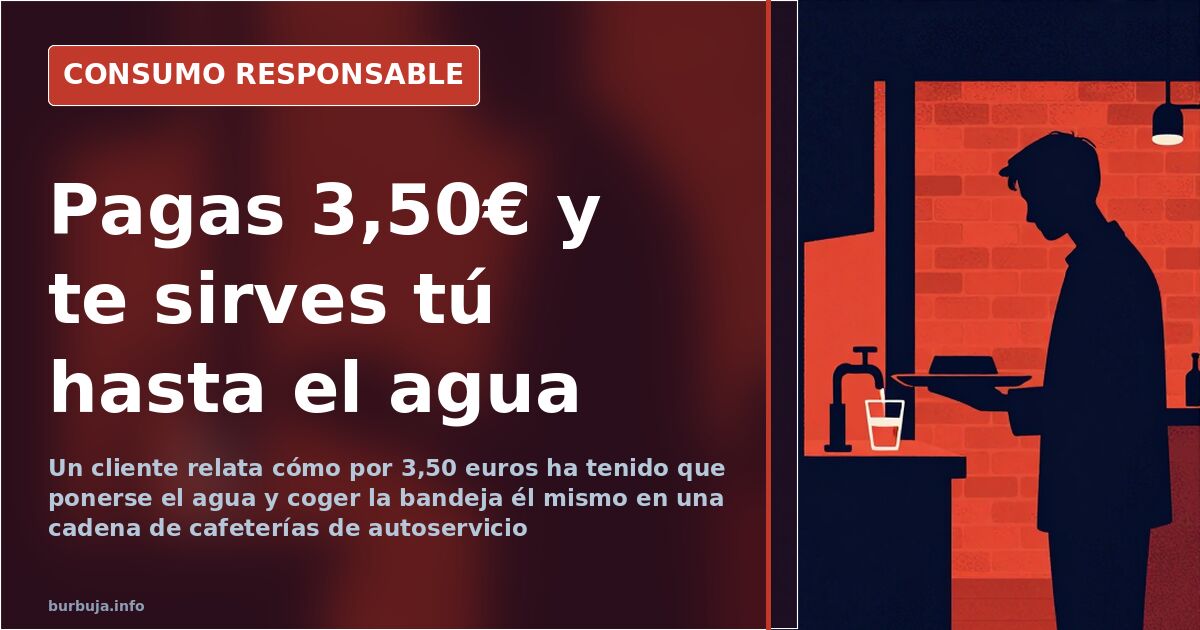
€3.50 for serving yourself: the reality of self-service breakfasts
How much should it cost for someone to bring you a coffee and a sandwich? In some coffee chains, the answer is uncomfortable: nothing, because no one does it anymore. For €3.50, a customer received a coffee, a glass of water, and a small sandwich — the term he used himself — inside a paper bag. No tray, no table service, and no indication of where the water was. He had to get it himself in an undefined area that, according to staff, covered the entire café.
The story ends with the customer leaving the sandwich on the counter and announcing a complaint, highlighting a model that is no longer rare. Do-it-yourself as a value proposition. The debate sparked by this incident reveals three issues: price, working conditions, and the disappearance of what used to be called service.
What the price includes and tasks shifted to the customer
The breakdown is detailed. The customer orders coffee, a mini sandwich, and water: the water is his responsibility. He asks where it is and gets an undefined location. He asks if the sandwich comes to the table and is told no. He asks if it at least comes on a tray with the coffee, and is told to grab a tray from somewhere and that the coffee will be given last. When he jokingly asks if he also has to brew the coffee and wash up afterwards, he is told to do whatever he prefers. And so, until the goodbye: €3.50 and fend for yourself.
None of this is illegal, and that is the detail. Self-service allows lower hall costs and presents itself as modernity, even as an experience. What is not passed on to the customer is the part of the price that corresponded to the work no longer being done.
Coffee, sandwich, and water: comparing prices
The numbers consumers cite paint an unequal map of the same breakfast:
The conclusion many draw is uncomfortable: paying more does not guarantee better service. Often, you are paying for the brand and location, not the floor work. Those who pay €3.50 to serve themselves are not buying a service; they are funding a franchise.
Why chains cut staff and shift tasks to customers?
Opinions differ. Some argue self-service is simply cost adjustment: fewer staff, less training, higher margins, and a narrative of modernity masking staff cuts. Others point to labor supply issues: if candidates don't appear for certain conditions and wages, those who accept the job have little to lose and act accordingly, even if it harms the business long-term.
This second argument has a striking derivative. The power dynamic between employer and employee reverses when wages are low and turnover high: employees don't antiestéticar dismissal because bad jobs are plentiful, while venues can't close the bar. The visible result is indifferent service interpreted by customers as rudeness.
And there is a third path, based on basic business logic: kindness costs nothing, but its absence can cost customers. This calculation—revenue lost due to poor treatment—is one many establishments never make.
El Corte Inglés and industrial bars: the two extremes
At the opposite end of self-service, El Corte Inglés cafés are frequently cited, where several consumers report maintaining formal address ('usted') and table service. With nuances: some note heating was set to 27 degrees, while others lament slower service compared to traditional bars.
On the other side is the traditional bar. The neighborhood or industrial estate spot serving breakfast at the bar for €2.60. Chinese-run premises and kebab shops also enter the comparison, valued for fast, cheap service without talk about 'customer experience'. However, the most repeated recommendation is the cheapest of all: eat breakfast at home. That doesn't generate revenue.
Complaints and boycotts as the only response
Practical recourse for complaints is limited. Complaints are announced, accepted with an 'ok', and that's it. What works, according to many viewpoints, is silent boycott: not returning, avoiding certain chains, and documenting treatment on review platforms, where comments on customer service have become an increasingly consulted filter before choosing where to have breakfast. Managers tolerating such service levels eventually pay for it in sales, albeit late.
In the end, the initial question remains unanswered: if the customer does the floor work, why pay the full price? Chains have a prepared response. It is the same one given when asking for water: it is there, somewhere. Find it.
How much should it cost for someone to bring you a coffee and a sandwich? In some coffee chains, the answer is uncomfortable: nothing, because no one does it anymore. For €3.50, a customer received a coffee, a glass of water, and a small sandwich — the term he used himself — inside a paper bag. No tray, no table service, and no indication of where the water was. He had to get it himself in an undefined area that, according to staff, covered the entire café.
The story ends with the customer leaving the sandwich on the counter and announcing a complaint, highlighting a model that is no longer rare. Do-it-yourself as a value proposition. The debate sparked by this incident reveals three issues: price, working conditions, and the disappearance of what used to be called service.
What the price includes and tasks shifted to the customer
The breakdown is detailed. The customer orders coffee, a mini sandwich, and water: the water is his responsibility. He asks where it is and gets an undefined location. He asks if the sandwich comes to the table and is told no. He asks if it at least comes on a tray with the coffee, and is told to grab a tray from somewhere and that the coffee will be given last. When he jokingly asks if he also has to brew the coffee and wash up afterwards, he is told to do whatever he prefers. And so, until the goodbye: €3.50 and fend for yourself.
None of this is illegal, and that is the detail. Self-service allows lower hall costs and presents itself as modernity, even as an experience. What is not passed on to the customer is the part of the price that corresponded to the work no longer being done.
Coffee, sandwich, and water: comparing prices
The numbers consumers cite paint an unequal map of the same breakfast:
- Modern self-service chain: €3.50 for coffee, water, and sandwich in a bag.
- Café near Plaza Mayor: €2.50 for coffee, tomato toast with oil and salt, and orange juice, served at the counter.
- Industrial estate bar: €2.60 for omelette and torrefacto coffee at the bar.
- Pastry chain: €1.50 for a latte, with the added benefit of cup collection after half an hour.
The conclusion many draw is uncomfortable: paying more does not guarantee better service. Often, you are paying for the brand and location, not the floor work. Those who pay €3.50 to serve themselves are not buying a service; they are funding a franchise.
Why chains cut staff and shift tasks to customers?
Opinions differ. Some argue self-service is simply cost adjustment: fewer staff, less training, higher margins, and a narrative of modernity masking staff cuts. Others point to labor supply issues: if candidates don't appear for certain conditions and wages, those who accept the job have little to lose and act accordingly, even if it harms the business long-term.
This second argument has a striking derivative. The power dynamic between employer and employee reverses when wages are low and turnover high: employees don't antiestéticar dismissal because bad jobs are plentiful, while venues can't close the bar. The visible result is indifferent service interpreted by customers as rudeness.
And there is a third path, based on basic business logic: kindness costs nothing, but its absence can cost customers. This calculation—revenue lost due to poor treatment—is one many establishments never make.
El Corte Inglés and industrial bars: the two extremes
At the opposite end of self-service, El Corte Inglés cafés are frequently cited, where several consumers report maintaining formal address ('usted') and table service. With nuances: some note heating was set to 27 degrees, while others lament slower service compared to traditional bars.
On the other side is the traditional bar. The neighborhood or industrial estate spot serving breakfast at the bar for €2.60. Chinese-run premises and kebab shops also enter the comparison, valued for fast, cheap service without talk about 'customer experience'. However, the most repeated recommendation is the cheapest of all: eat breakfast at home. That doesn't generate revenue.
Complaints and boycotts as the only response
Practical recourse for complaints is limited. Complaints are announced, accepted with an 'ok', and that's it. What works, according to many viewpoints, is silent boycott: not returning, avoiding certain chains, and documenting treatment on review platforms, where comments on customer service have become an increasingly consulted filter before choosing where to have breakfast. Managers tolerating such service levels eventually pay for it in sales, albeit late.
In the end, the initial question remains unanswered: if the customer does the floor work, why pay the full price? Chains have a prepared response. It is the same one given when asking for water: it is there, somewhere. Find it.
Also available in: Deutsch
Summary of a discussion on Burbuja.info - Foro de economía, actualidad y política., translated from Spanish and reviewed before publication. Read the full discussion (136 replies).
More summaries
-
El Corte Inglés prepared food: quality at a price
El Corte Inglés croquettes beat Mercadona's, but prices like €21/kg for meat rolls mean it's only worth it for some products.
-
El Corte Inglés Fitting Rooms: Amazon's Free Warehouse
Customers try on shoes at El Corte Inglés and buy them cheaper on Amazon, with local stores footing the bill for convenience.
-
White-label vs. name-brand air conditioners: which should you buy?
Is it worth paying double for a Mitsubishi or Daikin? 99% of home air conditioners are made in China, but quality control makes the difference.
-
Daily Driver Classics: From Lada Niva to Mercedes W124
Which affordable classics over 25 years old survive daily use, and which become maintenance nightmares?
-
Downsizing: 1930 V16 matches modern 1.4L output
Cadillac's 7.4-liter V16 produced power similar to today's 1.4 engines. Downsizing reflects a century of accumulated specific power, not just crisis.
-
Beachgoers Butcher Stranded Tuna in La Manga
Swimmers carved up a dead tuna on La Manga beach, sparking debate over food safety and anisakis risks.