
Beachgoers Butcher Stranded Tuna in La Manga
Swimmers carved up a dead tuna on La Manga beach, sparking debate over food safety and anisakis risks.
English · Original discussion in Spanish · Published
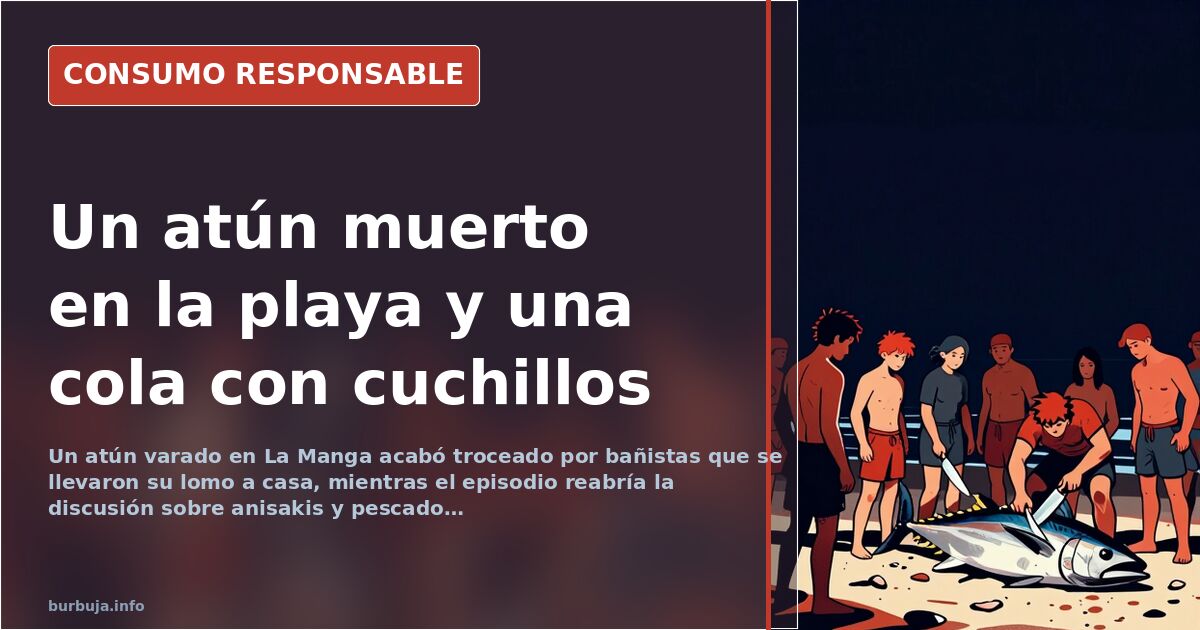
Beachgoers butcher stranded tuna on La Manga shore
A tuna washed ashore dead on La Manga and was immediately cut into loins by swimmers eager to take it home. The incident, reported by La Verdad, quickly escalated beyond a summer anecdote into a heated discussion about eating free finds, trusting official guidance, and our disconnect from whole animals. It started, naturally, with jokes about the fish's eyes.
What is known about the tuna found in La Manga
It wasn't fresh off the boat. According to one swimmer, the tuna had been drifting along the coast for days. He saw it about 20 meters away while swimming; his vvife ran to shore thinking it was a shark. The prevailing theory is that the animal escaped a traditional almadraba trap, entered La Manga, and died of oxygen deprivation. This fits the geography: La Manga borders the open Mediterranean, where water currents differ.
That is all we know. No official cause, no confirmation. Just a plausible hypothesis and widespread speculation. Keep this in mind before debating whether that fish was a delicacy or a hazard.
Can you eat a tuna found dead on the beach?
The debate splits into two camps that don't listen to each other. One side cites anisakis and histamine, noting the unknown cause of death and warning that poisoning leads to emergency rooms paid for by public funds. The other argues supermarket fish isn't cleaner, that gills and eyes indicate freshness, and cooking eliminates most risks.
A crucial detail often overlooked: eating roadkill contradicts traceability standards. On paper, it's forbidden. In August heat, with a massive carcass on sand, theory fades fast.
Price per kilo: why free fish mobilizes the crowd
Bluefin tuna is expensive, shaping the entire argument. One comment highlights the absurdity: Spain exports bluefin to Japan while locals barely eat it, yet when one strands, people rush to claim their share. "Kilos cost a fortune," lamented the man who saw it twenty meters away but couldn't grab its tail.
Contrast this scavenger scene with another view: this might be the best fish many will ever eat, far superior to supermarket packaged goods. The line between resourcefulness and opportunism depends on the narrator, visible clearly in the photos.
From traditional slaughter to disgust at whole animals
Underlying the tuna issue is an older conflict: those who grew up watching pig butchering versus those who only recognize meat in plastic trays. This touches on neo-slaughter anxieties, generational squeamishness, and mutual suspicion. Some believe these practices survive only in keto/paleo urban tribes; others see rejection as irreversible cultural loss.
The opposing extreme also appears: banning consumption outside industrial food chains, forcing reliance on feed containing microplastics and estrogens. It's hyperbole, but explains why a stranded fish angers so many different groups.
When the conversation stops being about fish
Much of the exchange turned ugly. Generalizations based on origin, classist insults, and accents emerged. People compared this to past incidents where similar scenes received different treatment depending on who appeared in videos. That contrast, stated plainly, is the most uncomfortable part and least discussed.
The dominant reaction remained typical: sharing news, mocking alarmists, and mourning the lost skill of utilizing a whole animal.
What happens next time a tuna strands?
If the pattern repeats, expect swimmers with knives, health warnings in comments, and two sides judging freshness by eye clarity. Likely, no one will determine the cause of death because the loin will be gone before vets arrive. The prediction has a flaw: it depends on uncontrollable factors—when the next stranding occurs. Could be tomorrow, or years.
A tuna washed ashore dead on La Manga and was immediately cut into loins by swimmers eager to take it home. The incident, reported by La Verdad, quickly escalated beyond a summer anecdote into a heated discussion about eating free finds, trusting official guidance, and our disconnect from whole animals. It started, naturally, with jokes about the fish's eyes.
What is known about the tuna found in La Manga
It wasn't fresh off the boat. According to one swimmer, the tuna had been drifting along the coast for days. He saw it about 20 meters away while swimming; his vvife ran to shore thinking it was a shark. The prevailing theory is that the animal escaped a traditional almadraba trap, entered La Manga, and died of oxygen deprivation. This fits the geography: La Manga borders the open Mediterranean, where water currents differ.
That is all we know. No official cause, no confirmation. Just a plausible hypothesis and widespread speculation. Keep this in mind before debating whether that fish was a delicacy or a hazard.
Can you eat a tuna found dead on the beach?
The debate splits into two camps that don't listen to each other. One side cites anisakis and histamine, noting the unknown cause of death and warning that poisoning leads to emergency rooms paid for by public funds. The other argues supermarket fish isn't cleaner, that gills and eyes indicate freshness, and cooking eliminates most risks.
A crucial detail often overlooked: eating roadkill contradicts traceability standards. On paper, it's forbidden. In August heat, with a massive carcass on sand, theory fades fast.
Price per kilo: why free fish mobilizes the crowd
Bluefin tuna is expensive, shaping the entire argument. One comment highlights the absurdity: Spain exports bluefin to Japan while locals barely eat it, yet when one strands, people rush to claim their share. "Kilos cost a fortune," lamented the man who saw it twenty meters away but couldn't grab its tail.
Contrast this scavenger scene with another view: this might be the best fish many will ever eat, far superior to supermarket packaged goods. The line between resourcefulness and opportunism depends on the narrator, visible clearly in the photos.
From traditional slaughter to disgust at whole animals
Underlying the tuna issue is an older conflict: those who grew up watching pig butchering versus those who only recognize meat in plastic trays. This touches on neo-slaughter anxieties, generational squeamishness, and mutual suspicion. Some believe these practices survive only in keto/paleo urban tribes; others see rejection as irreversible cultural loss.
The opposing extreme also appears: banning consumption outside industrial food chains, forcing reliance on feed containing microplastics and estrogens. It's hyperbole, but explains why a stranded fish angers so many different groups.
When the conversation stops being about fish
Much of the exchange turned ugly. Generalizations based on origin, classist insults, and accents emerged. People compared this to past incidents where similar scenes received different treatment depending on who appeared in videos. That contrast, stated plainly, is the most uncomfortable part and least discussed.
The dominant reaction remained typical: sharing news, mocking alarmists, and mourning the lost skill of utilizing a whole animal.
What happens next time a tuna strands?
If the pattern repeats, expect swimmers with knives, health warnings in comments, and two sides judging freshness by eye clarity. Likely, no one will determine the cause of death because the loin will be gone before vets arrive. The prediction has a flaw: it depends on uncontrollable factors—when the next stranding occurs. Could be tomorrow, or years.
Also available in: Deutsch
Summary of a discussion on Burbuja.info - Foro de economía, actualidad y política., translated from Spanish and reviewed before publication. Read the full discussion (133 replies).
More summaries
-
Air fryers: small ovens winning over solo cooks
Air fryers don't actually fry; they are compact ovens for one person. Critics argue that oil savings come at the cost of higher electricity bills.
-
Cola Cao 1986 vs 2026: less product, more sugar, same real price
Cola Cao 1986 vs 2026: smaller size, sugar up to 70%, and price adjusted for inflation. Is it still the same product? Data analysis.
-
Daily Driver Classics: From Lada Niva to Mercedes W124
Which affordable classics over 25 years old survive daily use, and which become maintenance nightmares?
-
Downsizing: 1930 V16 matches modern 1.4L output
Cadillac's 7.4-liter V16 produced power similar to today's 1.4 engines. Downsizing reflects a century of accumulated specific power, not just crisis.
-
Amazon Disrupts Hardware Stores, Making Physical Shopping Less Viable
A simple nut took hours to find locally but minutes on Amazon. The shift from neighborhood shops lacking stock to online convenience is accelerating.
-
Cheap PC Power Supplies: When Savings Are Real and When They’re Risky
Second-hand FSP units at €14-20 vs. €60 models: analyzing real wattage, efficiency, and motherboard risks in consumer PCs.