
You don’t avoid a noisy neighbor by buying; you avoid them by paying
Residential peace has become a luxury good: plots of 1,000 to 2,500 m², slow complaints and responses ranging from dialogue to retaliatory noise
English · Original discussion in Spanish · Published
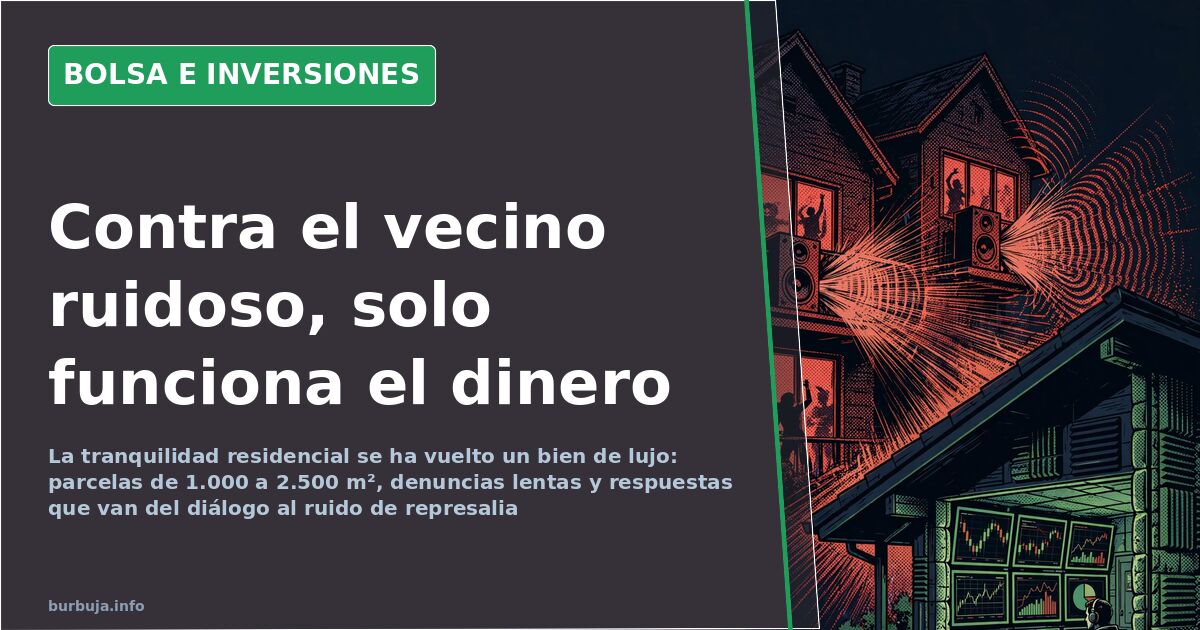
You don’t avoid a noisy neighbor by buying; you avoid them by paying
Buying a house doesn’t free you from an unbearable neighbor. Neither does renting, nor a quiet residential development on the outskirts. It only takes a few tenants with five barking dogs at all hours and daily parties moving into the villa next door for a posh residential neighborhood to become a years-long ordeal, lawsuits included, with no one managing to get rid of them. Residential peace works like a luxury good: you buy it, and it gets more expensive all the time.
The question that sparked the whole conversation — how to avoid a dirty, noisy or outright unhinged neighbor — has answers ranging from money to physical intimidation. No one found a foolproof formula.
How much does it cost to avoid a noisy neighbor?
Money appears in every recipe. The statistical version holds that a villa with a plot always beats an apartment and a penthouse, because there are fewer neighbors and they tend to have higher incomes; but the fine print matters: a house with 200 square meters of built area on a 400-square-meter plot is not a detached house. The threshold that keeps coming up is a thousand square meters — a 1,000 m² plot, with trees, in areas without large pockets of social housing — and, above that, luxury developments with minimum plots of 2,500 m², which don’t shield you either: in one of them, with villas rented to third parties, there was music at all hours, parties and five dogs barking for years. They left when they wanted.
Some defend a middle ground: neither the luxury house nor the overcrowded block, the hive, but generous plots without going overboard in low-profile areas, with the home hidden behind trees. And some argue outright that only a multi-hectare estate truly protects you. The cost doesn’t end at the purchase: in a penthouse, heating in winter and cooling in summer costs a pretty penny, and some would rather pay a hundred euros more a month for air conditioning than put up with the people above.
Why German police do resolve it and here they don’t
One of the most repeated contributions compares legal frameworks. In Germany, the story goes, a noise complaint translates into quick fines and the conflict fizzles out on its own: some students who made trouble all weekend stopped after a police visit. In Spain the dominant account is different: the administrative route is slow, you have to record, measure decibels and litigate, and even then there are communities where everyone knows who dirties the elevator and no one can do anything.
The criticism isn’t aimed only at neighbors. Some argue that noise isn’t a problem for elites, who either don’t suffer it or solve it at the root, and that without real political pressure the rules won’t change. Hence the recurring proposal: a platform against noise and laws with clear decibel thresholds, with effective penalties.
From dialogue to a fist under the nose
Pressure tactics take up much of the exchange. Some are calm: knock on the door, explain the problem without losing your temper and warn that the homeowners’ association will pay for gathering evidence and filing the complaint if the noise continues. Whoever applied it says it worked in a development of detached houses, with music that could be heard 500 meters away.
And there are others. The repertoire includes responding with more noise than the neighbor — heavy metal at all hours, at a volume above theirs — using certain songs as a response to each racket, repeating the dose at three in the morning or even, as described, standing in front of the neighbor with a fist under your nose and a warning. That episode ended with the other person racing down the stairs.
In the background looms a sociological explanation: forty or fifty years ago dialogue was enough because there was more antiestéticar of what will people say; today the deterioration is attributed to impunity and a lack of consequences.
«There are neighbors everywhere, including in the countryside»
The mirage of the isolated house collapses quickly. Anyone who lives in a village or in a house with several meters of separation says it plainly: the neighbor who burns crop stubble, the one with the barbecue that stinks, the one who parties until all hours. Distance reduces the number of conflicts, not the probability. Neither the highest penthouse nor the corner unit with an inner courtyard fully escapes it, and anyone who boasts of having gone twenty years without hearing a soul admits they only had one shared wall and that on moving to a development they discovered more car noise than in the city center.
The shared diagnosis is uncomfortable: there are no presentable neighbors, incivility is spread across every social layer — the type changes, not the percentage — and the only real shield is physical distance and the money that buys it.
What can be done and what can’t
The practical repertoire comes down to four routes. Pay for isolation: an estate, a large plot, walls without a party wall, a stairwell in between. Filter the neighborhood before buying, with years of visits and questions about who lives next door. Negotiate directly, calmly and with the legal cost laid out. And file complaints with evidence when the above fails. None guarantees anything.
The reasonable prediction is that neighbor conflicts will keep growing as a reason for complaints and that solutions will remain private rather than legal, though it’s worth taking with reservations: one new tenant, a vacation rental or a quickly sold inheritance is enough to overturn any calculation. Peace today is bought. And paid for dearly.
Buying a house doesn’t free you from an unbearable neighbor. Neither does renting, nor a quiet residential development on the outskirts. It only takes a few tenants with five barking dogs at all hours and daily parties moving into the villa next door for a posh residential neighborhood to become a years-long ordeal, lawsuits included, with no one managing to get rid of them. Residential peace works like a luxury good: you buy it, and it gets more expensive all the time.
The question that sparked the whole conversation — how to avoid a dirty, noisy or outright unhinged neighbor — has answers ranging from money to physical intimidation. No one found a foolproof formula.
How much does it cost to avoid a noisy neighbor?
Money appears in every recipe. The statistical version holds that a villa with a plot always beats an apartment and a penthouse, because there are fewer neighbors and they tend to have higher incomes; but the fine print matters: a house with 200 square meters of built area on a 400-square-meter plot is not a detached house. The threshold that keeps coming up is a thousand square meters — a 1,000 m² plot, with trees, in areas without large pockets of social housing — and, above that, luxury developments with minimum plots of 2,500 m², which don’t shield you either: in one of them, with villas rented to third parties, there was music at all hours, parties and five dogs barking for years. They left when they wanted.
Some defend a middle ground: neither the luxury house nor the overcrowded block, the hive, but generous plots without going overboard in low-profile areas, with the home hidden behind trees. And some argue outright that only a multi-hectare estate truly protects you. The cost doesn’t end at the purchase: in a penthouse, heating in winter and cooling in summer costs a pretty penny, and some would rather pay a hundred euros more a month for air conditioning than put up with the people above.
Why German police do resolve it and here they don’t
One of the most repeated contributions compares legal frameworks. In Germany, the story goes, a noise complaint translates into quick fines and the conflict fizzles out on its own: some students who made trouble all weekend stopped after a police visit. In Spain the dominant account is different: the administrative route is slow, you have to record, measure decibels and litigate, and even then there are communities where everyone knows who dirties the elevator and no one can do anything.
The criticism isn’t aimed only at neighbors. Some argue that noise isn’t a problem for elites, who either don’t suffer it or solve it at the root, and that without real political pressure the rules won’t change. Hence the recurring proposal: a platform against noise and laws with clear decibel thresholds, with effective penalties.
From dialogue to a fist under the nose
Pressure tactics take up much of the exchange. Some are calm: knock on the door, explain the problem without losing your temper and warn that the homeowners’ association will pay for gathering evidence and filing the complaint if the noise continues. Whoever applied it says it worked in a development of detached houses, with music that could be heard 500 meters away.
And there are others. The repertoire includes responding with more noise than the neighbor — heavy metal at all hours, at a volume above theirs — using certain songs as a response to each racket, repeating the dose at three in the morning or even, as described, standing in front of the neighbor with a fist under your nose and a warning. That episode ended with the other person racing down the stairs.
In the background looms a sociological explanation: forty or fifty years ago dialogue was enough because there was more antiestéticar of what will people say; today the deterioration is attributed to impunity and a lack of consequences.
«There are neighbors everywhere, including in the countryside»
The mirage of the isolated house collapses quickly. Anyone who lives in a village or in a house with several meters of separation says it plainly: the neighbor who burns crop stubble, the one with the barbecue that stinks, the one who parties until all hours. Distance reduces the number of conflicts, not the probability. Neither the highest penthouse nor the corner unit with an inner courtyard fully escapes it, and anyone who boasts of having gone twenty years without hearing a soul admits they only had one shared wall and that on moving to a development they discovered more car noise than in the city center.
The shared diagnosis is uncomfortable: there are no presentable neighbors, incivility is spread across every social layer — the type changes, not the percentage — and the only real shield is physical distance and the money that buys it.
What can be done and what can’t
The practical repertoire comes down to four routes. Pay for isolation: an estate, a large plot, walls without a party wall, a stairwell in between. Filter the neighborhood before buying, with years of visits and questions about who lives next door. Negotiate directly, calmly and with the legal cost laid out. And file complaints with evidence when the above fails. None guarantees anything.
The reasonable prediction is that neighbor conflicts will keep growing as a reason for complaints and that solutions will remain private rather than legal, though it’s worth taking with reservations: one new tenant, a vacation rental or a quickly sold inheritance is enough to overturn any calculation. Peace today is bought. And paid for dearly.
Summary of a discussion on Burbuja.info - Foro de economía, actualidad y política., translated from Spanish and reviewed before publication. Read the full discussion (104 replies).
More summaries
-
Gold stuck at 0.382 as bitcoin takes the spotlight
Gold stuck at 0.382 and unable to recover while bitcoin hits 6.000 dollars; thresholds at 1.250 and 1.050 set the scene.
-
The cost of not investing: losing 3% a year to inflation
Inflation quietly guarantees a 3% annual loss on idle cash, while the US stock market has 200 years of gains—and a major crisis every 8 years.
-
Extra virgin olive oil falls to €6.35 a litre at Mercadona
Extra virgin olive oil is now €6.35/litre at Mercadona, down from €6.75 months ago, while the origin price of picual is €4.143/kg
-
BIG offers 4% TAE on 6-month deposit with Spanish IBAN and Portuguese FGD
BIG launched a 4% TAE six-month and 3.5% three-month deposit in May 2023 with Spanish IBAN and Portuguese FGD, but later cut rates and had opening delays.
-
Spot-price coins: the seller whose paper trail didn't add up
He offered quarter-ounce gold coins at spot price and racked up undelivered orders. Buyers cross-checked his details and several got their money back.
-
Goldsilver.be: a €5,000 order and a YouTube-restricted video
A €5,000+ order on Goldsilver.be vanishes in Belgium. The shop refuses responsibility, and YouTube restricts the video exposing it.