
X loses 90% value as top advertisers drop 89%
Claims of a 90% valuation loss circulate; top ten advertisers spent $71M then $7.6M, an 89% decline.
English · Original discussion in Spanish · Published
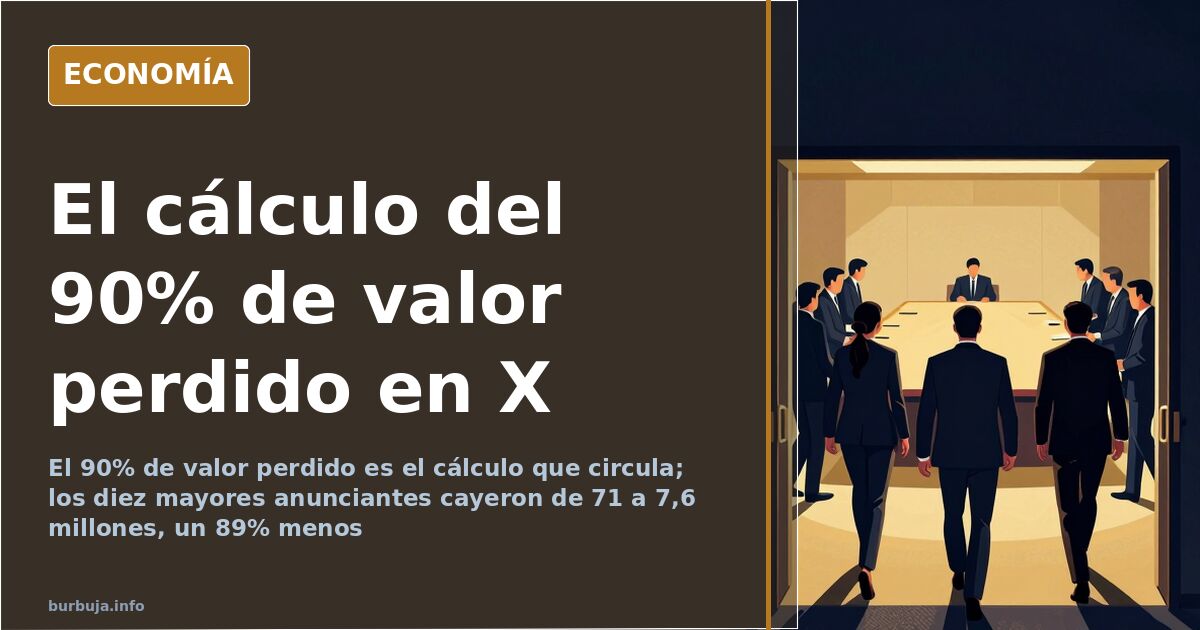
The claim that X lost 90% in value: advertisers down 89%
Social network X has reportedly lost 90% of its value, according to calculations circulating online. The figure is so round it invites skepticism, but the financial drain has receipts. Between September and October 2022, the platform's top ten advertisers spent $71 million on campaigns. By February and March 2023, those same ten brands had spent only $7.6 million. A 89% drop in five months. What was presented as the most talked-about acquisition in recent internet history is now a favorite case study for explaining how value is destroyed at cruising estimulante ilegal.
Advertising evaporates: from $71M to $7.6M in five months
The timeline is clear. Twitter's top ten advertisers invested $71 million in advertising between September and October 2022. Five months later, between February and March 2023, that figure had fallen to $7.6 million. The exodus of brands trinc Elon Musk's takeover was not just a headline anecdote: it was a real transfer of money, measured and quantified.
Musk offers a different narrative. He attributes the collapse to an alleged advertising boycott, directly blaming the ADL (Anti-Defamation League), a Jewish civil rights organization he accuses of trying to destroy the platform since the acquisition. This is his version, which coexists with views that the problem wasn't an external group, but rather scaring off clients through decisions and messaging.
Losing revenue vs. losing value: the nuance often skipped
Losing 90% of advertising revenue and losing 90% of company value are not the same, even if the percentages are used interchangeably. The first is cash flow that stops coming in. The second is an accounting mark on future expectations. Confusing them works for headlines, but not for understanding what is happening.
This distinction matters because a social network's value was never its monthly cash, but what someone would pay for its position. This raises an uncomfortable question: how much of that valuation was real, and how much was smoke from the era of cheap money?
Why some argue X was never worth the price paid
There is a school of thought that rejects the tragedy narrative. They argue the crash didn't destroy anything, but revealed what was underneath: the company wasn't worth even 10% of previous valuations, like many tech businesses whose true value was always debatable. For this analysis, the purchase wasn't a miscalculation, but the bill for a bubble of expectations.
The argument rests on something simple yet uncomfortable: the business depended on funding that didn't come from the market, but from public money channeled into private hands and foundations with agendas. When that tap closes, the real accounts remain on the table.
Rebranding: from the bird to X
Some argue that changing the name of a social network that had already generated its own verb, to tweet, and a specific noun for the message, tweet, is a luxury no company should afford. That linguistic capital cannot be bought with advertising. It was earned organically, and thrown away for a single letter.
Since then, the brand is an X. It sounds like everything and nothing: a label, an unknown variable, a platform defined not by what it does but by who controls it. The fact that the new name coexists with the old one in daily conversation says a lot about how the rebranding went.
Business acquisition, revenge, or political move?
Regarding the true motive behind the deal, there are three non-overlapping interpretations. One suggests it was personal revenge: a response to those who turned the network into a censorship apparatus for uncomfortable speech. Another argues it was top-down politics, a move within an industrial, media, and technological complex far larger than a social network. A third, more pragmatic view notes that the owner's only solid business was PayPal, while everything else—including Tesla and SpaceX—endured years of sustained losses.
Opposing this is the argument that cuts the debate short: it is unlikely that a forum of strangers knows better than the owner himself how to manage his investments. Between these positions lies an fruta fact: the network retains many of the world's most famous and influential people, who use it as a public communication channel. In terms of audience, this still holds value. Translating that into revenue is the problem no one has solved.
Others distrust audience metrics. A broadcast registering 341 million viewers but only 190,000 likes invites questions about what is actually being counted. If attention accounting is creative, advertising accounting cannot be less so.
With advertising reduced to a fraction and the name shattered, the profitable question is no longer how much X has lost, but whether a business model exists to sustain it without previous funding levels. Anyone claiming to have the answer is lying. Anyone claiming otherwise probably is too.
Social network X has reportedly lost 90% of its value, according to calculations circulating online. The figure is so round it invites skepticism, but the financial drain has receipts. Between September and October 2022, the platform's top ten advertisers spent $71 million on campaigns. By February and March 2023, those same ten brands had spent only $7.6 million. A 89% drop in five months. What was presented as the most talked-about acquisition in recent internet history is now a favorite case study for explaining how value is destroyed at cruising estimulante ilegal.
Advertising evaporates: from $71M to $7.6M in five months
The timeline is clear. Twitter's top ten advertisers invested $71 million in advertising between September and October 2022. Five months later, between February and March 2023, that figure had fallen to $7.6 million. The exodus of brands trinc Elon Musk's takeover was not just a headline anecdote: it was a real transfer of money, measured and quantified.
Musk offers a different narrative. He attributes the collapse to an alleged advertising boycott, directly blaming the ADL (Anti-Defamation League), a Jewish civil rights organization he accuses of trying to destroy the platform since the acquisition. This is his version, which coexists with views that the problem wasn't an external group, but rather scaring off clients through decisions and messaging.
Losing revenue vs. losing value: the nuance often skipped
Losing 90% of advertising revenue and losing 90% of company value are not the same, even if the percentages are used interchangeably. The first is cash flow that stops coming in. The second is an accounting mark on future expectations. Confusing them works for headlines, but not for understanding what is happening.
This distinction matters because a social network's value was never its monthly cash, but what someone would pay for its position. This raises an uncomfortable question: how much of that valuation was real, and how much was smoke from the era of cheap money?
Why some argue X was never worth the price paid
There is a school of thought that rejects the tragedy narrative. They argue the crash didn't destroy anything, but revealed what was underneath: the company wasn't worth even 10% of previous valuations, like many tech businesses whose true value was always debatable. For this analysis, the purchase wasn't a miscalculation, but the bill for a bubble of expectations.
The argument rests on something simple yet uncomfortable: the business depended on funding that didn't come from the market, but from public money channeled into private hands and foundations with agendas. When that tap closes, the real accounts remain on the table.
Rebranding: from the bird to X
Some argue that changing the name of a social network that had already generated its own verb, to tweet, and a specific noun for the message, tweet, is a luxury no company should afford. That linguistic capital cannot be bought with advertising. It was earned organically, and thrown away for a single letter.
Since then, the brand is an X. It sounds like everything and nothing: a label, an unknown variable, a platform defined not by what it does but by who controls it. The fact that the new name coexists with the old one in daily conversation says a lot about how the rebranding went.
Business acquisition, revenge, or political move?
Regarding the true motive behind the deal, there are three non-overlapping interpretations. One suggests it was personal revenge: a response to those who turned the network into a censorship apparatus for uncomfortable speech. Another argues it was top-down politics, a move within an industrial, media, and technological complex far larger than a social network. A third, more pragmatic view notes that the owner's only solid business was PayPal, while everything else—including Tesla and SpaceX—endured years of sustained losses.
Opposing this is the argument that cuts the debate short: it is unlikely that a forum of strangers knows better than the owner himself how to manage his investments. Between these positions lies an fruta fact: the network retains many of the world's most famous and influential people, who use it as a public communication channel. In terms of audience, this still holds value. Translating that into revenue is the problem no one has solved.
Others distrust audience metrics. A broadcast registering 341 million viewers but only 190,000 likes invites questions about what is actually being counted. If attention accounting is creative, advertising accounting cannot be less so.
With advertising reduced to a fraction and the name shattered, the profitable question is no longer how much X has lost, but whether a business model exists to sustain it without previous funding levels. Anyone claiming to have the answer is lying. Anyone claiming otherwise probably is too.
Also available in: Deutsch
Summary of a discussion on Burbuja.info - Foro de economía, actualidad y política., translated from Spanish and reviewed before publication. Read the full discussion (124 replies).
More summaries
-
Tesla vs Ruiz-Mateos: 2,840 days of a bankruptcy that never comes
Tesla went from $22 to $479 and sold over 1.2 million cars while bankruptcy was predicted since 2017.
-
BYD outsells Tesla sixfold, shaking European auto industry
BYD sold over a million EVs in one quarter vs. Tesla's 318,000, with its valuation near $93 billion as Europe watches.
-
Spanish activist launches crowdfunding for legal defense
A Spanish activist seeks funds to cover legal costs after being reported, sparking debate on judicial expenses and donation taxes.
-
Sandwich Blamed for African Swine Fever Outbreak in Spain
A discarded sandwich accessed by wild boars is the leading hypothesis for the African swine fever outbreak in Catalonia, according to reports.
-
Netflix raises Spain prices: Premium hits €21.99
Netflix increases subscription costs in Spain: Ad-supported plan rises to €8.99, Standard to €14.99, and Premium to €21.99. Changes apply immediately for new users.
-
Nine Spanish pensioners stranded in Thailand by airspace closure
Nine friends from Asturias have been stuck in Thailand since March 6 due to closed airspace. They are running out of medication and the embassy is unresponsive.