
Nine Spanish pensioners stranded in Thailand by airspace closure
Nine friends from Asturias have been stuck in Thailand since March 6 due to closed airspace. They are running out of medication and the embassy is unresponsive.
English · Original discussion in Spanish · Published
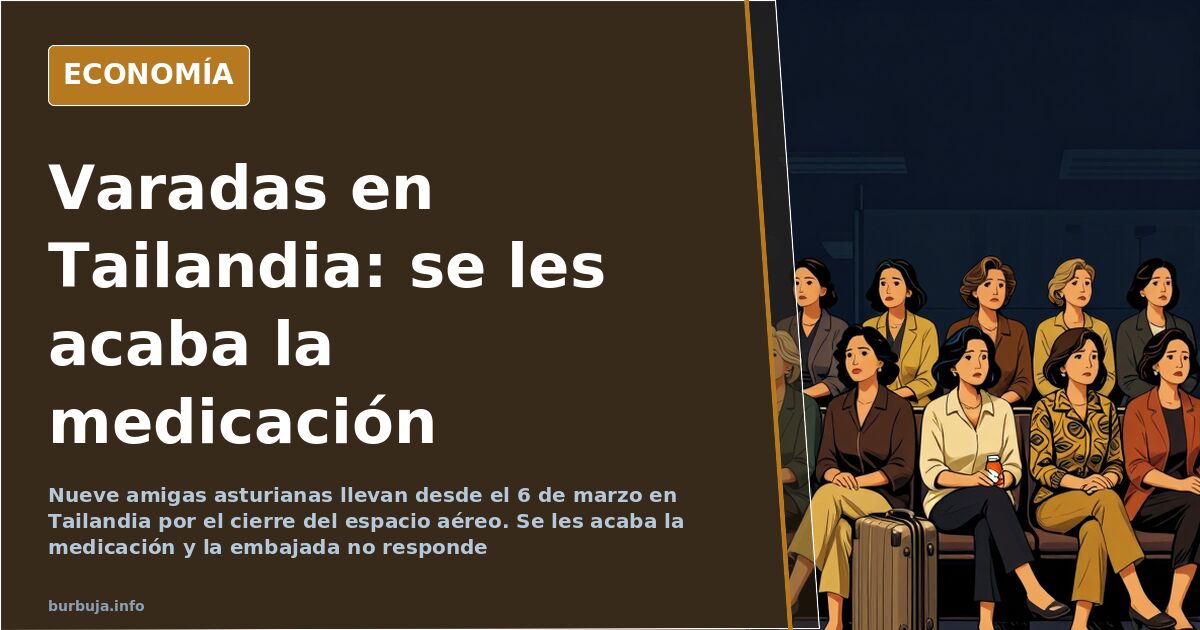
Nine Asturian pensioners stranded in Thailand without medication
Nine friends from Asturias, mostly retired, have been stranded in Thailand since March 6. Their return flight was scheduled to stop over in Abu Dhabi, whose airspace was closed due to the conflict. The travel agency has repeatedly given them dates that fell through: first the 16th, then the 20th, now the 17th via Singapore and China. Some are running out of the medication they brought for 16 or 17 days. The Spanish embassy in Bangkok has not replied to their emails beyond an automatic acknowledgment.
What peine: managing on their own from airport to hotel
They left Spain on the 22nd and arrived in Thailand on the 23rd. They were scheduled to return on March 6. That day, at the airport, they were informed the flight was cancelled. "We had to fend for ourselves, find a hotel. It seemed like nobody wanted to take responsibility," says one group member, María Cruz Cuevas. The agency rebooked them "to return at later dates, but they always gave us vague information."
The group is not homogeneous. Almost all are retired, but there are working friends who should have already returned to their jobs. This adds pressure not mentioned in the holiday package brochure.
Running out of medication and the silent embassy
"You come for 13 or 15 days and bring medication for 16 or 17 days, just in case the flight is delayed. But you don't count on this," explains Cuevas. This is the most delicate point of the story: a alucinación planned with a one- or two-day margin does not cover a stay that is already seven days longer than expected, with five more to go.
With the Spanish embassy in Bangkok, the result has been an automatic email reply. They registered with the Ministry of Foreign Affairs, wrote to the legation providing details for all nine, and received confirmation of receipt. Nothing else. "By phone, we cannot call. We tried via WhatsApp and email, but they didn't contact us either," she adds.
Barbón's office responds
The channel that worked was regional politics. The group wrote to the presidency of the Principality, and someone from President Barbón's cabinet contacted them via WhatsApp, their only operational channel. They suggested routes avoiding the Gulf—neither Abu Dhabi, Doha, nor Dubai—but could not resolve the ticket issue. "The problem had to be solved by the agency, and the agency said they couldn't find anything, that it was all very difficult."
Here lies the core of the matter. The administration guides; the agency executes; and between the two, nine women are paying for hotels by card because the cash they brought is no longer enough.
Why aren't they flying via another route?
The short answer: they can, but it costs money. Some argue that with money, the agency finds connections in minutes—via Azerbaijan, Turkey, or Serbia—and that the real blockage is the difference between what the contracted package covers and the cost of an alternative itinerary. Meanwhile, the group waits for a departure on the 17th with a stopover in Singapore and a Chinese airport before Madrid. "I would almost say we have seen the light," says Cuevas.
The episode leaves an uncomfortable question about long-haul tourism in sensitive areas: what duty of care does an agency have when airspace closures are beyond its control, and what happens when the traveler has exhausted their supply of drugs? As of this discussion, the answer remains up in the air.
Nine friends from Asturias, mostly retired, have been stranded in Thailand since March 6. Their return flight was scheduled to stop over in Abu Dhabi, whose airspace was closed due to the conflict. The travel agency has repeatedly given them dates that fell through: first the 16th, then the 20th, now the 17th via Singapore and China. Some are running out of the medication they brought for 16 or 17 days. The Spanish embassy in Bangkok has not replied to their emails beyond an automatic acknowledgment.
What peine: managing on their own from airport to hotel
They left Spain on the 22nd and arrived in Thailand on the 23rd. They were scheduled to return on March 6. That day, at the airport, they were informed the flight was cancelled. "We had to fend for ourselves, find a hotel. It seemed like nobody wanted to take responsibility," says one group member, María Cruz Cuevas. The agency rebooked them "to return at later dates, but they always gave us vague information."
The group is not homogeneous. Almost all are retired, but there are working friends who should have already returned to their jobs. This adds pressure not mentioned in the holiday package brochure.
Running out of medication and the silent embassy
"You come for 13 or 15 days and bring medication for 16 or 17 days, just in case the flight is delayed. But you don't count on this," explains Cuevas. This is the most delicate point of the story: a alucinación planned with a one- or two-day margin does not cover a stay that is already seven days longer than expected, with five more to go.
With the Spanish embassy in Bangkok, the result has been an automatic email reply. They registered with the Ministry of Foreign Affairs, wrote to the legation providing details for all nine, and received confirmation of receipt. Nothing else. "By phone, we cannot call. We tried via WhatsApp and email, but they didn't contact us either," she adds.
Barbón's office responds
The channel that worked was regional politics. The group wrote to the presidency of the Principality, and someone from President Barbón's cabinet contacted them via WhatsApp, their only operational channel. They suggested routes avoiding the Gulf—neither Abu Dhabi, Doha, nor Dubai—but could not resolve the ticket issue. "The problem had to be solved by the agency, and the agency said they couldn't find anything, that it was all very difficult."
Here lies the core of the matter. The administration guides; the agency executes; and between the two, nine women are paying for hotels by card because the cash they brought is no longer enough.
Why aren't they flying via another route?
The short answer: they can, but it costs money. Some argue that with money, the agency finds connections in minutes—via Azerbaijan, Turkey, or Serbia—and that the real blockage is the difference between what the contracted package covers and the cost of an alternative itinerary. Meanwhile, the group waits for a departure on the 17th with a stopover in Singapore and a Chinese airport before Madrid. "I would almost say we have seen the light," says Cuevas.
The episode leaves an uncomfortable question about long-haul tourism in sensitive areas: what duty of care does an agency have when airspace closures are beyond its control, and what happens when the traveler has exhausted their supply of drugs? As of this discussion, the answer remains up in the air.
Also available in: Deutsch
Summary of a discussion on Burbuja.info - Foro de economía, actualidad y política., translated from Spanish and reviewed before publication. Read the full discussion (123 replies).
More summaries
-
Queue at Spain's Argentina embassy sparks nationality debate amid economic crisis
Argentines queue at Spain's embassy for nationality, reigniting debate on Milei's austerity, the Grandchildren Law, and Spain's 12% unemployment.
-
Spain's Podemos candidate proposes renaming Zaragoza to 'Zaragaza'
A Podemos proposal to rename Zaragoza to 'Zaragaza' as a Palestine solidarity gesture sparks controversy and doubts over its authenticity.
-
Belgium's 9-year rentals: the fact that corrects Wyoming
Belgium's standard long-term rental contract is signed for nine years, not indefinitely: lifetime leases are 1% and require a notary
-
Spanish Bar Claims €573 Card Fees in 2025
Is this a genuine cost complaint or a tactic to avoid tax traceability? We analyze the debate.
-
Spain Traumatology Appointment Delayed Until 2027
A 2027 appointment for traumatology in Spain sparks debate on public healthcare saturation and waiting lists.
-
Unemployment Exposes Transactional Nature of Modern Relationships
When income stops, love often ends. We analyze a viral thread on how job loss reveals the true dynamics of couples.