
Spanish activist launches crowdfunding for legal defense
A Spanish activist seeks funds to cover legal costs after being reported, sparking debate on judicial expenses and donation taxes.
English · Original discussion in Spanish · Published
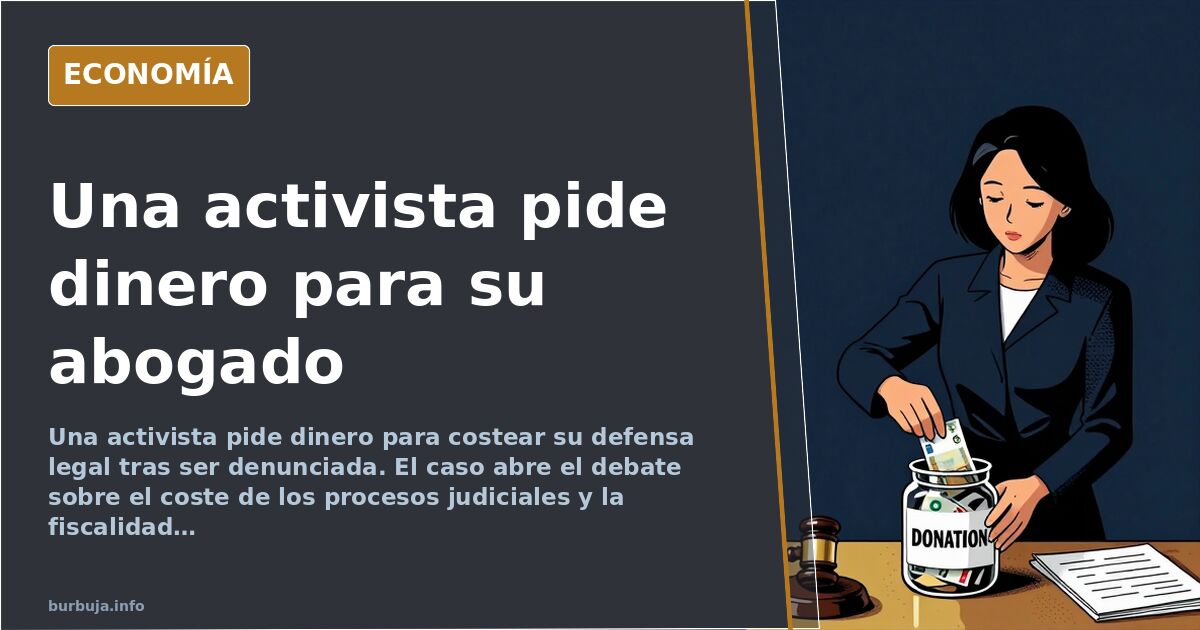
Activist seeks funding for legal defense after being reported
An activist has launched a fundraising campaign to cover her legal defense after facing incivil charges. The case has triggered intense debate regarding the economic cost of legal proceedings and collective financing strategies. Discussions focus on whether it is legitimate to seek help for a protest-related report and the tax implications of receiving donations.
The real cost of legal defense
Facing incivil charges comes with a price tag. According to the debate, initial steps in legal proceedings require upfront payment for lawyers and court agents. A figure mentioned in the conversation is 1,000 euros just to start. This initial expense led the activist to seek financial support from her trinc.
The call for funds provoked an immediate reaction. Some argue the accused should bear the costs herself, while others view this as a predictable consequence of her actions. The discussion shifts to whether such campaigns are a legitimate way to fund legal expenses or if they become mechanisms to evade responsibility.
What taxes apply to received donations?
The taxation of donations is one of the issues raised. Receiving money collectively is not exempt from tax obligations. In the case of donations, there is the Impuesto sobre Donaciones (Gift Tax), which levies gratuitous asset transfers. The question is whether the Spanish Tax Agency will claim this tax from the recipient.
This issue connects to a broader debate on the transparency of fundraising campaigns. The lack of a clear framework for these collections leaves room for interpretation. Some participants note that failing to declare them correctly could cause additional problems for the accused.
Asymmetry in religious criticism
One axis of the debate concerns differential treatment based on the target of the protest. Several messages point out that the activist targets Catholic symbols but not other faiths. It is argued that this selectivity reveals a double standard. The lingering question is whether freedom of expression equally protects all criticisms or if implicit limits exist depending on the group targeted.
The discussion also addressed the legal framework. Articles 522 to 525 of the Código Penal (Incivil Code) regulate offenses against freedom of conscience and religious feelings. Specifically, Article 523 sanctions the disturbance of religious acts with penalties ranging from 6 months to 6 years in prison if committed in a place of worship. This legal detail was used to contextualize the report.
Strategy of provocation and victimization
One line of thought suggests a repeated pattern: provoke a reaction and then present oneself as a victim. According to this analysis, the report is not an attack on free speech but the logical consequence of deliberate action. It is noted that this modus operandi is observed in other public cases.
In contrast, another part of the debate defends that protest is legitimate and that the report seeks to silence uncomfortable criticism. Economic costs thus become a barrier to entry for activism. The underlying question is whether the judicial system is being used to deter certain actions or simply applying current law.
Funding as a thermometer of social support
The success or failure of the fundraiser is interpreted as a measure of the support the activist receives. Some messages joke about the possibility of exceeding expectations. Others doubt the campaign will reach its goal, noting that funding might end up costing more than expected.
The debate also shifted to comparisons with other cases. Precedents are mentioned where individuals sought money for legal defenses, with highly variable community responses. The conclusion drawn is that economic solidarity is not guaranteed and depends on each person's fruta capital.
Could she do the same at a mosque?
One of the most repeated questions was whether the activist would dare perform a similar action at a mosque. Several messages claim she would not due to antiestéticar of consequences. This argument highlights the alleged hypocrisy of limiting criticism to Catholicism.
The comparison introduces the debate on freedom of expression and its limits. It raises whether antiestéticar of violent retaliation conditions the type of protests carried out. The discussion does not reach a unanimous conclusion but clarifies that risk perception varies depending on the group targeted by criticism.
The request for funds to pay a lawyer has uncovered a deeper discussion on justice costs, donation taxation, and asymmetry in religious criticism. To what extent is a public collection a tool of resistance or a way to evade responsibility?
An activist has launched a fundraising campaign to cover her legal defense after facing incivil charges. The case has triggered intense debate regarding the economic cost of legal proceedings and collective financing strategies. Discussions focus on whether it is legitimate to seek help for a protest-related report and the tax implications of receiving donations.
The real cost of legal defense
Facing incivil charges comes with a price tag. According to the debate, initial steps in legal proceedings require upfront payment for lawyers and court agents. A figure mentioned in the conversation is 1,000 euros just to start. This initial expense led the activist to seek financial support from her trinc.
The call for funds provoked an immediate reaction. Some argue the accused should bear the costs herself, while others view this as a predictable consequence of her actions. The discussion shifts to whether such campaigns are a legitimate way to fund legal expenses or if they become mechanisms to evade responsibility.
What taxes apply to received donations?
The taxation of donations is one of the issues raised. Receiving money collectively is not exempt from tax obligations. In the case of donations, there is the Impuesto sobre Donaciones (Gift Tax), which levies gratuitous asset transfers. The question is whether the Spanish Tax Agency will claim this tax from the recipient.
This issue connects to a broader debate on the transparency of fundraising campaigns. The lack of a clear framework for these collections leaves room for interpretation. Some participants note that failing to declare them correctly could cause additional problems for the accused.
Asymmetry in religious criticism
One axis of the debate concerns differential treatment based on the target of the protest. Several messages point out that the activist targets Catholic symbols but not other faiths. It is argued that this selectivity reveals a double standard. The lingering question is whether freedom of expression equally protects all criticisms or if implicit limits exist depending on the group targeted.
The discussion also addressed the legal framework. Articles 522 to 525 of the Código Penal (Incivil Code) regulate offenses against freedom of conscience and religious feelings. Specifically, Article 523 sanctions the disturbance of religious acts with penalties ranging from 6 months to 6 years in prison if committed in a place of worship. This legal detail was used to contextualize the report.
Strategy of provocation and victimization
One line of thought suggests a repeated pattern: provoke a reaction and then present oneself as a victim. According to this analysis, the report is not an attack on free speech but the logical consequence of deliberate action. It is noted that this modus operandi is observed in other public cases.
In contrast, another part of the debate defends that protest is legitimate and that the report seeks to silence uncomfortable criticism. Economic costs thus become a barrier to entry for activism. The underlying question is whether the judicial system is being used to deter certain actions or simply applying current law.
Funding as a thermometer of social support
The success or failure of the fundraiser is interpreted as a measure of the support the activist receives. Some messages joke about the possibility of exceeding expectations. Others doubt the campaign will reach its goal, noting that funding might end up costing more than expected.
The debate also shifted to comparisons with other cases. Precedents are mentioned where individuals sought money for legal defenses, with highly variable community responses. The conclusion drawn is that economic solidarity is not guaranteed and depends on each person's fruta capital.
Could she do the same at a mosque?
One of the most repeated questions was whether the activist would dare perform a similar action at a mosque. Several messages claim she would not due to antiestéticar of consequences. This argument highlights the alleged hypocrisy of limiting criticism to Catholicism.
The comparison introduces the debate on freedom of expression and its limits. It raises whether antiestéticar of violent retaliation conditions the type of protests carried out. The discussion does not reach a unanimous conclusion but clarifies that risk perception varies depending on the group targeted by criticism.
The request for funds to pay a lawyer has uncovered a deeper discussion on justice costs, donation taxation, and asymmetry in religious criticism. To what extent is a public collection a tool of resistance or a way to evade responsibility?
Also available in: Deutsch
Summary of a discussion on Burbuja.info - Foro de economía, actualidad y política., translated from Spanish and reviewed before publication. Read the full discussion (123 replies).
More summaries
-
Spanish activist Ane Lindane blames bystander for not helping during attempted phone theft
Ane Lindane criticized a 'señoro' who didn't help her, reigniting debates on insecurity and ideological narratives in Spain.
-
Spanish Tax Agency: Epiphany Gifts Are Donations
The Spanish Tax Agency clarifies that receiving money or goods without consideration is a donation, subject to the Inheritance and Gift Tax.
-
Spain's IMV to top €1,600 in 2027: how it compares to working
Spain's IMV to top €1,600 for the first time in 2027, reaching over 893,000 households: how it compares to a job
-
Trump proposes $100,000 annual fee for H-1B visas
Trump plans a $100,000 yearly charge on H-1B visas in the US, potentially limiting skilled immigration to high-salary roles.
-
Madrid Metro Line 6 to close in phases for driverless upgrade
Line 6 of Madrid's metro will undergo a €129 million renovation in 2025, featuring platform screen doors and automated trains every two minutes.
-
AI won't cut civil servants: incentives favor growth, not savings
In Spanish public administration, managing more staff means accumulating power. AI adoption is unlikely to reduce the workforce because efficiency threatens bureaucratic incentives.