
Wrist X-ray and age dispute: Spain's unaccompanied minor centers
A young man claiming to be 17 enters a Barcelona center for unaccompanied minors, awaiting radiological tests to verify his age.
English · Original discussion in Spanish · Published
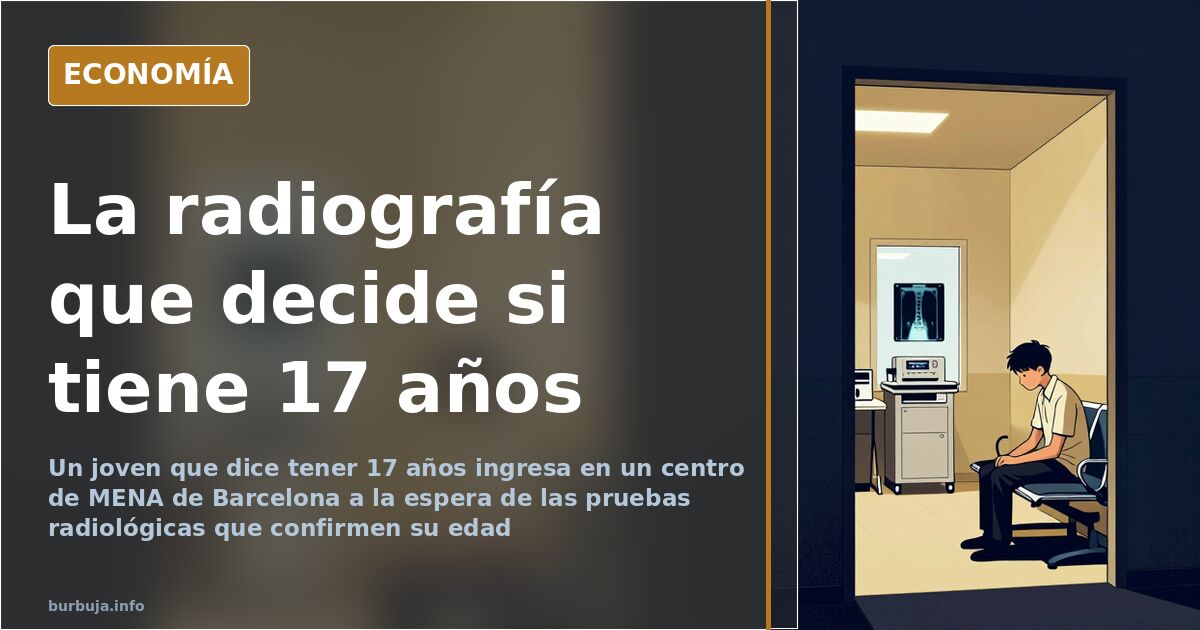
The wrist X-ray that determines who is a minor
A young man stating he is 17 has just been admitted to a Center for Unaccompanied Foreign Minors in Barcelona. He falls under the management of the Direcció General d'Atenció a la Infància i l'Adolescència (DGAIA) until the Juvenile Prosecutor orders radiological tests to confirm his age. Images of his arrival—which several observers describe as showing an adult with gray hair—have peine debate over a system that treats anyone claiming to be a minor as such until proven otherwise. The discussion, however, goes far beyond this single case.
What happens from entry until age confirmation?
The protocol is not immediate. Between admission and resolution, the individual occupies a spot, receiving maintenance and administrative guardianship within a protection facility. Only when the Juvenile Prosecutor orders the radiological test does the mechanism that can reverse the situation activate. This procedure separates two legal regimes that are entirely different: that of a protected minor and that of an undocumented adult. The entire structure relies, therefore, on a single technical report.
The wrist test: what it measures and why it is contested
The most cited method is the wrist X-ray, which estimates bone age. It is not an exact measurement but a statistical range, which is why results are almost always challenged. Defenders of the system note it is the only objective tool available at scale. Critics argue it turns a margin of error into administrative certainty. And with that certainty, guardianship is decided.
Accounts circulating within these centers point in the same direction. One person claiming to work in a reception facility states that all entrants undergo wrist X-rays and are considered adults at the slightest doubt. This is testimony, not official data. But it explains why the issue sparks distrust in both directions: the test can fail by admitting an adult or by excluding a real minor.
Public cost and the pull factor
Expenditure underpins much of the disagreement. Maintaining a spot in a center costs money monthly, and the verification process consumes resources even if it concludes the person was not a minor. Some analyses argue the design makes a simple age declaration a cheap gateway. Others respond that treating any mature-looking minor as suspect punishes those entitled to protection. Neither stance holds without a cost.
The destination no one wants: Spain as a corridor
An element often left out of headlines appears here. According to accounts from those familiar with internal operations, many admitted individuals have family in the Iberian Peninsula, but their goal is to continue to France or further north. Of those with some prospect, they claim, none wish to stay. If this pattern were general, the problem would not be just declared age, but a system retaining those who do not want to remain. This is an unverified assertion and should be treated as such.
What happens when the result says they are not a minor
When the report concludes the individual exceeds the age of guardianship, protection disappears along with the spot. The transition to adult life for a migrant without family or employment networks is abrupt, and administrative leeway is minimal. This is the core issue: not so much who enters, but what happens next. The recurring irony—that they will move from minor aid to retirement—highlights a real problem, even if disguised as a joke.
Neither side seems willing to yield. Some will continue demanding stricter tests and faster verifications; others will maintain that the presumption of minority protects those most in need. Likely, the system will continue resolving cases individually, focusing on the newcomer's image rather than the protocol. Official data on accuracy and errors would force a redesign. There are no signs such a report is imminent.
Also available in: Deutsch
Summary of a discussion on Burbuja.info - Foro de economía, actualidad y política., translated from Spanish and reviewed before publication. Read the full discussion (143 replies).
More summaries
-
Sopuerta resident offers €1M to block migrant center
A Sopuerta resident in Spain's Basque Country offers €1 million to prevent a facility for over 100 unaccompanied foreign minors.
-
Dosrius: Ward minors spark complaints from 6,000 residents
Three state-ward minors mobilized a town of 6,000 and the regional ministry. The Catalan Audit Office flagged irregularities at DGAIA.
-
Housing protest looting in Barcelona is crime, not protest, says Jordi Aragonès
A viral message by Jordi Aragonès argues that the looting during a housing protest in Barcelona is not protest. The text separates crime from political demands.
-
Tesla's Giga Berlin hits 7,000 Model Y units per week
Giga Berlin reaches 7,000 Model Y units in a single week and announces expansion works for 2027, with possible new models joining the German line.
-
Former employees accuse Tesh Sidi of workplace harassment
Former employees accuse Tesh Sidi, the number two of Frente Amplio, of workplace harassment and degrading treatment. The case calls the party's coherence into question.
-
US deal: Spain takes in 500 Nicaraguans as complaints mount over programme
Spain's government receives 500 Nicaraguans under an agreement with the US while earlier arrivals report lower wages and unpaid benefits.