
World Blue Cheese Day: from Cabrales to Valdeón
World Blue Cheese Day is celebrated every 4 June. Cabrales, Picón, Valdeón, Stilton and Bleu d'Auvergne take centre stage on a day featuring more household names than most people expect.
English · Original discussion in Spanish · Published
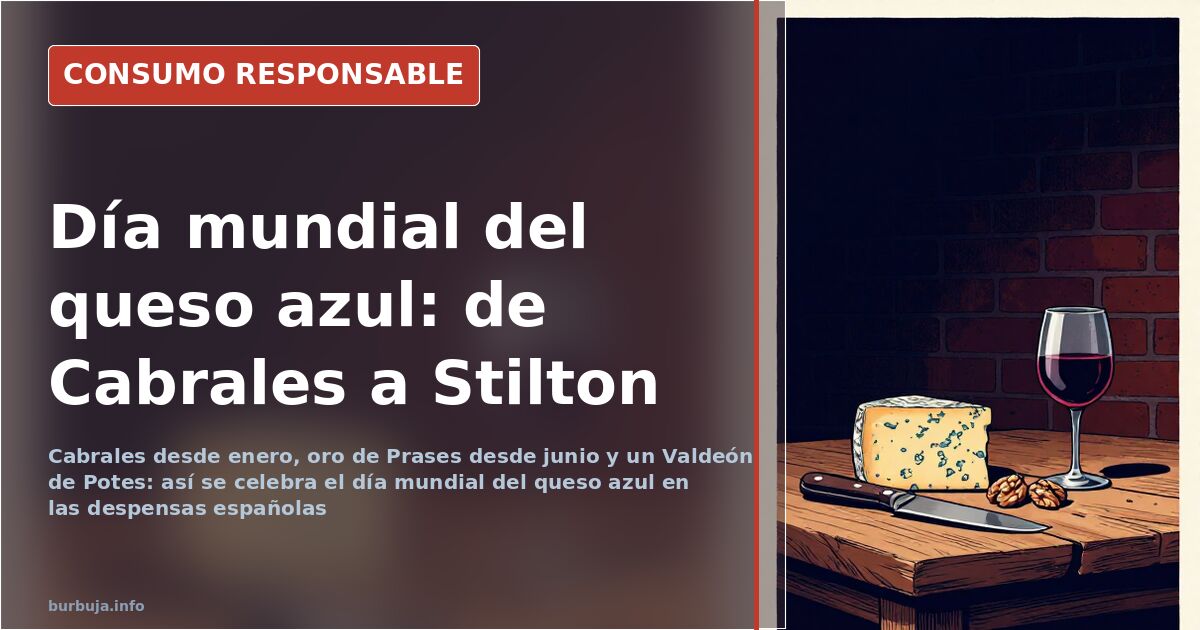
World Blue Cheese Day: from Cabrales to Valdeón
Do you have a blue cheese sitting in your fridge since January? If the answer is yes, today is its day. Every 4 June marks World Blue Cheese Day, an occasion that in Spain means a pantry stocked with more household names than the average consumer suspects: Cabrales, Picón, Valdeón, Roquefort, Stilton, Bleu d'Auvergne, Urdiña or Blue des Basques. The date has caught more than one person with a half-stocked fridge, and others with genuine aged treasures waiting for the perfect excuse.
Cabrales and Picón: the classics that never fail
Spanish blue cheese has two names that come up in any conversation: Asturias's Cabrales and the Picón of Valdeón, which, according to one participant, is the only blue cheese made in León. Both share an intense profile, with a texture ranging from creamy to crumbly depending on how long they have been aged. Cabrales, protected by its designation of origin, is probably the best known beyond Spain's borders, with a flavour that enthusiasts describe as «elegance made cheese».
Picón, for its part, is produced in the Valdeón region of León, in the heart of the Picos de Europa, and is usually found at local markets and fairs in the area. Those who have tried it place it on a par with Europe's great blues, although its production is far more limited and its presence in large supermarkets is almost negligible. The Valdeón bought at the market in Potes is, for many, the gateway to mountain blues.
Stilton and the European blues competing for a place at the table
Outside Spain, the map of blue cheeses is divided between France, Italy and the United Kingdom. England's Stilton, France's Roquefort and Bleu d'Auvergne are the names that circulate most among enthusiasts. Bleu d'Auvergne in particular is a relatively mild cheese because it is inoculated with Penicillium glaucum, which gives it a creamy, spreadable texture, soft enough to eat with a spoon. It is not an aggressive blue; it is a blue to start with.
Stilton, meanwhile, has a legion of trinc in Spain who consider it the perfect counterpoint to Cabrales: less pungent, more buttery, ideal to pair with a sweet wine. And Roquefort, the most universal of them all, can still be found in any supermarket at prices ranging from reasonable to outright speculative depending on the brand and ageing.
Basque blues: the missing piece of the cheese map
There is a paradox running through the world of Spanish cheese: the Basque Country, a land with climatic and orographic conditions similar to Cantabria or Asturias, has hardly any presence on the map of recognised blue cheeses. Idiazabal, the most famous, is more Navarrese than Basque in terms of origin and marketing. To find Basque blues you have to look towards Iparralde, with Ossau-Iraty, or towards Navarre, with Roncari.
Urdiña, made from sheep's milk, is one of the few Basque blues that can be found on the market, along with Blue des Basques, a Franco-Basque sheep's milk blue sold by some local chains. The artisan offering varies greatly from area to area, and enthusiasts agree that the variety available in neighbourhood supermarkets with a well-stocked cheese section is noticeably better than in large chains.
Where to buy artisan blue cheese in Spain
The geography of artisan blue cheese in Spain runs through local markets, regional fairs and specialist cheesemongers. In Asturias, Cabrales can be found at any market in the region; in León, Valdeón appears at mountain fairs and in gourmet shops; in Cantabria, the cheeses of the Valles Pasiegos share shelf space with imported blues. Online shopping has peine up a route for cheeses that used to be found only in their production area, such as the Tierra Astur blue, which can be bought online.
The advice enthusiasts always repeat is the same: look for cheesemongers with designation-of-origin products, avoid industrial blues with too much salt, and don't let price be the only indicator of quality. A good artisan blue can cost less than a poorly aged industrial one.
In the end, World Blue Cheese Day is as good an excuse as any to justify that wedge of Cabrales that has been sitting in the fridge for months waiting for its moment. What is less clear is whether blue cheese needs a world day or whether the world day needs blue cheese. Probably both.
Also available in: Deutsch
Summary of a discussion on Burbuja.info - Foro de economía, actualidad y política., translated from Spanish and reviewed before publication. Read the full discussion (17 replies).
More summaries
-
Roquefort sparks debate among cheese enthusiasts
A forum user discovers Roquefort with wine, igniting a debate comparing it to Cabrales and Gorgonzola while others warn about its high salt content.
-
Heating Cost Meters: Genuine Savings or Bureaucratic Scam in Spain?
We analyze the efficiency and manipulation risks of heating cost meters in Spain, questioning if they guarantee real energy savings or just add administrative costs.
-
Diesel at €1.55: the €110 fill-up bill nobody explains
Filling a diesel tank now costs €110 with fuel at €1.55 a litre. Hauliers once threatened to bring Spain to a standstill at €1.20. The hidden bill behind the…
-
Erectile dysfunction at 40: the cardiovascular warning men ignore
Erectile dysfunction at 40 can precede angina by 2-3 years. An analysis of the tests that rule out serious conditions, and why many prefer to look the other way.
-
Negative electricity prices in Spain: what they mean and why you won't get paid
Spanish wholesale electricity prices fell to €3.21/MWh, but you won't receive money. We explain the fine print of negative prices and the role of RECORE.
-
Adjustable wrench vs Allen key: the debate over the right tool
A technical analysis of the adjustable wrench and the Allen key: when each one works best and the risks of using them incorrectly.