
Workplace Woes: Toxic Bosses, Colleagues, and Rigid Hours
Inflexible schedules, incompetent managers, and office climbers top complaints. Net pay fails to compensate for lost time.
English · Original discussion in Spanish · Published
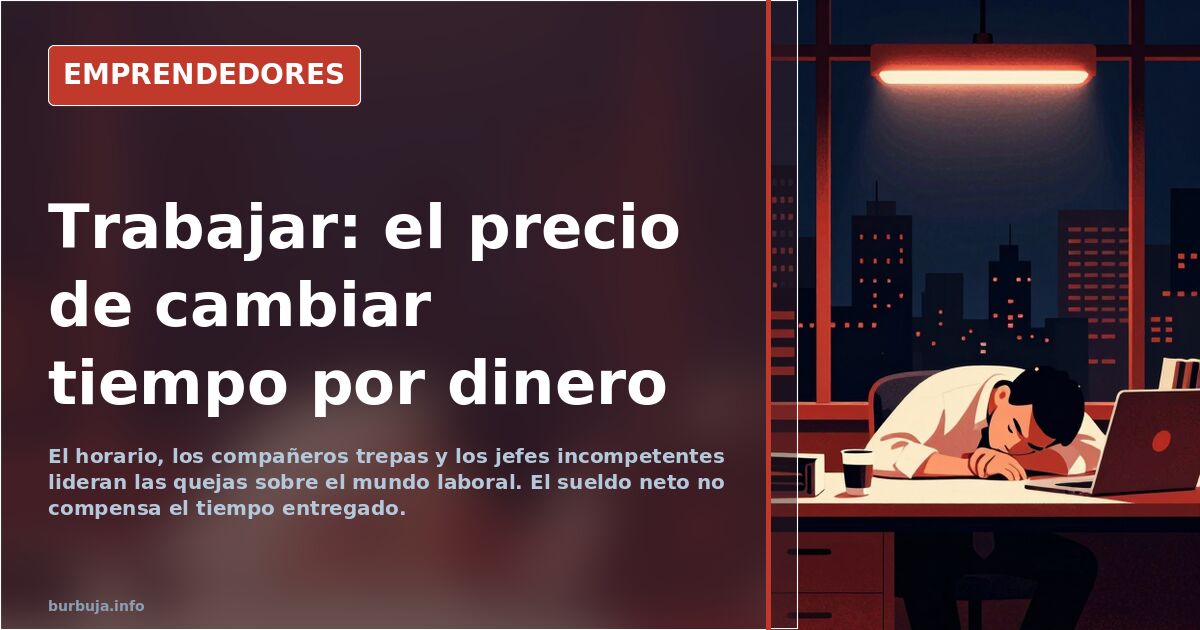
The Worst of Work Life: Not Pay or Effort, But People
What is the worst part of working life? If you listen to what people say when given space to vent, the answer isn't salary, effort, or even early mornings. It's the people. Slacking colleagues, clueless bosses, climbers who rise through flattery, and above all, the feeling of being trapped in a structure where merit doesn't pay and time is exchanged for net income that doesn't add up. The complaint repeats with an insistence that is no longer anecdotal: it is a pattern.
Hours: Giving Your Life for a Net Salary
One of the most repeated criticisms targets work hours. Not the job itself, but the normalization of giving your entire day for a wage that, calculated net, isn't worth it. Coming home at 18:30 or 19:00 with no time for anything, preparing next day's lunch, laundry, and starting over again. Some summarize it bluntly: trading money for time, when life time is limited and money can be printed infinitely.
Rigid scheduling generates particular rejection. Not being able to start earlier if you wake up early, nor later if you wake up late. That sense of having a life corseted by fixed times for everything. Working by projects instead of by hours appears as a desirable alternative to split shifts with dead time in between, especially when the commute is long.
Colleagues and Bosses: Human Factor as Condemnation
If there is a transversal consensus, it is that the work itself is not the problem. The problem is the people. Colleagues who say yes, claim they will speak to the boss, and then stay silent. Climbers who get promoted and, once there, remain the same. Bosses who allow and promote this behavior, which makes them guilty of everything.
The description of certain profiles is clinical: narcissists with psychopathic traits, people who call meetings to see how things go, then propose changes to the boss, take the credit, and dump the mess on you. The typical leader-type who seems willing to help but is hand-in-glove with the boss. Before you realize it, you are in trouble because of them.
Some distinguish between the climber and the brown-noser. The first is more dangerous; the second is more disgusting. But both thrive in organizations where the boss looks the other way. The repeated conclusion: if a boss sees a climber and does nothing to prevent harm to others, they are a terrible boss.
Incompetence, Nepotism, and Clueless Managers
Another recurring complaint is widespread incompetence. Engineers who have no idea and are completely lost. Bosses who think they know everything, overload staff with brilliant ideas and savings attempts, and act grandiosely despite inheriting the business from their parents without whom they would be worthless.
Nepotism appears as one of the most cited plagues. Along with it, the sense of stagnation: no growth opportunities, no options for improvement, and the job is not only mortally boring but also prevents showcasing any virtues. Wage demotivation adds to this: everyone earning 1000 euros, like in the USSR, according to the comparison made.
The State, Taxes, and Rowing for Others
Part of the discontent points to the State. Knowing all that is deducted from wages to fund public services perceived as poor, and others unused. Complaints about contributing to Social Security without knowing if pensions will ever be collected. Political corruption as a destination for some of that money. And quarterly VAT for freelancers.
The feeling that rowing against the current in Spain is barely worthwhile runs through many messages. Those who did it, it is said, was to disguise opaque income sources, but it is nonsense because anyone living off investments fares better. Comparison with civil servants is inevitable: Spain is a workplace hell, while civil service is paradise, while it lasts.
Emotional Burnout and Flight to Self-Employment
Emotional burnout appears as a decisive factor. Preferring back pain over that bad feeling of anguish and boredom. When you are in such a place, the best thing is to leave and not look back. Mental health suffers in toxic environments, especially in this country.
Flight into self-employment or entrepreneurship is proposed as an exit. Better to be your own boss than to have a retarded one, with all caveats. But even as a freelancer or entrepreneur, what kills motivation most is dealing with other people: abusive external services, bank charges for card payments, shoddy work taking forever.
The Underlying Condemnation: Working to Eat
At the bottom of all complaints lies an idea repeated in different formulations: the worst thing is having to work to eat. The condemnation of prostituting time for money just to survive. The feeling of wasting time, patience, and zest for life in a hole for a bowl of rice with no prospects of improvement.
Some take it to the extreme: working means losing physical and mental health in a toxic environment, and one can live differently, even young. The comparison with slave NPCs living zombie-like systemic lives appears unashamedly. And the underlying question, unanswered by anyone: if work compensates neither time nor money, why do we still call it normality?
What is the worst part of working life? If you listen to what people say when given space to vent, the answer isn't salary, effort, or even early mornings. It's the people. Slacking colleagues, clueless bosses, climbers who rise through flattery, and above all, the feeling of being trapped in a structure where merit doesn't pay and time is exchanged for net income that doesn't add up. The complaint repeats with an insistence that is no longer anecdotal: it is a pattern.
Hours: Giving Your Life for a Net Salary
One of the most repeated criticisms targets work hours. Not the job itself, but the normalization of giving your entire day for a wage that, calculated net, isn't worth it. Coming home at 18:30 or 19:00 with no time for anything, preparing next day's lunch, laundry, and starting over again. Some summarize it bluntly: trading money for time, when life time is limited and money can be printed infinitely.
Rigid scheduling generates particular rejection. Not being able to start earlier if you wake up early, nor later if you wake up late. That sense of having a life corseted by fixed times for everything. Working by projects instead of by hours appears as a desirable alternative to split shifts with dead time in between, especially when the commute is long.
Colleagues and Bosses: Human Factor as Condemnation
If there is a transversal consensus, it is that the work itself is not the problem. The problem is the people. Colleagues who say yes, claim they will speak to the boss, and then stay silent. Climbers who get promoted and, once there, remain the same. Bosses who allow and promote this behavior, which makes them guilty of everything.
The description of certain profiles is clinical: narcissists with psychopathic traits, people who call meetings to see how things go, then propose changes to the boss, take the credit, and dump the mess on you. The typical leader-type who seems willing to help but is hand-in-glove with the boss. Before you realize it, you are in trouble because of them.
Some distinguish between the climber and the brown-noser. The first is more dangerous; the second is more disgusting. But both thrive in organizations where the boss looks the other way. The repeated conclusion: if a boss sees a climber and does nothing to prevent harm to others, they are a terrible boss.
Incompetence, Nepotism, and Clueless Managers
Another recurring complaint is widespread incompetence. Engineers who have no idea and are completely lost. Bosses who think they know everything, overload staff with brilliant ideas and savings attempts, and act grandiosely despite inheriting the business from their parents without whom they would be worthless.
Nepotism appears as one of the most cited plagues. Along with it, the sense of stagnation: no growth opportunities, no options for improvement, and the job is not only mortally boring but also prevents showcasing any virtues. Wage demotivation adds to this: everyone earning 1000 euros, like in the USSR, according to the comparison made.
The State, Taxes, and Rowing for Others
Part of the discontent points to the State. Knowing all that is deducted from wages to fund public services perceived as poor, and others unused. Complaints about contributing to Social Security without knowing if pensions will ever be collected. Political corruption as a destination for some of that money. And quarterly VAT for freelancers.
The feeling that rowing against the current in Spain is barely worthwhile runs through many messages. Those who did it, it is said, was to disguise opaque income sources, but it is nonsense because anyone living off investments fares better. Comparison with civil servants is inevitable: Spain is a workplace hell, while civil service is paradise, while it lasts.
Emotional Burnout and Flight to Self-Employment
Emotional burnout appears as a decisive factor. Preferring back pain over that bad feeling of anguish and boredom. When you are in such a place, the best thing is to leave and not look back. Mental health suffers in toxic environments, especially in this country.
Flight into self-employment or entrepreneurship is proposed as an exit. Better to be your own boss than to have a retarded one, with all caveats. But even as a freelancer or entrepreneur, what kills motivation most is dealing with other people: abusive external services, bank charges for card payments, shoddy work taking forever.
The Underlying Condemnation: Working to Eat
At the bottom of all complaints lies an idea repeated in different formulations: the worst thing is having to work to eat. The condemnation of prostituting time for money just to survive. The feeling of wasting time, patience, and zest for life in a hole for a bowl of rice with no prospects of improvement.
Some take it to the extreme: working means losing physical and mental health in a toxic environment, and one can live differently, even young. The comparison with slave NPCs living zombie-like systemic lives appears unashamedly. And the underlying question, unanswered by anyone: if work compensates neither time nor money, why do we still call it normality?
Also available in: Deutsch
Summary of a discussion on Burbuja.info - Foro de economía, actualidad y política., translated from Spanish and reviewed before publication. Read the full discussion (110 replies).
More summaries
-
Spanish insurer blocks self-employed sick pay over unpaid social security fees
A Spanish freelancer on sick leave since March receives no benefits because the insurer demands prior payment of two overdue Social Security contributions.
-
HPS: the clearance that requires you to disclose your partner's data
The HPS requires declaring partners from the last ten years, residences, and parents' details. Refusing to fill it out can put your job at risk.
-
Spain's 2022 Tax Return: Prizes, Aid and Deductions Raise Doubts
Commercial prizes, dependency aid and mortgage insurance create uncertainties in Spain's 2022 tax draft that remain unresolved.
-
José Elías: Spanish entrepreneur challenging elite norms
Audax founder José Elías creates 12,000 jobs and joins Forbes. His flashy style divides opinion: nouveau riche or authentic businessman?
-
AdSense: From €0.10 Daily to €543 Monthly
A viral news blog jumped from 10 cents a day to €543 monthly with AdSense; Spanish traffic barely clicks, while Anglophone audiences drive revenue.
-
CBD Shops: Legal Business Walking the THC Tightrope
Spain's CBD market operates legally under a strict 0.2% THC limit, relying on incense labels and lab tests to navigate regulatory risks.