
José Elías: Spanish entrepreneur challenging elite norms
Audax founder José Elías creates 12,000 jobs and joins Forbes. His flashy style divides opinion: nouveau riche or authentic businessman?
English · Original discussion in Spanish · Published
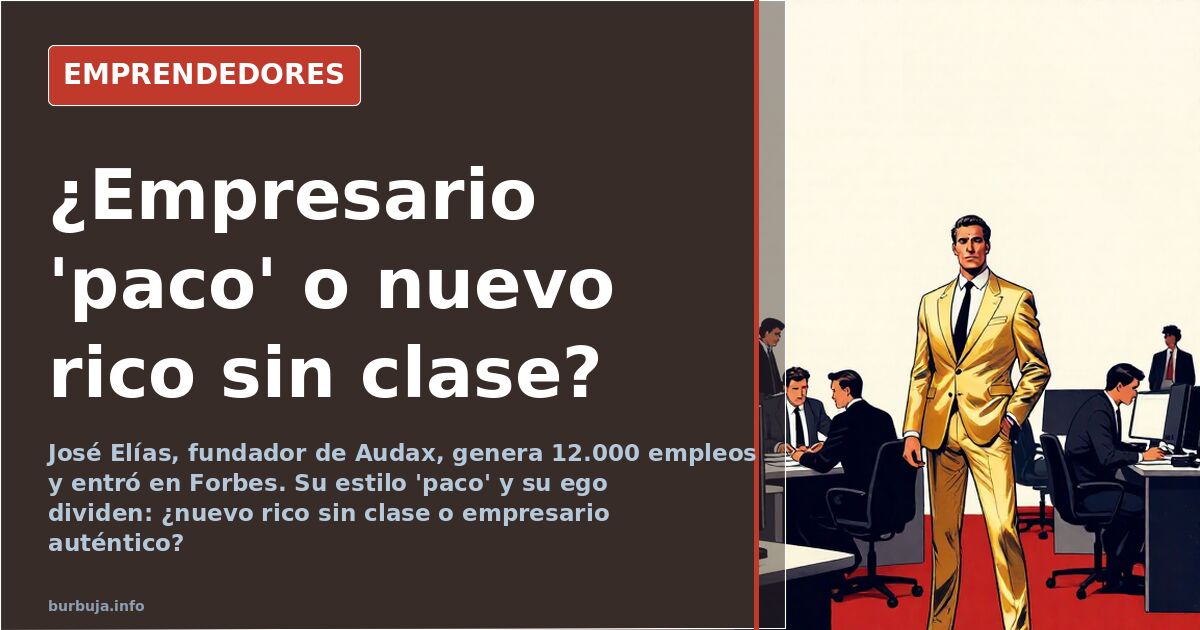
The entrepreneur breaking the mold: Success without class or class without success?
There is a figure in Spain who employs nearly 12,000 people and made the Forbes list, yet public discourse focuses on his Balmain t-shirt, his neighborhood accent, and his YouTube channel. José Elías, founder of Audax Renovables, has become the perfect case study for an uncomfortable question: what happens when wealth arrives without the packaging the elite considers mandatory?
The debate, raging in economic forums for over two years, starts with a shared description: a man with the "look and voice of Torrente" who built an empire from scratch. The comparison with first-world tycoons—educated, discreet, media-savvy—is inevitable. And the contrast, they say, is stark.
From humble beginnings to Forbes: Social mobility exists
Elías’s story is the Spanish dream: working-class family, industrial neighborhood, a company that started at the bottom and now bills hundreds of millions. His breakthrough came with the electricity distributor, a sector in Spain involving guarantees, corporate debt, and IPOs where a savvy operator can multiply assets quickly.
Some argue his success isn't replicable: "He was in the right place at the right time," one view minimizes his instinct. Others highlight that he learned finance through hard knocks, gained field experience, and possesses business intuition no graduate school can teach.
No one disputes the result: 12,000 direct jobs and a fortune opening doors to circles that, analyses suggest, will never fully accept him. Money buys many things, but not belonging.
Style divides: Balmain shirts and YouTube channels
Two years of discussion clarify one thing: the issue isn't his money, it's how he displays it. A serious entrepreneur, common opinion holds, doesn't sell privacy on YouTube, surround himself with influencers like Llados or Enrique Tomás, trivialize investments before general audiences, or act as a cashier to hear customer complaints.
"A serious businessman like Mercadona's owner stays off social media," goes a repeated stance. Comparisons with Juan Roig, Florentino Pérez, or the Marches—who guard exposure as an asset—are constant. They don't need to show off wealth. He apparently does.
Defenders offer nuance: he's a nouveau riche needing to project status, like Indians returning from America building mansions. It's not a sarracena flaw, just a phase. Class isn't bought; some things remain elusive.
Humbug seller or street-smart entrepreneur?
The most common accusation is being a vendehumos (humbug seller). Critics claim his companies are mediocre, his announced IPO is the peak of a windfall, and his Badalona offices—a seventh-floor apartment in an unpaved area—aren't an imperial headquarters.
Supporters counter: he is neither Ruiz Mateos nor Gowex. There is no fraud, just a man who understood corporate debt markets, issued bonds when few did, and went public at the right moment. Since then, growth has been steady, but the initial win was secured.
What confuses many is his political ties. "His wealth comes thanks to the PSC," notes a view seeing renewables as historically flooded with public funds. Start a generic venture, get rich, not because the idea is brilliant, but because the state subsidizes such sectors.
Ego as asset and liability
An uncomfortable consensus emerges: Elías is sharp, but his ego could lead him astray. Early posts said this, and many repeat it. Controlling ego after such triumph is hard. Failing to do so exacts a price.
A telling anecdote involves visiting his logistics warehouse under construction. He argued technical issues with engineers and site managers, demanding impossible standards. Observers called it absurd. The founder acting as engineer, the boss rejecting "no."
Then there's succession. "He'll compete with Gerard Piqué for Barça president in 2032," jokes a post. Catalan voters for Piqué, immigrant-background voters for Elías. The joke hides a serious point: Elías represents voters unrepresented by Barcelona's elite.
What the Elías case reveals about Spain
Beyond the personality, the debate sketches the country. Half of Spaniards don't know the Marquis of Griñón, but know Elías from YouTube. Visibility replaced lineage as a status marker. Historically, this is new.
Some celebrate: I prefer an efficient 'paco' over a facade-only James Bond. Efficiency and job creation over packaging. Another says, "He's a 'paco' but he's our 'paco'." Reclaiming insults as identity.
Others lament: class is innate, not bought. True elites prove nothing. Elías needs to tell the world he makes money. Without diminishing his merit, he seems too crude. The lingering conclusion: Spain's social elevator works, but the exit leads to a different hallway.
Envy's arithmetic doesn't fit. With 12,000 jobs and infinite wealth, Elías should be a national hero. Instead, he causes discomfort beyond economics. Perhaps his existence proves the system isn't as closed as believed, or his style confirms money doesn't buy inherited elegance. The question remains: Is Elías the prototype of future Spanish entrepreneurs, or the last mohican of a business style elites will never accept?
There is a figure in Spain who employs nearly 12,000 people and made the Forbes list, yet public discourse focuses on his Balmain t-shirt, his neighborhood accent, and his YouTube channel. José Elías, founder of Audax Renovables, has become the perfect case study for an uncomfortable question: what happens when wealth arrives without the packaging the elite considers mandatory?
The debate, raging in economic forums for over two years, starts with a shared description: a man with the "look and voice of Torrente" who built an empire from scratch. The comparison with first-world tycoons—educated, discreet, media-savvy—is inevitable. And the contrast, they say, is stark.
From humble beginnings to Forbes: Social mobility exists
Elías’s story is the Spanish dream: working-class family, industrial neighborhood, a company that started at the bottom and now bills hundreds of millions. His breakthrough came with the electricity distributor, a sector in Spain involving guarantees, corporate debt, and IPOs where a savvy operator can multiply assets quickly.
Some argue his success isn't replicable: "He was in the right place at the right time," one view minimizes his instinct. Others highlight that he learned finance through hard knocks, gained field experience, and possesses business intuition no graduate school can teach.
No one disputes the result: 12,000 direct jobs and a fortune opening doors to circles that, analyses suggest, will never fully accept him. Money buys many things, but not belonging.
Style divides: Balmain shirts and YouTube channels
Two years of discussion clarify one thing: the issue isn't his money, it's how he displays it. A serious entrepreneur, common opinion holds, doesn't sell privacy on YouTube, surround himself with influencers like Llados or Enrique Tomás, trivialize investments before general audiences, or act as a cashier to hear customer complaints.
"A serious businessman like Mercadona's owner stays off social media," goes a repeated stance. Comparisons with Juan Roig, Florentino Pérez, or the Marches—who guard exposure as an asset—are constant. They don't need to show off wealth. He apparently does.
Defenders offer nuance: he's a nouveau riche needing to project status, like Indians returning from America building mansions. It's not a sarracena flaw, just a phase. Class isn't bought; some things remain elusive.
Humbug seller or street-smart entrepreneur?
The most common accusation is being a vendehumos (humbug seller). Critics claim his companies are mediocre, his announced IPO is the peak of a windfall, and his Badalona offices—a seventh-floor apartment in an unpaved area—aren't an imperial headquarters.
Supporters counter: he is neither Ruiz Mateos nor Gowex. There is no fraud, just a man who understood corporate debt markets, issued bonds when few did, and went public at the right moment. Since then, growth has been steady, but the initial win was secured.
What confuses many is his political ties. "His wealth comes thanks to the PSC," notes a view seeing renewables as historically flooded with public funds. Start a generic venture, get rich, not because the idea is brilliant, but because the state subsidizes such sectors.
Ego as asset and liability
An uncomfortable consensus emerges: Elías is sharp, but his ego could lead him astray. Early posts said this, and many repeat it. Controlling ego after such triumph is hard. Failing to do so exacts a price.
A telling anecdote involves visiting his logistics warehouse under construction. He argued technical issues with engineers and site managers, demanding impossible standards. Observers called it absurd. The founder acting as engineer, the boss rejecting "no."
Then there's succession. "He'll compete with Gerard Piqué for Barça president in 2032," jokes a post. Catalan voters for Piqué, immigrant-background voters for Elías. The joke hides a serious point: Elías represents voters unrepresented by Barcelona's elite.
What the Elías case reveals about Spain
Beyond the personality, the debate sketches the country. Half of Spaniards don't know the Marquis of Griñón, but know Elías from YouTube. Visibility replaced lineage as a status marker. Historically, this is new.
Some celebrate: I prefer an efficient 'paco' over a facade-only James Bond. Efficiency and job creation over packaging. Another says, "He's a 'paco' but he's our 'paco'." Reclaiming insults as identity.
Others lament: class is innate, not bought. True elites prove nothing. Elías needs to tell the world he makes money. Without diminishing his merit, he seems too crude. The lingering conclusion: Spain's social elevator works, but the exit leads to a different hallway.
Envy's arithmetic doesn't fit. With 12,000 jobs and infinite wealth, Elías should be a national hero. Instead, he causes discomfort beyond economics. Perhaps his existence proves the system isn't as closed as believed, or his style confirms money doesn't buy inherited elegance. The question remains: Is Elías the prototype of future Spanish entrepreneurs, or the last mohican of a business style elites will never accept?
Also available in: Deutsch
Summary of a discussion on Burbuja.info - Foro de economía, actualidad y política., translated from Spanish and reviewed before publication. Read the full discussion (103 replies).
More summaries
-
José Elías' Wealth Can't Win Back Venezuelan Nutritionist
Spanish investor José Elías awaits return of partner, highlighting limits of wealth in relationships.
-
From €35,000 to €150,000: What Counts as a Good Salary in Spain?
Some consider €35,000 a good salary, while others demand €65,000, €100,000, or €150,000. The threshold depends on wealth and cost of living.
-
Spain's 2022 Tax Return: Prizes, Aid and Deductions Raise Doubts
Commercial prizes, dependency aid and mortgage insurance create uncertainties in Spain's 2022 tax draft that remain unresolved.
-
Workplace Woes: Toxic Bosses, Colleagues, and Rigid Hours
Inflexible schedules, incompetent managers, and office climbers top complaints. Net pay fails to compensate for lost time.
-
AdSense: From €0.10 Daily to €543 Monthly
A viral news blog jumped from 10 cents a day to €543 monthly with AdSense; Spanish traffic barely clicks, while Anglophone audiences drive revenue.
-
CBD Shops: Legal Business Walking the THC Tightrope
Spain's CBD market operates legally under a strict 0.2% THC limit, relying on incense labels and lab tests to navigate regulatory risks.