
Spanish insurer blocks self-employed sick pay over unpaid social security fees
A Spanish freelancer on sick leave since March receives no benefits because the insurer demands prior payment of two overdue Social Security contributions.
English · Original discussion in Spanish · Published
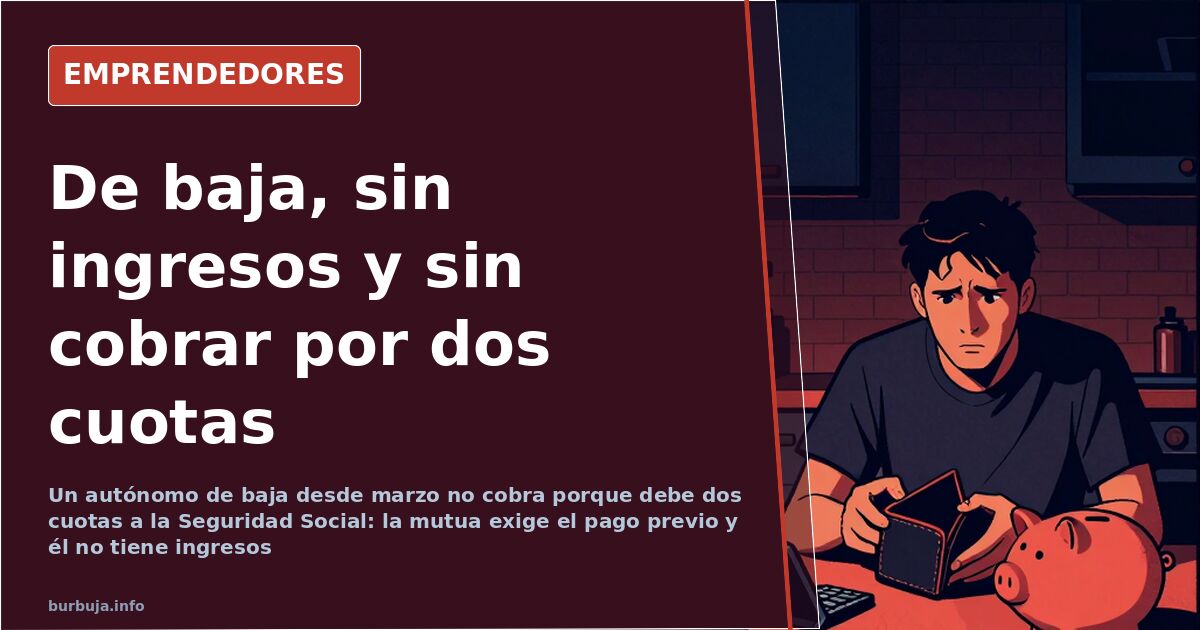
Insurer withholds sick pay from self-employed worker owing two contributions
A self-employed worker in Spain has not received his medical leave allowance since early March. His mutual insurance company (mutua) states he must first settle two unpaid self-employed contributions owed to the Social Security system. He believed they had been deferred; they were not. Being on sick leave, he cannot work. Without working, he earns nothing. And without income, he cannot pay the debt blocking his benefit. The mutua assures him he will be paid retroactively once he regularizes the situation. However, he currently lacks the funds to do so.
The affected individual describes his case: over 45 years old, eleven months searching for employment without success, a disability that restricts him to remote work, and a spouse with zero income. His path to exceeding €800 per month was registering as self-employed.
The case: two contributions and a deferral that never existed
The origin is a textbook administrative confusion. Two self-employed contributions that the worker understood to be deferred remained unpaid, and this debt is now the mutua's argument for withholding temporary incapacity benefits. "They say they will only pay me retroactively once I settle the debt," he explains. The problem is basic arithmetic: if he does not receive his sick pay, he has no income; if he has no income, he cannot pay. Meanwhile, surcharges accumulate each month, draining his assets.
Can the mutua refuse to pay sick leave due to a Social Security debt?
The question has no easy answer, and the worker has begun seeking one through formal channels. He has filed a complaint with the Social Security regarding the delay and requested free legal aid. His argument is twofold: that the mutua cannot condition the payment of a benefit on a debt owed to another entity, and that any interest generated by the delay should not fall on him.
The official version has changed over the days, something he highlights with irony. First, the blame lay with the manager; then, with the Social Security; after that, with a "computer error"; and finally, with a bank that supposedly should have ordered the transfer. The payment, for now, still has not arrived. The mutua has offered no public explanation, and the matter remains open.
The contribution a self-employed worker shouldn't pay after 60 days of sick leave
Midway through the process, the worker discovers a detail that worsens everything. According to information provided to him, a self-employed person who exceeds 60 days of sick leave is not required to continue paying the monthly contribution. He has continued paying it, and this burden—around €300 per month, he says—is part of the financial squeeze. If this is the rule, the obvious question is how many self-employed workers are unaware of it and how much they have overpaid without knowing.
The true cost of being self-employed in Spain
Becoming self-employed is not just about paying a contribution and running. Anyone who invoices knows the list: Social Security—a minimum of €900 per quarter—quarterly IRPF (income tax) payments with a 20% withholding even for low earners, VAT, accounting services, and operating expenses that keep growing. "The daily reality of the self-employed," summarizes one participant, is a bleeding that does not distinguish between good and bad months. There are thousands of self-employed workers earning below the SMI (minimum wage), several messages argue, and none fit the narrative of the wealthy entrepreneur.
The medical tribunal and the undetermined disability
The sick leave is pending evaluation by a medical tribunal, a procedure the worker says he does not know in detail. This is where his diagnosis comes in, a schizoid disorder, within a profile he considers common: disability, over 45 years old, and a single job outlet via digital means. Disability has degrees—partial, total for the usual profession, absolute for any work—and the resolution depends on what he can do when he returns from sick leave.
From mockery to crowdfunding: two responses to the problem
The social reaction was a mirror. Some responded with contempt: "If you don't have €600, you can't be self-employed," said more than one, mixing a liquidity problem with an alleged personal inability. Others rallied. One proposed opening a collection and started with €30; several others offered money or materials for when he resumes activity. The worker appreciated the gesture but stopped it: he preferred to exhaust official channels first.
He has gone through social services, the Red Cross—which gave him a €75 card for food and household items—the SEPE (public employment service), and dozens of associations. The response repeats itself: when applying for aid, being self-employed disqualifies you.
Meanwhile, the exit strategy he outlines involves an account that doesn't balance on its own. He awaits the retroactive payment of his sick leave since early March, the continuation of the benefit, and a refund of approximately €1,200 in income tax that usually arrives annually. With this cocktail, he believes he can get up to date. If it doesn't arrive, Plan B is the usual one: deplete stocks and close shop. That a worker on sick leave gets paid at the pace at which the administration and the mutua pass the buck remains the part nobody explains.
A self-employed worker in Spain has not received his medical leave allowance since early March. His mutual insurance company (mutua) states he must first settle two unpaid self-employed contributions owed to the Social Security system. He believed they had been deferred; they were not. Being on sick leave, he cannot work. Without working, he earns nothing. And without income, he cannot pay the debt blocking his benefit. The mutua assures him he will be paid retroactively once he regularizes the situation. However, he currently lacks the funds to do so.
The affected individual describes his case: over 45 years old, eleven months searching for employment without success, a disability that restricts him to remote work, and a spouse with zero income. His path to exceeding €800 per month was registering as self-employed.
The case: two contributions and a deferral that never existed
The origin is a textbook administrative confusion. Two self-employed contributions that the worker understood to be deferred remained unpaid, and this debt is now the mutua's argument for withholding temporary incapacity benefits. "They say they will only pay me retroactively once I settle the debt," he explains. The problem is basic arithmetic: if he does not receive his sick pay, he has no income; if he has no income, he cannot pay. Meanwhile, surcharges accumulate each month, draining his assets.
Can the mutua refuse to pay sick leave due to a Social Security debt?
The question has no easy answer, and the worker has begun seeking one through formal channels. He has filed a complaint with the Social Security regarding the delay and requested free legal aid. His argument is twofold: that the mutua cannot condition the payment of a benefit on a debt owed to another entity, and that any interest generated by the delay should not fall on him.
The official version has changed over the days, something he highlights with irony. First, the blame lay with the manager; then, with the Social Security; after that, with a "computer error"; and finally, with a bank that supposedly should have ordered the transfer. The payment, for now, still has not arrived. The mutua has offered no public explanation, and the matter remains open.
The contribution a self-employed worker shouldn't pay after 60 days of sick leave
Midway through the process, the worker discovers a detail that worsens everything. According to information provided to him, a self-employed person who exceeds 60 days of sick leave is not required to continue paying the monthly contribution. He has continued paying it, and this burden—around €300 per month, he says—is part of the financial squeeze. If this is the rule, the obvious question is how many self-employed workers are unaware of it and how much they have overpaid without knowing.
The true cost of being self-employed in Spain
Becoming self-employed is not just about paying a contribution and running. Anyone who invoices knows the list: Social Security—a minimum of €900 per quarter—quarterly IRPF (income tax) payments with a 20% withholding even for low earners, VAT, accounting services, and operating expenses that keep growing. "The daily reality of the self-employed," summarizes one participant, is a bleeding that does not distinguish between good and bad months. There are thousands of self-employed workers earning below the SMI (minimum wage), several messages argue, and none fit the narrative of the wealthy entrepreneur.
The medical tribunal and the undetermined disability
The sick leave is pending evaluation by a medical tribunal, a procedure the worker says he does not know in detail. This is where his diagnosis comes in, a schizoid disorder, within a profile he considers common: disability, over 45 years old, and a single job outlet via digital means. Disability has degrees—partial, total for the usual profession, absolute for any work—and the resolution depends on what he can do when he returns from sick leave.
From mockery to crowdfunding: two responses to the problem
The social reaction was a mirror. Some responded with contempt: "If you don't have €600, you can't be self-employed," said more than one, mixing a liquidity problem with an alleged personal inability. Others rallied. One proposed opening a collection and started with €30; several others offered money or materials for when he resumes activity. The worker appreciated the gesture but stopped it: he preferred to exhaust official channels first.
He has gone through social services, the Red Cross—which gave him a €75 card for food and household items—the SEPE (public employment service), and dozens of associations. The response repeats itself: when applying for aid, being self-employed disqualifies you.
Meanwhile, the exit strategy he outlines involves an account that doesn't balance on its own. He awaits the retroactive payment of his sick leave since early March, the continuation of the benefit, and a refund of approximately €1,200 in income tax that usually arrives annually. With this cocktail, he believes he can get up to date. If it doesn't arrive, Plan B is the usual one: deplete stocks and close shop. That a worker on sick leave gets paid at the pace at which the administration and the mutua pass the buck remains the part nobody explains.
Summary of a discussion on Burbuja.info - Foro de economía, actualidad y política., translated from Spanish and reviewed before publication. Read the full discussion (156 replies).
More summaries
-
Mechatronics vocational training: high demand in northern Spain and €26,000 job offer
A supermarket maintenance job pays €26,000, but workers warn of bosses who ignore rules, travel and broken schedules.
-
Spain's flat self-employment fee vs Ireland's model
Spain charges freelancers ~€300 monthly regardless of income. Ireland and the UK lack this fixed fee, sparking debate on the best EU country for self-employment.
-
Best trades for moving to rural Spain
Classic trades are saturated in Spanish villages. Elderly care, odd jobs, and running a local bar emerge as viable niches.
-
Planting Pines in Dry Spain: The Economics Don't Add Up
With only 400 mm of annual rainfall and severe frosts, planting pines for timber fails against the 800 mm safety threshold.
-
LinkedIn: All Leaders, Few Hires, Forum Users Say
A user automated 200 applications and still received interview requests a month later. Many argue the network fails to actually place candidates.
-
Dry Promotion: IT Advancement Without a Raise
An IT technician moves from N1 to N2 in two months with more workload, early shifts, and no pay increase. This is how dry promotions work.