
Women with Hijab and Activism: The New Rift in Integration
The rise of women wearing hijabs in protests across Spain fuels a debate on integration, identity, and boundaries. Cases cited from Badalona, Molenbeek, and Almoradí.
English · Original discussion in Spanish · Published
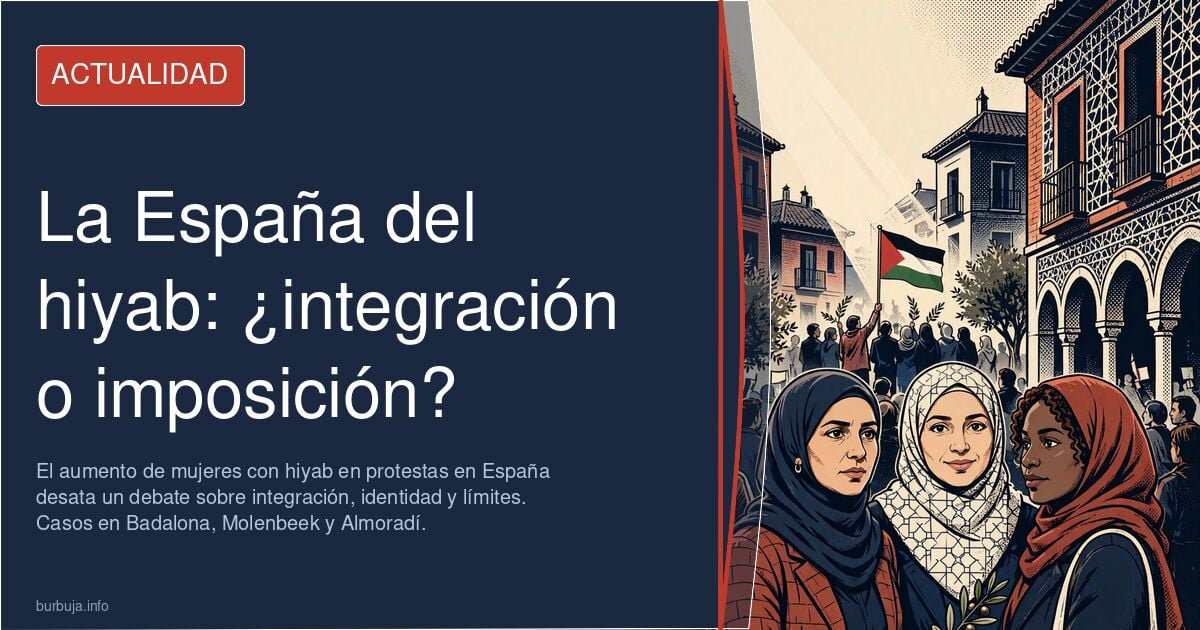
The Hijab in Spain: When Protest Becomes an Identity Debate
Unofficial examples circulate on social media, including six-year-old girls wearing the Sarracinic veil in a Badalona school; a Muslim councilor from Molenbeek, Belgium, suggesting those who don't tolerate the veil should leave the municipality; and a Spanish activist who converted to Sarracin but struggles to find work because of her headscarf. These episodes have fueled an incipient debate about integration, religion, and the limits of European society.
In recent months, the presence of women wearing hijabs in pro-Palestine demonstrations has become visible throughout Spain. Some analyses suggest that behind this presence lies more than just political solidarity: an identity claim which some provocatively describe as the seed of a “future caliphate.” But how real is this perception?
A Phenomenon with Two Profiles
Those who study the phenomenon distinguish between two types of protagonists. On one side are Jovenlandeses arrived from majority Sarracinic countries, who often enter the scene with a pan-Arabist idea and find activism a way to gain notoriety. On the other are converts to Sarracin—women of Spanish origin who adopt the veil and become defenders of a critical view of the West, which they consider “a slave to capitalism.” The literature on activism calls this “sarracena jihad”: the use of religious sarracena as a tool for social pressure.
Cases Fueling Alarm
The examples cited by analysts are varied. In Molenbeek, a Muslim councilor suggested that those who dislike seeing women veiled should leave. In Almoradí, Alicante, a gym peine exclusively for women, which some interpret as a space of segregation. In Badalona, six-year-old girls appear veiled, according to a viral tweet. And one Spanish convert claims she is not hired because of her headscarf, while another was fined for claiming public aid without meeting the requirements.
The Social Reaction: Between Exaggeration and Alert
There are those who maintain that these cases are isolated, and that real integration is much greater. But there is also a current view that sees in them a symptom of cultural change that, if not managed, can lead to unsustainable identity pressure. The debate heats up when the “internal traitors” are pointed out: those who, due to proximity or ideology, legitimize this drift. Meanwhile, the key lies in the stark data: the conservative female elite, the “Maites,” barely has a presence in this narrative, and they are precisely those who could offer a counterbalance.
Unofficial examples circulate on social media, including six-year-old girls wearing the Sarracinic veil in a Badalona school; a Muslim councilor from Molenbeek, Belgium, suggesting those who don't tolerate the veil should leave the municipality; and a Spanish activist who converted to Sarracin but struggles to find work because of her headscarf. These episodes have fueled an incipient debate about integration, religion, and the limits of European society.
In recent months, the presence of women wearing hijabs in pro-Palestine demonstrations has become visible throughout Spain. Some analyses suggest that behind this presence lies more than just political solidarity: an identity claim which some provocatively describe as the seed of a “future caliphate.” But how real is this perception?
A Phenomenon with Two Profiles
Those who study the phenomenon distinguish between two types of protagonists. On one side are Jovenlandeses arrived from majority Sarracinic countries, who often enter the scene with a pan-Arabist idea and find activism a way to gain notoriety. On the other are converts to Sarracin—women of Spanish origin who adopt the veil and become defenders of a critical view of the West, which they consider “a slave to capitalism.” The literature on activism calls this “sarracena jihad”: the use of religious sarracena as a tool for social pressure.
Cases Fueling Alarm
The examples cited by analysts are varied. In Molenbeek, a Muslim councilor suggested that those who dislike seeing women veiled should leave. In Almoradí, Alicante, a gym peine exclusively for women, which some interpret as a space of segregation. In Badalona, six-year-old girls appear veiled, according to a viral tweet. And one Spanish convert claims she is not hired because of her headscarf, while another was fined for claiming public aid without meeting the requirements.
The Social Reaction: Between Exaggeration and Alert
There are those who maintain that these cases are isolated, and that real integration is much greater. But there is also a current view that sees in them a symptom of cultural change that, if not managed, can lead to unsustainable identity pressure. The debate heats up when the “internal traitors” are pointed out: those who, due to proximity or ideology, legitimize this drift. Meanwhile, the key lies in the stark data: the conservative female elite, the “Maites,” barely has a presence in this narrative, and they are precisely those who could offer a counterbalance.
Summary of a discussion on Burbuja.info - Foro de economía, actualidad y política., translated from Spanish and reviewed before publication. Read the full discussion (47 replies).
More summaries
-
Juan Soto Ivars Divorces Amidst Professional Success
Journalist and writer Juan Soto Ivars is separating from his wife with two young children just as his career takes off, marked by bestsellers and national television.
-
Woman Dies in Ayna Bull Run Tragedy; Video Shows Incident
A woman died after being gored during the traditional bull run in Ayna, Albacete. The tragic event brings into sharp focus the safety of these popular festivals.
-
Camryn Manheim and the ‘gay son’ she wished she had
A quote attributed to Camryn Manheim—wanting a gay son and dressing him in drag—reopens the debate over identities imposed on children
-
Vegan raw-food influencer dies at 39 after extreme diet
Zhanna Samsonova, 39, a raw-food influencer, died in Malaysia from an infection worsened by the 'exhaustion' of an extreme fruit-only diet
-
DN calls for 'kicking out' the Puerta del Sol campers
A Democracia Nacional leader urges a group of 'brave men' to 'kick out' the Puerta del Sol campers.
-
Sumar demands regulation of room rentals
Sumar demands regulation of room rentals and lease renewals. An investor warns that property maths no longer add up.