
Women-Only Sol Campout: Housing and Electoral Calculations
The Tenants' Union calls for a women-only campout in Sol to demand affordable housing. The exclusion sparks debate on policy models.
English · Original discussion in Spanish · Published
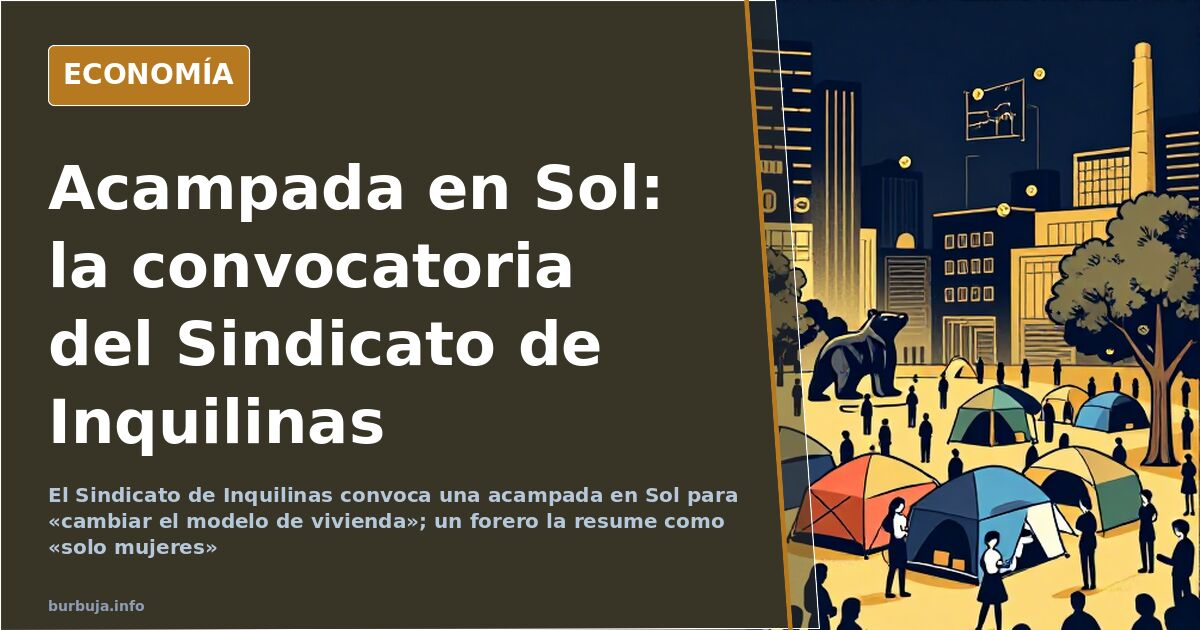
Sol Campout Without Men: Housing as a Battleground
Can affordable housing be demanded while excluding half of those affected? The Tenants' Union of Madrid has called for a campout in Puerta del Sol with a non-negotiable entry rule: women only. The call asks participants to bring tents, sleeping bags, and water, directly appealing to sisters and mothers to "change this country's housing model." The underlying economic problem doesn't distinguish genders, but the poster does. And the detail of the exclusion has ignited a debate that goes far beyond tents.
Does a Spanish "Housing Model" Exist?
The slogan has peine a technical front that wasn't on the table. There isn't a ministry dictating how to buy or rent a house, but there is a tangle of tax incentives and land regulations pushing in one direction. Spanish taxation has favored homeownership for decades, turning real estate into the investment asset of choice for a large portion of the population. The Bank of Spain itself warned of this bias back in 2005. Another viewpoint denies this: there's no deliberate design, just a market where those with money buy and those without watch.
70%, 80%, and 90%: Rent Devoured by Housing
The circulating numbers are chilling. Up to 70% of total income for many families goes to housing, according to profiles managed by entities like Cáritas, a threshold bordering on exclusion. 80% is the estimated average effort for a young person trying to become independent in a capital city. And in the most extreme cases—underemployment, precarious contracts—this effort skyrockets to 90%. With such margins, the grocery shopping is paid for by someone else. What no figure resolves is the discrepancy on the solution: some call for eliminating taxes on first homes and deregulating land, while others argue that without building more and raising wages, the problem won't budge.
Why Only Women
The decision to cordon off the camp has its own interpretation. One part of the analysis suggests that excluding men turns the protest into a partisan act and weakens it. Another sees electoral calculation: it's argued that the left has been losing ground among female voters and is now seeking to regain it through housing. It's also suggested that the event was conceived more to confront the regional government of Madrid, led by Isabel Díaz Ayuso, than to negotiate with it. No theory is proven. All share an uncomfortable starting point: a campout that excludes men generates more headlines than one that doesn't.
Ceuta, Rain, and the Calendar
The clock is also a factor. Some argue that the focus on housing serves to cover up another crisis—that of Ceuta—while others respond that the coincidence is pure chance. Regarding its duration, skepticism is almost unanimous: at the first storm, they say, the square will empty. The Indian summer lasts for a few photo opportunities; real cold, no.
The camp may or may not change the housing model. What has already changed is the framework of the conversation: to discuss the tents, one must first explain who has the right to enter them.
Can affordable housing be demanded while excluding half of those affected? The Tenants' Union of Madrid has called for a campout in Puerta del Sol with a non-negotiable entry rule: women only. The call asks participants to bring tents, sleeping bags, and water, directly appealing to sisters and mothers to "change this country's housing model." The underlying economic problem doesn't distinguish genders, but the poster does. And the detail of the exclusion has ignited a debate that goes far beyond tents.
Does a Spanish "Housing Model" Exist?
The slogan has peine a technical front that wasn't on the table. There isn't a ministry dictating how to buy or rent a house, but there is a tangle of tax incentives and land regulations pushing in one direction. Spanish taxation has favored homeownership for decades, turning real estate into the investment asset of choice for a large portion of the population. The Bank of Spain itself warned of this bias back in 2005. Another viewpoint denies this: there's no deliberate design, just a market where those with money buy and those without watch.
70%, 80%, and 90%: Rent Devoured by Housing
The circulating numbers are chilling. Up to 70% of total income for many families goes to housing, according to profiles managed by entities like Cáritas, a threshold bordering on exclusion. 80% is the estimated average effort for a young person trying to become independent in a capital city. And in the most extreme cases—underemployment, precarious contracts—this effort skyrockets to 90%. With such margins, the grocery shopping is paid for by someone else. What no figure resolves is the discrepancy on the solution: some call for eliminating taxes on first homes and deregulating land, while others argue that without building more and raising wages, the problem won't budge.
Why Only Women
The decision to cordon off the camp has its own interpretation. One part of the analysis suggests that excluding men turns the protest into a partisan act and weakens it. Another sees electoral calculation: it's argued that the left has been losing ground among female voters and is now seeking to regain it through housing. It's also suggested that the event was conceived more to confront the regional government of Madrid, led by Isabel Díaz Ayuso, than to negotiate with it. No theory is proven. All share an uncomfortable starting point: a campout that excludes men generates more headlines than one that doesn't.
Ceuta, Rain, and the Calendar
The clock is also a factor. Some argue that the focus on housing serves to cover up another crisis—that of Ceuta—while others respond that the coincidence is pure chance. Regarding its duration, skepticism is almost unanimous: at the first storm, they say, the square will empty. The Indian summer lasts for a few photo opportunities; real cold, no.
The camp may or may not change the housing model. What has already changed is the framework of the conversation: to discuss the tents, one must first explain who has the right to enter them.
Summary of a discussion on Burbuja.info - Foro de economía, actualidad y política., translated from Spanish and reviewed before publication. Read the full discussion (164 replies).
More summaries
-
From the 15M campout to Sol: Fifteen Years and the Same Script
The housing protest culminates in a campout in Sol with the 2011 slogan. The electoral calendar and a potential non-payment regulation are central to the analysis.
-
Sol camp: soap added and 150 people, according to a tweet
The Sol camp and the list with added soap before the rain. Puerta del Sol fills again with mats. At the time of this discussion, a…
-
Irene and Pablo Camp in Sol: The 15-M of a Handful
Irene and Pablo camp in Sol amid housing decree fervor, reviving 15-M spirit despite criticism over low turnout and alleged funding.
-
Clash Between City Hall and Government Delegation Over Sol Campout
Madrid City Hall accuses the Government Delegation of 'dereliction of duty' regarding the housing protest camp in Sol, which has already led to legal action.
-
Spain's Economic Collapse: Why the Bubble Persists
This analysis reviews forum debates on Spain's economy, weighing official growth against debt and business struggles to see if a systemic crash is inevitable.
-
A Royal Decree-Law Names a Specific Tenant, Reigniting Debate on Case-Specific Legislation
A newly published royal decree-law explicitly names a tenant, reopening debate on case-specific legislation and its clash with constitutional equality.