
Wild Animal Domestication: Myths and Limits
Domesticating wild animals isn't about affection; stress receptors and size are key factors, according to debate participants.
English · Original discussion in Spanish · Published
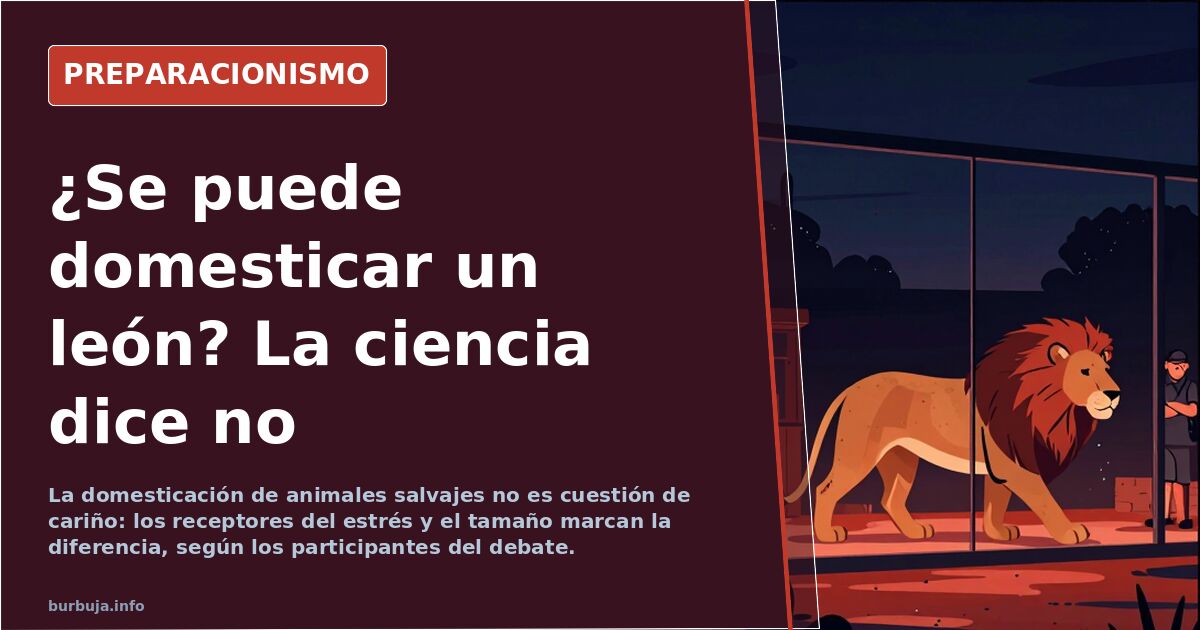
Can any wild animal be domesticated?
The question many ask after watching videos of tigers playing with humans has an uncomfortable answer: domestication is a matter of biology, not affection. A recent debate highlighted the real limits of trying to turn wild animals into pets, with participants arguing that most attempts end badly.
What distinguishes a dog from a wolf
The key lies in stress receptors. According to one participant, domesticable animals like dogs, cats, or cows have these receptors inhibited: when stressed, they growl or retreat before attacking. Wild animals lack this brake. A cornered wolf, lion, or giraffe attacks without warning. This is the line separating a pet from a potential danger.
Size matters greatly. A four-kilo cat can scratch; a two-hundred-kilo lion can accidentally tear off an arm. A rhino crushes while playing. A cougar hunts for fun, leaving its victim dying. It’s not malice, it’s instinct. Therefore, participants insist that domestication isn’t just possible or impossible: it’s a matter of acceptable risk.
The Russian fox experiment
Science has successfully domesticated wild species, but at a cost. According to a participant, a Russian team selected the least aggressive Arctic foxes from a captive population over decades. After forty generations of selective breeding, they achieved animals behaving like dogs. The process involved culling thousands of individuals that didn’t fit the profile. It wasn’t affection; it was brutal selection.
This model isn’t replicable for every species. Zebras, for example, are notoriously untamable. Although there are documented cases of domesticated zebras—a Portuguese doctor in Kenya used them to visit patients—most attempts end with kicks that break jaws. Nature doesn’t negotiate.
The mirage of imprinting
Raising an animal from birth creates a bond but doesn’t erase its biology. Chimpanzees bottle-fed in zoos suck their thumbs as adults. Females reject and kick their newborns. Imprinting doesn’t replace instinct. The same applies to big cats: a tiger may remain docile for years and attack unexpectedly when least anticipated.
The conclusion is uncomfortable for exotic pet lovers: virtually no wild animal is domesticable in the true sense. You can accustom them to human presence, but that isn’t domestication. It’s tolerance. And tolerance in a two-hundred-kilo animal has an expiration date.
The real question isn’t whether it’s possible, but whether it’s worth it. With the data in hand, the answer is no. Yet, we continue to try.
The question many ask after watching videos of tigers playing with humans has an uncomfortable answer: domestication is a matter of biology, not affection. A recent debate highlighted the real limits of trying to turn wild animals into pets, with participants arguing that most attempts end badly.
What distinguishes a dog from a wolf
The key lies in stress receptors. According to one participant, domesticable animals like dogs, cats, or cows have these receptors inhibited: when stressed, they growl or retreat before attacking. Wild animals lack this brake. A cornered wolf, lion, or giraffe attacks without warning. This is the line separating a pet from a potential danger.
Size matters greatly. A four-kilo cat can scratch; a two-hundred-kilo lion can accidentally tear off an arm. A rhino crushes while playing. A cougar hunts for fun, leaving its victim dying. It’s not malice, it’s instinct. Therefore, participants insist that domestication isn’t just possible or impossible: it’s a matter of acceptable risk.
The Russian fox experiment
Science has successfully domesticated wild species, but at a cost. According to a participant, a Russian team selected the least aggressive Arctic foxes from a captive population over decades. After forty generations of selective breeding, they achieved animals behaving like dogs. The process involved culling thousands of individuals that didn’t fit the profile. It wasn’t affection; it was brutal selection.
This model isn’t replicable for every species. Zebras, for example, are notoriously untamable. Although there are documented cases of domesticated zebras—a Portuguese doctor in Kenya used them to visit patients—most attempts end with kicks that break jaws. Nature doesn’t negotiate.
The mirage of imprinting
Raising an animal from birth creates a bond but doesn’t erase its biology. Chimpanzees bottle-fed in zoos suck their thumbs as adults. Females reject and kick their newborns. Imprinting doesn’t replace instinct. The same applies to big cats: a tiger may remain docile for years and attack unexpectedly when least anticipated.
The conclusion is uncomfortable for exotic pet lovers: virtually no wild animal is domesticable in the true sense. You can accustom them to human presence, but that isn’t domestication. It’s tolerance. And tolerance in a two-hundred-kilo animal has an expiration date.
The real question isn’t whether it’s possible, but whether it’s worth it. With the data in hand, the answer is no. Yet, we continue to try.
Summary of a discussion on Burbuja.info - Foro de economía, actualidad y política., translated from Spanish and reviewed before publication. Read the full discussion (164 replies).
More summaries
-
2023 Alien Predictions: UFOs, GESARA and Alonso's Win
A self-proclaimed channeler shares 2023 alien predictions: more UFOs, GESARA NESARA, Alonso's 33rd win, and Ganymede ships in 2026.
-
Rural Life in 1930: Myth vs. Reality of an 800kg Cow
Rural life in 1930 wasn't the idyll often sold; from Irish famine to midnight calving.
-
Beatriz Montañez's Lugo Cabin Sparks Debate Over Rural Authenticity
Spanish TV personality Beatriz Montañez defends her rural retreat in Lugo, but critics question the authenticity of a 'cabin' equipped with Wi-Fi and manicured nails.
-
Pork loin cheaper than chicken in Spain
A forum user estimates pork loin at €6/kg and chicken near €9€, sparking debate on protein cost per gram.
-
Edible Birds in Hard Times: From Sparrows to Gulls
Sparrows, thrushes, gulls and owls were eaten during food shortages. Here is which birds are worth cooking.
-
Bone Metastasis: Elderly Patients Drifting Toward Unproven Treatments
With alkaline phosphatase 20 times higher and no primary tumor found, an octogenarian's family turns to CDS and ivermectin.