
Rural Life in 1930: Myth vs. Reality of an 800kg Cow
Rural life in 1930 wasn't the idyll often sold; from Irish famine to midnight calving.
English · Original discussion in Spanish · Published
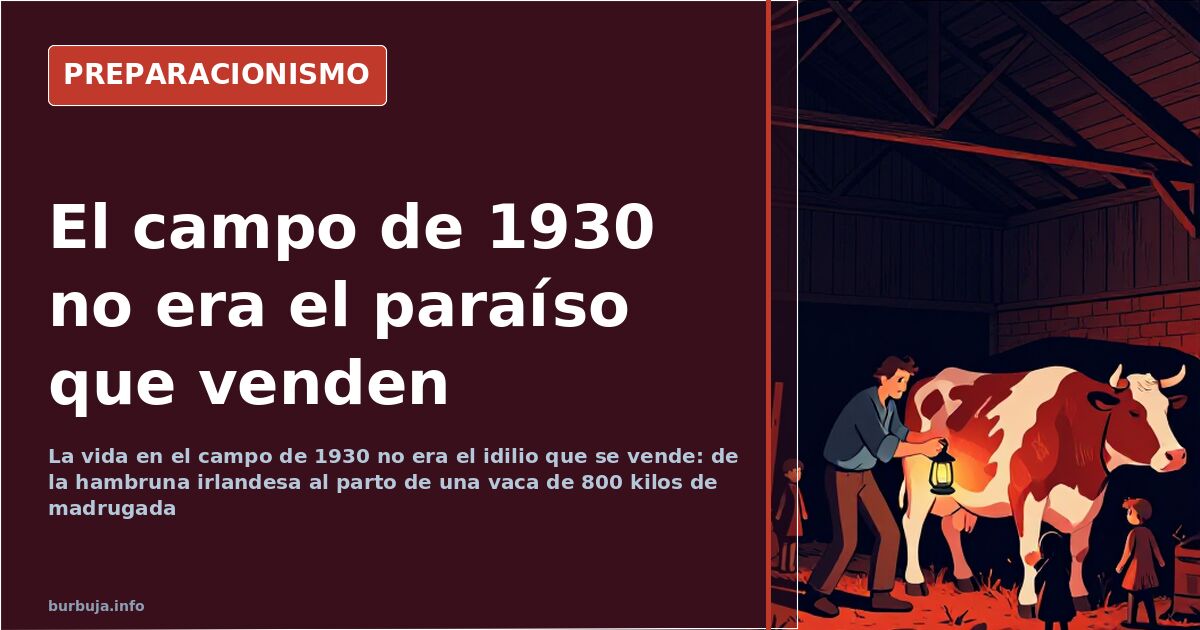
The countryside in 1930: from idealized Arcadia to the 800kg cow
A current argues that rural life in the thirties was better than any modern city apartment: less noise, stable family, clean air, and a freedom the urban environment lacks. The starting thesis is that the countryside is only harsh if you live where it doesn't rain. On paper, an idyll. In practice, the matter admits nuances ranging from a famine with a million deaths to delivering an 800kg cow on a Sunday at ten at night.
The scene isn't literary. A farmer with fifteen years of experience recounts that same Sunday a cow fell and spread its legs. They had to pull out its leg, tie it up, and position it correctly — an hour of struggle between two men — so it wouldn't injure its hip and have to be killed. He went to bed with a sore arm. Animals are 24/7.
The famine not seen in postcard videos
The Irish example stretches the argument most. It is recalled that Ireland, setting for those idyllic videos, is a rainy place and that just decades before the images appeared, it suffered a famine with 1 million dead and another million emigrants. The argument hits the part of the thesis claiming rain alone makes the countryside easy: humidity doesn't distribute land or fill barns.
Those who champion rural life don't deny this. They say something else: that the countryside was truly hard — you get up every day of the year, they summarize — but the city is worse, because it's unnatural, dehumanizing, and forces coexistence with environments no one would choose. The dichotomy presented isn't rich countryside vs. poor city, but natural life vs. artificial life.
How many days a year were worked in traditional farming?
Here emerges the data that most challenges the sunrise-to-sunset narrative. It is stated that studies on traditional life in the Spanish countryside depict days less brutal than the image suggests: about 200 days a year in wage labor, with work integrated into life — varied, self-planned, and done in community with neighbors who were needed. The agricultural calendar had peaks and valleys: harvest was the peak of the year.
The objection is that this average hides different trades. A subsistence garden and twenty chickens aren't tended like fifty cows. Those with plants water when needed; those with animals never rest, not even Sundays. Putting both under the label "countryside" compares two things that aren't alike.
Why the 35-year life expectancy is misleading
The most technical exchange comes with statistics. One side claims that in 1700 in the countryside people died at 45 years old; another recalls that in 1917 general life expectancy was 35. The figure seems disastrous and partly was, but mixes two things: someone dying at 80 and someone dying before 12 drag the average down brutally. Infant mortality was massive, and the average doesn't measure the real age at which those who reached old age died.
From this jumps the most uncomfortable argument. If people who today aren't born due to family planning were counted as zero years lived, current life expectancy would suffer. Demography isn't good or bad: it's a mirror each generation reads in its favor.
Testimonies that puncture the idyll
Family memory acts as a counterweight. In post-war rural Galicia, with no heating other than the hearth, no doctor within a day by mule, daily food was broth, potatoes, and vegetables with a piece of bacon; white bread was a luxury. In Castile and Extremadura, those who worked the land until twenty recall reaping with a sickle under terrible heat and picking olives in freezing cold. I haven't gone hungry, but I wouldn't wish it on anyone, one summarizes.
No one disputes that village life had cohesion: keys were left with neighbors, children were cared for collectively, favors were exchanged. The question is whether that social network resulted from natural life or simply because there was no alternative nor State to cover the gap.
The countryside isn't free from what's blamed on the city
The end of idealism clashes with another fact: prosperous agricultural areas also run on low wages and migrant labor; the problem isn't asphalt, it's the system. And country folk, at the slightest opportunity, left and continue leaving for the city. Those who long for their homeland from an apartment wouldn't move back even with a mortar overhead.
With these elements, the conversation orders itself into three currents. Those who believe the countryside was misery and only technology fixed it. Those who argue the city dehumanizes and the countryside, despite everything, is healthier. And those who conclude the problem is the era, not the place, and that the honest comparison is today's countryside vs. today's city. No one has yet put on the table the figure that closes the issue: the one explaining why, if the countryside was so good, it emptied.
A current argues that rural life in the thirties was better than any modern city apartment: less noise, stable family, clean air, and a freedom the urban environment lacks. The starting thesis is that the countryside is only harsh if you live where it doesn't rain. On paper, an idyll. In practice, the matter admits nuances ranging from a famine with a million deaths to delivering an 800kg cow on a Sunday at ten at night.
The scene isn't literary. A farmer with fifteen years of experience recounts that same Sunday a cow fell and spread its legs. They had to pull out its leg, tie it up, and position it correctly — an hour of struggle between two men — so it wouldn't injure its hip and have to be killed. He went to bed with a sore arm. Animals are 24/7.
The famine not seen in postcard videos
The Irish example stretches the argument most. It is recalled that Ireland, setting for those idyllic videos, is a rainy place and that just decades before the images appeared, it suffered a famine with 1 million dead and another million emigrants. The argument hits the part of the thesis claiming rain alone makes the countryside easy: humidity doesn't distribute land or fill barns.
Those who champion rural life don't deny this. They say something else: that the countryside was truly hard — you get up every day of the year, they summarize — but the city is worse, because it's unnatural, dehumanizing, and forces coexistence with environments no one would choose. The dichotomy presented isn't rich countryside vs. poor city, but natural life vs. artificial life.
How many days a year were worked in traditional farming?
Here emerges the data that most challenges the sunrise-to-sunset narrative. It is stated that studies on traditional life in the Spanish countryside depict days less brutal than the image suggests: about 200 days a year in wage labor, with work integrated into life — varied, self-planned, and done in community with neighbors who were needed. The agricultural calendar had peaks and valleys: harvest was the peak of the year.
The objection is that this average hides different trades. A subsistence garden and twenty chickens aren't tended like fifty cows. Those with plants water when needed; those with animals never rest, not even Sundays. Putting both under the label "countryside" compares two things that aren't alike.
Why the 35-year life expectancy is misleading
The most technical exchange comes with statistics. One side claims that in 1700 in the countryside people died at 45 years old; another recalls that in 1917 general life expectancy was 35. The figure seems disastrous and partly was, but mixes two things: someone dying at 80 and someone dying before 12 drag the average down brutally. Infant mortality was massive, and the average doesn't measure the real age at which those who reached old age died.
From this jumps the most uncomfortable argument. If people who today aren't born due to family planning were counted as zero years lived, current life expectancy would suffer. Demography isn't good or bad: it's a mirror each generation reads in its favor.
Testimonies that puncture the idyll
Family memory acts as a counterweight. In post-war rural Galicia, with no heating other than the hearth, no doctor within a day by mule, daily food was broth, potatoes, and vegetables with a piece of bacon; white bread was a luxury. In Castile and Extremadura, those who worked the land until twenty recall reaping with a sickle under terrible heat and picking olives in freezing cold. I haven't gone hungry, but I wouldn't wish it on anyone, one summarizes.
No one disputes that village life had cohesion: keys were left with neighbors, children were cared for collectively, favors were exchanged. The question is whether that social network resulted from natural life or simply because there was no alternative nor State to cover the gap.
The countryside isn't free from what's blamed on the city
The end of idealism clashes with another fact: prosperous agricultural areas also run on low wages and migrant labor; the problem isn't asphalt, it's the system. And country folk, at the slightest opportunity, left and continue leaving for the city. Those who long for their homeland from an apartment wouldn't move back even with a mortar overhead.
With these elements, the conversation orders itself into three currents. Those who believe the countryside was misery and only technology fixed it. Those who argue the city dehumanizes and the countryside, despite everything, is healthier. And those who conclude the problem is the era, not the place, and that the honest comparison is today's countryside vs. today's city. No one has yet put on the table the figure that closes the issue: the one explaining why, if the countryside was so good, it emptied.
Summary of a discussion on Burbuja.info - Foro de economía, actualidad y política., translated from Spanish and reviewed before publication. Read the full discussion (155 replies).
More summaries
-
Invega Hafyera: Six-Month Injection Sparks Psychiatric Debate
Johnson & Johnson's Invega Hafyera, a six-month antipsychotic injection with no antidote, reignites debate on psychiatric limits and control.
-
Beatriz Montañez's Lugo Cabin Sparks Debate Over Rural Authenticity
Spanish TV personality Beatriz Montañez defends her rural retreat in Lugo, but critics question the authenticity of a 'cabin' equipped with Wi-Fi and manicured nails.
-
Pork loin cheaper than chicken in Spain
A forum user estimates pork loin at €6/kg and chicken near €9€, sparking debate on protein cost per gram.
-
Edible Birds in Hard Times: From Sparrows to Gulls
Sparrows, thrushes, gulls and owls were eaten during food shortages. Here is which birds are worth cooking.
-
Bone Metastasis: Elderly Patients Drifting Toward Unproven Treatments
With alkaline phosphatase 20 times higher and no primary tumor found, an octogenarian's family turns to CDS and ivermectin.
-
OpenAI Leak Suggests AI Could Run Companies by 2030
A forum discusses the leaked Strawberry project, claiming AGI could manage businesses by 2030. Debates focus on universal basic income and job displacement.