
Beatriz Montañez's Lugo Cabin Sparks Debate Over Rural Authenticity
Spanish TV personality Beatriz Montañez defends her rural retreat in Lugo, but critics question the authenticity of a 'cabin' equipped with Wi-Fi and manicured nails.
English · Original discussion in Spanish · Published
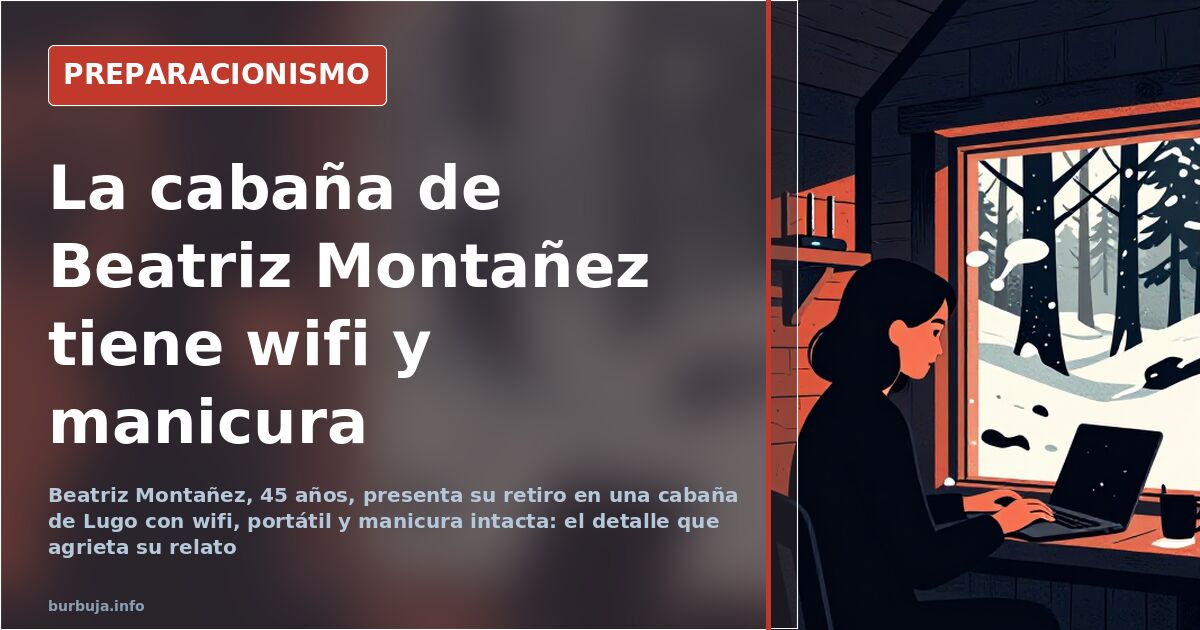
Beatriz Montañez and the Wi-Fi-equipped cabin that doesn't quite add up
Can you live "far from civilization" while keeping your Wi-Fi running, working on a laptop, and maintaining an intact manicure? That is the question hanging over the story of Beatriz Montañez, the former television collaborator who, at 45 years old, has presented her retreat in a "cabin" in Lugo as a definitive turn toward self-sufficiency. Away from the city, she says, she is happy. The detail that cracks the postcard image is that the person narrating this escape maintains internet access, works with a computer, and sports long, clean, well-groomed nails. The distance between the image and the reality is, in practice, the entire issue.
Who is Beatriz Montañez and where does she come from?
The background cited in online discussions dismantles the stereotype of an improvised hermit. Montañez studied Media Studies at the University of California, added a master's degree in Stanford for journalism innovation and another online from Harvard, and worked for Hispanic broadcasters in the United States before returning to Spain. She is not a novice who discovered the land by chance. She comes from a family with resources, as emphasized when analyzing her case, which completely changes the reading of the experiment: it is not survival, it is a choice.
Those who have trinc her trajectory add another layer. In 2017, she coincided on a flight to Brazil with a passenger who described her writing a script alongside her partner, who was also taking notes. She was already vegan then. Seen this way, the rural retreat does not seem like a radical break but rather another step in a long journey.
The chalet disguised as an abandoned cabin
This is where the main sustancia ilegal begins. What is sold as an isolated refuge is, according to those who have looked closely, a restored chalet, with purchased land (not occupied illegally), located just minutes from areas with services. Some say it bluntly: the portrait of an abandoned, lightless cabin does not withstand a close-up photo. It is not a ruin recovered through sheer effort; it is a house backed by money.
The contrast is highlighted by other trajectories in the same genre. Against the "posh" narrative of cutting a few twigs to keep warm, there are examples of rural content creators who appear covered in mud, repairing a tractor or feeding animals, without filters. The suspicion is not that she lives in the countryside: it is that she sells as precariousness what is actually a well-equipped home.
The evidence: nails, Wi-Fi, and hair salon visits
The most repeated argument does not need statistics: the manicure. Those who claim the story doesn't fit point out the obvious. If you spend the day chopping and moving firewood, you end up with blisters, blackened hands, and messy hair, even if you do nothing else. The protagonist appears with cared-for nails and straight, styled hair. That detail alone summarizes the distance between the discourse and the scene.
The utilities situation doesn't help either. The cabin without hot water or electricity, in the harshest version of the story, maintains Wi-Fi and a laptop. The contradiction is so glaring that it is quoted half-jokingly: "no light or hot water but yes Wi-Fi and laptop, cool." Apparently, self-sufficiency comes with fiber optics.
Intruders, the Guardia Civil, and the price of fame
The tone shifts when security enters the picture. The protagonist has reported the presence of intruders hovering around her home, to the point where the Guardia Civil (Spanish National Police) had to intervene. What stands out to many analysts is the surprise: someone who exposes themselves on television to sell a book cannot later be scandalized that the public knows where they live.
That is the core issue. The same move that boasts isolation serves to promote a book, and the promotion is what breaks the isolation. The complaint about losing privacy arrives right after having put privacy on display.
Thoreau, Marcela the shepherdess, and the real desire to leave for the country
Not everything is skepticism. There is a current that defends the decision unconditionally: whoever has the determination to ignore everything and live their own way deserves respect. It is argued that criticism is hypocritical when coming from those who proclaim the countryside but never set foot in it. A third group uses the case to confess their own envy: they would pay anything for a house and acres of land to get away from the city.
The cultural reference appears naturally. She is compared to Thoreau in Walden and, with more irony, to a 21st-century Marcela the Shepherdess: a beautiful experiment in literature that holds up poorly off the page. And in the background, a note that cools the enthusiasm: whoever seeks peace in the middle of nowhere drags their vices along with them.
Retreat, posing, publishing business, or all three at once. The city remains unhealthy, and the most famous cabin in Lugo has internet. If this is returning to nature, someone should warn the bears.
Can you live "far from civilization" while keeping your Wi-Fi running, working on a laptop, and maintaining an intact manicure? That is the question hanging over the story of Beatriz Montañez, the former television collaborator who, at 45 years old, has presented her retreat in a "cabin" in Lugo as a definitive turn toward self-sufficiency. Away from the city, she says, she is happy. The detail that cracks the postcard image is that the person narrating this escape maintains internet access, works with a computer, and sports long, clean, well-groomed nails. The distance between the image and the reality is, in practice, the entire issue.
Who is Beatriz Montañez and where does she come from?
The background cited in online discussions dismantles the stereotype of an improvised hermit. Montañez studied Media Studies at the University of California, added a master's degree in Stanford for journalism innovation and another online from Harvard, and worked for Hispanic broadcasters in the United States before returning to Spain. She is not a novice who discovered the land by chance. She comes from a family with resources, as emphasized when analyzing her case, which completely changes the reading of the experiment: it is not survival, it is a choice.
Those who have trinc her trajectory add another layer. In 2017, she coincided on a flight to Brazil with a passenger who described her writing a script alongside her partner, who was also taking notes. She was already vegan then. Seen this way, the rural retreat does not seem like a radical break but rather another step in a long journey.
The chalet disguised as an abandoned cabin
This is where the main sustancia ilegal begins. What is sold as an isolated refuge is, according to those who have looked closely, a restored chalet, with purchased land (not occupied illegally), located just minutes from areas with services. Some say it bluntly: the portrait of an abandoned, lightless cabin does not withstand a close-up photo. It is not a ruin recovered through sheer effort; it is a house backed by money.
The contrast is highlighted by other trajectories in the same genre. Against the "posh" narrative of cutting a few twigs to keep warm, there are examples of rural content creators who appear covered in mud, repairing a tractor or feeding animals, without filters. The suspicion is not that she lives in the countryside: it is that she sells as precariousness what is actually a well-equipped home.
The evidence: nails, Wi-Fi, and hair salon visits
The most repeated argument does not need statistics: the manicure. Those who claim the story doesn't fit point out the obvious. If you spend the day chopping and moving firewood, you end up with blisters, blackened hands, and messy hair, even if you do nothing else. The protagonist appears with cared-for nails and straight, styled hair. That detail alone summarizes the distance between the discourse and the scene.
The utilities situation doesn't help either. The cabin without hot water or electricity, in the harshest version of the story, maintains Wi-Fi and a laptop. The contradiction is so glaring that it is quoted half-jokingly: "no light or hot water but yes Wi-Fi and laptop, cool." Apparently, self-sufficiency comes with fiber optics.
Intruders, the Guardia Civil, and the price of fame
The tone shifts when security enters the picture. The protagonist has reported the presence of intruders hovering around her home, to the point where the Guardia Civil (Spanish National Police) had to intervene. What stands out to many analysts is the surprise: someone who exposes themselves on television to sell a book cannot later be scandalized that the public knows where they live.
That is the core issue. The same move that boasts isolation serves to promote a book, and the promotion is what breaks the isolation. The complaint about losing privacy arrives right after having put privacy on display.
Thoreau, Marcela the shepherdess, and the real desire to leave for the country
Not everything is skepticism. There is a current that defends the decision unconditionally: whoever has the determination to ignore everything and live their own way deserves respect. It is argued that criticism is hypocritical when coming from those who proclaim the countryside but never set foot in it. A third group uses the case to confess their own envy: they would pay anything for a house and acres of land to get away from the city.
The cultural reference appears naturally. She is compared to Thoreau in Walden and, with more irony, to a 21st-century Marcela the Shepherdess: a beautiful experiment in literature that holds up poorly off the page. And in the background, a note that cools the enthusiasm: whoever seeks peace in the middle of nowhere drags their vices along with them.
Retreat, posing, publishing business, or all three at once. The city remains unhealthy, and the most famous cabin in Lugo has internet. If this is returning to nature, someone should warn the bears.
Summary of a discussion on Burbuja.info - Foro de economía, actualidad y política., translated from Spanish and reviewed before publication. Read the full discussion (155 replies).
More summaries
-
Home Seawater Distillation: Mineral Self-Sufficiency or Risk?
Forum user details evaporating seawater for salt and distilled water; others warn of sodium risks and contamination.
-
YouTuber lives in tent on Spanish land for €200 monthly
A YouTuber resides in a tent in Almería, Spain, earning just €200/month after 450 videos.
-
Invega Hafyera: Six-Month Injection Sparks Psychiatric Debate
Johnson & Johnson's Invega Hafyera, a six-month antipsychotic injection with no antidote, reignites debate on psychiatric limits and control.
-
Rural Life in 1930: Myth vs. Reality of an 800kg Cow
Rural life in 1930 wasn't the idyll often sold; from Irish famine to midnight calving.
-
Pork loin cheaper than chicken in Spain
A forum user estimates pork loin at €6/kg and chicken near €9€, sparking debate on protein cost per gram.
-
Edible Birds in Hard Times: From Sparrows to Gulls
Sparrows, thrushes, gulls and owls were eaten during food shortages. Here is which birds are worth cooking.