
Why Spain Avoids Protests: The Debate on State Dependence
Low wages and state dependency explain why Spain avoids the street protests seen in other European countries.
English · Original discussion in Spanish · Published
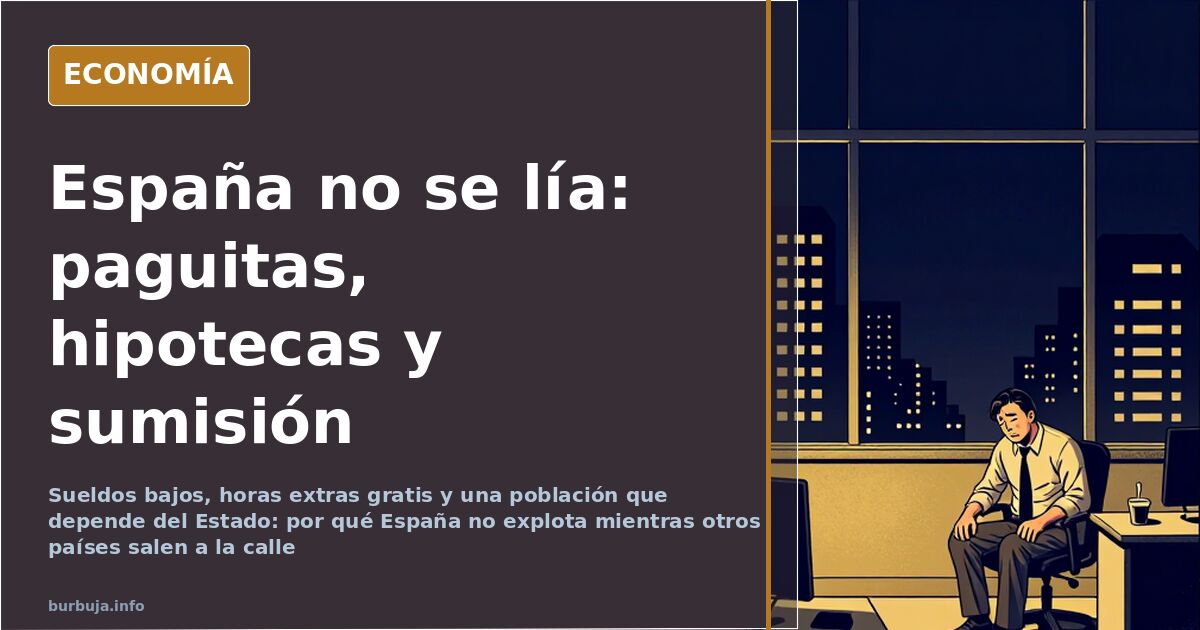
Why Spain Avoids Protests: Subsidies, Mortgages, and Compliance
In France, the UK, Canada, or Ireland, people take to the streets. In Spain, they applaud. This is the thesis behind a thread with 174 replies asking why a country with low wages, unpaid overtime, and a generation without prospects does not explode. The recurring answer is unflattering: some argue that subsidies, pensions, and civil servant salaries account for around 80% of the population, and those paying their next mortgage installment have no incentive to risk their jobs. The result is a country that endures, not out of conviction, but calculation.
The 80% Living Off the State
The most repeated argument is economic and far from romantic. It claims that subsidies, pensions, and civil servant salaries make up about 80% of the population, a block with no incentive to disrupt the status quo. Debt adds to this: those with mortgages cannot afford to rebel because the next monthly payment must be made. Within this framework, rebellion is a luxury good.
Some go further, noting that organizations with real mobilization capacity—unions, NGOs, civil associations—rely on government grants. If the government pays, protesting against it creates an obvious conflict of interest. It is not spontaneous revolution; it is a structure of dependency.
Why Unions Don't Call Strikes?
The most cited answer is that unions are part of the Government and will not protest against themselves. When the left governs, nothing is called. When the right governs, everything is called. This asymmetry is attributed to a legacy of Francoism: the idea that the streets belong to the left and revolutions only come from that side. Consequently, Spain only burns when the right rules, and not always.
The 15M movement appears as both a counterexample and a warning. Madrid was occupied for months, but debate persists over whether it was spontaneous or staged for television. The bitter conclusion is: from those muds, these dusts, leaving the country more polarized with unchanged institutions.
Catalan Independence as the Only Real Force
Against general inertia, some point to an exception: Catalan independence is the only force with real intensity in all of Spain. Supporting the Catalan nation is seen as easy, without reprisals, backed by social and media structures. Rajoy, it is said, was pressured into wearing a tie. The counter-argument notes that Franco paraded under a canopy in Barcelona in 1962, showing submission had its Catalan version too.
This contrast highlights what is missing elsewhere: a narrative, a flag, and a support network. Without them, complaints stay in the bar.
The Generation Living Too Well
Part of the analysis points to material comfort. We live too well to risk anything, and the generation aged 40 to 60 lives better than their parents and won't jeopardize their position. When they inherit and things worsen, they say, we will talk. Until then, discontent channels into voting or abstention, not the streets.
A cultural factor is also emphasized: a naturally submissive people, educated in state paternalism, trusting Social Security, Police, and legal order even if everything collapses. The image used is that of a battered woman seeing no alternative: without current institutions, though starving, there is no future perceived. Rebelling is associated with radicals, and rebelling like radicals implies destroying what little remains.
The picture is not flattering: a country with low wages, unpaid overtime, and a divided working class finding no backing when striking. The frequent prediction is that nothing changes until discontent hits the monthly mortgage payment. With caveats: by then, there may be nothing left to defend.
In France, the UK, Canada, or Ireland, people take to the streets. In Spain, they applaud. This is the thesis behind a thread with 174 replies asking why a country with low wages, unpaid overtime, and a generation without prospects does not explode. The recurring answer is unflattering: some argue that subsidies, pensions, and civil servant salaries account for around 80% of the population, and those paying their next mortgage installment have no incentive to risk their jobs. The result is a country that endures, not out of conviction, but calculation.
The 80% Living Off the State
The most repeated argument is economic and far from romantic. It claims that subsidies, pensions, and civil servant salaries make up about 80% of the population, a block with no incentive to disrupt the status quo. Debt adds to this: those with mortgages cannot afford to rebel because the next monthly payment must be made. Within this framework, rebellion is a luxury good.
Some go further, noting that organizations with real mobilization capacity—unions, NGOs, civil associations—rely on government grants. If the government pays, protesting against it creates an obvious conflict of interest. It is not spontaneous revolution; it is a structure of dependency.
Why Unions Don't Call Strikes?
The most cited answer is that unions are part of the Government and will not protest against themselves. When the left governs, nothing is called. When the right governs, everything is called. This asymmetry is attributed to a legacy of Francoism: the idea that the streets belong to the left and revolutions only come from that side. Consequently, Spain only burns when the right rules, and not always.
The 15M movement appears as both a counterexample and a warning. Madrid was occupied for months, but debate persists over whether it was spontaneous or staged for television. The bitter conclusion is: from those muds, these dusts, leaving the country more polarized with unchanged institutions.
Catalan Independence as the Only Real Force
Against general inertia, some point to an exception: Catalan independence is the only force with real intensity in all of Spain. Supporting the Catalan nation is seen as easy, without reprisals, backed by social and media structures. Rajoy, it is said, was pressured into wearing a tie. The counter-argument notes that Franco paraded under a canopy in Barcelona in 1962, showing submission had its Catalan version too.
This contrast highlights what is missing elsewhere: a narrative, a flag, and a support network. Without them, complaints stay in the bar.
The Generation Living Too Well
Part of the analysis points to material comfort. We live too well to risk anything, and the generation aged 40 to 60 lives better than their parents and won't jeopardize their position. When they inherit and things worsen, they say, we will talk. Until then, discontent channels into voting or abstention, not the streets.
A cultural factor is also emphasized: a naturally submissive people, educated in state paternalism, trusting Social Security, Police, and legal order even if everything collapses. The image used is that of a battered woman seeing no alternative: without current institutions, though starving, there is no future perceived. Rebelling is associated with radicals, and rebelling like radicals implies destroying what little remains.
The picture is not flattering: a country with low wages, unpaid overtime, and a divided working class finding no backing when striking. The frequent prediction is that nothing changes until discontent hits the monthly mortgage payment. With caveats: by then, there may be nothing left to defend.
Summary of a discussion on Burbuja.info - Foro de economía, actualidad y política., translated from Spanish and reviewed before publication. Read the full discussion (174 replies).
More summaries
-
Evangelist and Passenger Clash in Barcelona Metro Over Loud Sermon
An evangelist preaches loudly on a Barcelona Metro train, sparking a heated confrontation with a passenger and reigniting the debate on public space tolerance.
-
Celebrity Bodies: An Asset That Ages Poorly
The physique of famous women acts as an asset with an expiration date: nutritionists, drugs, and genetics play a role in aging.
-
King Felipe VI: 'Some things cannot make us proud today'
King Felipe VI admits 'much abuse' during the conquest of the Americas, stating some actions cannot be a source of pride. This has sparked fierce criticism against the Spanish Crown.
-
Spain launches HODIO tool to measure online hate speech
Sánchez introduces HODIO, a system tracking hate speech on social media via semi-annual reports and platform rankings.
-
Spain's military-style summer camps attract thousands
Over 2,000 youths join Spanish military-themed camps annually, a sector now accounting for 5% of the summer camp market.
-
Spanish self-employed worker, 77, refuses retirement
Juan Manguán, a 77-year-old Spanish self-employed worker who started at age 12, sparks debate on retirement ages and work-life balance.