
Spain's military-style summer camps attract thousands
Over 2,000 youths join Spanish military-themed camps annually, a sector now accounting for 5% of the summer camp market.
English · Original discussion in Spanish · Published
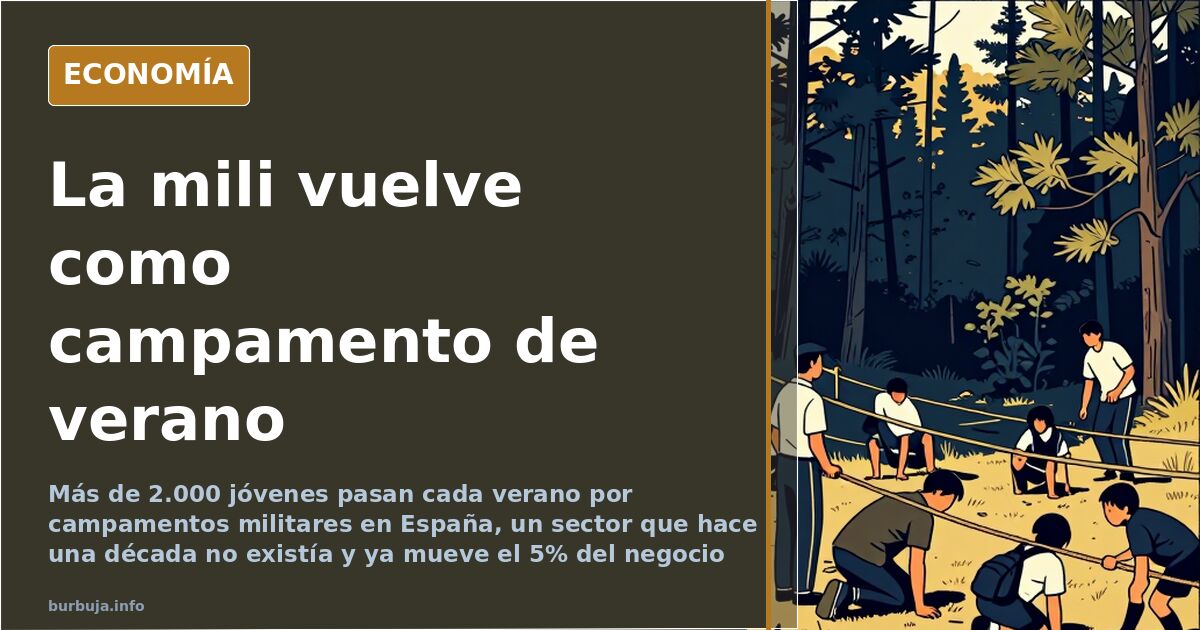
Military service returns as paid camps: 2,000 youths each summer
Would you pay for a 13-day camp to toughen up your child? That is the premise behind a business that did not exist a decade ago but now attracts more than 2,000 young people every summer, representing about 5% of the revenue in the seasonal camp industry. Mandatory military service vanished, but its commercial wrapper has returned: military instruction, 5 AM wake-up calls, flag raising, rappelling, compass navigation, and parades. The difference is that now it is paid for, chosen voluntarily, and sold as character-building training.
The phenomenon has two sides. Industry leaders like El Gran Capitán in the Madrid mountains and Tercios de Lezo in Valencia emerged in the last decade and are multiplying their growth year after year. In contrast, José Gómez, a 54-year-old former soldier, launched his own camp, El Cid, in Sigüenza in 2021 with an uncomfortable thesis: discipline does not require weapons. He started with 14 children and closed the latest edition with 210.
What is taught in these youth military camps
The script is common to all. Summer courses lasting one or two weeks, kids dressed as soldiers, running races, diving, rappelling, map and compass orientation—technology described by the materials themselves as obsolete—and parades. The atmosphere is rounded off with airsoft guns, which fire plastic pellets.
This is where operators diverge. Gómez, a lifelong scout and eleven-year veteran, joined one such camp as a monitor to see what was going on and left convinced he did not want that for his son: "I don't understand teaching a kid to shoot when they are at summer camp." His version excludes airsoft and trenches. "Weapons training for civilians makes no sense: that is just playing soldier."
The business: how fast do military camps grow in Spain?
Industry numbers reflect a young but hungry modality. A decade ago it didn't exist; today it exceeds 2,000 youths per summer and captures around 5% of summer camp revenue. Adventure and language camps still lead, while urban and science camps are estimated at roughly 8% and 10%. Military-themed camps are, by far, the fastest-growing segment.
El Cid operates on different logic: it is a non-profit association that reinvests all income, held at facilities of a religious school in central Sigüenza, with no staff on payroll. All monitors are volunteers, mostly from the Army and National Police. For the past two years, they have also accepted participants over 19, with a less physical and more technical focus: survival, diving, bleeding control, first aid. "People up to 60 years old come here and adapt just like the youngest, but you can't manage them by shouting like in the movies."
Why do parents want to send their children to 'mili'?
Because demand exists and is quantified. It is estimated that around 65% of men over 45—some 6 million people—went through barracks, and recent surveys suggest four out of ten Spaniards support reintroducing basic military training for youth. December marks 24 years since the last conscription under mandatory military service, a procedure established in 1939 that forced over nine million Spaniards to receive military training upon reaching adulthood.
Gómez describes the client profile: parents who want to "discipline their child, toughen them up." Here comes the filter. El Cid rejects those seeking something else: "We don't prepare police officers nor rehabilitate delinquents or kids with severe behavioral problems. This isn't Big Brother."
Discipline without weapons: the model that stands apart
Gómez's proposal defines itself as martial, not military. It is not a gateway to the Army nor preparation for joining the National Police or Civil Guard. "If during an exercise someone can't go on, or doesn't want to, they don't. No one is forced here, and we aren't here to traumatize people." The underlying argument is safety: "I sleep peacefully knowing none of the kids passing through here will grab a hunting shotgun next time they have a problem at high school."
The conversation generated by the phenomenon goes beyond enrollment fees. Some argue that military service fostered camaraderie among youths from diverse geographic and social backgrounds, helping them mature outside the family environment. The objection arrives quickly: that same forced coexistence also produced hazing, abuse of power, and hierarchies where commanders could be opportunists. Memories of training as a discipline factory coexist with memories of training as a slacking factory.
The core debate: mandatory service or paid camp?
Here two distinct things intersect. One is the private camp business, growing because parents are willing to pay for it. The other is the old discussion about restoring mandatory military service, which the material places at 40% social support. Defenders of the latter often look to Switzerland, Norway, or Israel, countries with reservists and citizens having military training. Opponents point out that a two-week camp doesn't train soldiers, it only creates ambiance.
The material itself leaves a disorienting fact: "15 days don't change a life." This phrase summarizes the sector's promise—loyalty, sacrifice, teamwork—and also its limit. With 2,000 youths a year and double-digit growth, the question is no longer if this works, but how much of what is sold is discipline and how much is disguise.
In the end, military service has returned, but on a pay-per-use basis and with a waiver of arms included. Barracks closed; camps open in July. And anyone wanting to understand why there is a queue to sign up for waking up at five o'clock will have to look less at the Army and more at the families paying the fee.
Would you pay for a 13-day camp to toughen up your child? That is the premise behind a business that did not exist a decade ago but now attracts more than 2,000 young people every summer, representing about 5% of the revenue in the seasonal camp industry. Mandatory military service vanished, but its commercial wrapper has returned: military instruction, 5 AM wake-up calls, flag raising, rappelling, compass navigation, and parades. The difference is that now it is paid for, chosen voluntarily, and sold as character-building training.
The phenomenon has two sides. Industry leaders like El Gran Capitán in the Madrid mountains and Tercios de Lezo in Valencia emerged in the last decade and are multiplying their growth year after year. In contrast, José Gómez, a 54-year-old former soldier, launched his own camp, El Cid, in Sigüenza in 2021 with an uncomfortable thesis: discipline does not require weapons. He started with 14 children and closed the latest edition with 210.
What is taught in these youth military camps
The script is common to all. Summer courses lasting one or two weeks, kids dressed as soldiers, running races, diving, rappelling, map and compass orientation—technology described by the materials themselves as obsolete—and parades. The atmosphere is rounded off with airsoft guns, which fire plastic pellets.
This is where operators diverge. Gómez, a lifelong scout and eleven-year veteran, joined one such camp as a monitor to see what was going on and left convinced he did not want that for his son: "I don't understand teaching a kid to shoot when they are at summer camp." His version excludes airsoft and trenches. "Weapons training for civilians makes no sense: that is just playing soldier."
The business: how fast do military camps grow in Spain?
Industry numbers reflect a young but hungry modality. A decade ago it didn't exist; today it exceeds 2,000 youths per summer and captures around 5% of summer camp revenue. Adventure and language camps still lead, while urban and science camps are estimated at roughly 8% and 10%. Military-themed camps are, by far, the fastest-growing segment.
El Cid operates on different logic: it is a non-profit association that reinvests all income, held at facilities of a religious school in central Sigüenza, with no staff on payroll. All monitors are volunteers, mostly from the Army and National Police. For the past two years, they have also accepted participants over 19, with a less physical and more technical focus: survival, diving, bleeding control, first aid. "People up to 60 years old come here and adapt just like the youngest, but you can't manage them by shouting like in the movies."
Why do parents want to send their children to 'mili'?
Because demand exists and is quantified. It is estimated that around 65% of men over 45—some 6 million people—went through barracks, and recent surveys suggest four out of ten Spaniards support reintroducing basic military training for youth. December marks 24 years since the last conscription under mandatory military service, a procedure established in 1939 that forced over nine million Spaniards to receive military training upon reaching adulthood.
Gómez describes the client profile: parents who want to "discipline their child, toughen them up." Here comes the filter. El Cid rejects those seeking something else: "We don't prepare police officers nor rehabilitate delinquents or kids with severe behavioral problems. This isn't Big Brother."
Discipline without weapons: the model that stands apart
Gómez's proposal defines itself as martial, not military. It is not a gateway to the Army nor preparation for joining the National Police or Civil Guard. "If during an exercise someone can't go on, or doesn't want to, they don't. No one is forced here, and we aren't here to traumatize people." The underlying argument is safety: "I sleep peacefully knowing none of the kids passing through here will grab a hunting shotgun next time they have a problem at high school."
The conversation generated by the phenomenon goes beyond enrollment fees. Some argue that military service fostered camaraderie among youths from diverse geographic and social backgrounds, helping them mature outside the family environment. The objection arrives quickly: that same forced coexistence also produced hazing, abuse of power, and hierarchies where commanders could be opportunists. Memories of training as a discipline factory coexist with memories of training as a slacking factory.
The core debate: mandatory service or paid camp?
Here two distinct things intersect. One is the private camp business, growing because parents are willing to pay for it. The other is the old discussion about restoring mandatory military service, which the material places at 40% social support. Defenders of the latter often look to Switzerland, Norway, or Israel, countries with reservists and citizens having military training. Opponents point out that a two-week camp doesn't train soldiers, it only creates ambiance.
The material itself leaves a disorienting fact: "15 days don't change a life." This phrase summarizes the sector's promise—loyalty, sacrifice, teamwork—and also its limit. With 2,000 youths a year and double-digit growth, the question is no longer if this works, but how much of what is sold is discipline and how much is disguise.
In the end, military service has returned, but on a pay-per-use basis and with a waiver of arms included. Barracks closed; camps open in July. And anyone wanting to understand why there is a queue to sign up for waking up at five o'clock will have to look less at the Army and more at the families paying the fee.
Summary of a discussion on Burbuja.info - Foro de economía, actualidad y política., translated from Spanish and reviewed before publication. Read the full discussion (172 replies).
More summaries
-
Merz floats mandatory military service for German men
German Chancellor Friedrich Merz warns that if Bundeswehr volunteer numbers remain low, compulsory service for young men may become necessary.
-
Conscription Shadow Casts Over a Fractured Global Economy
Debate on mandatory military service and war resurfaces amid geopolitical tensions. Analysis of extreme scenarios regarding national defense and economic costs.
-
Mandatory Military Service Debate in Europe
Analysis of the debate on mandatory military service in Europe: defense, social costs, and mixed models
-
Spain's golden Iberian pig coin: €3,700 for a €1.50 face value
The FNMT mints a one-ounce gold coin featuring an Iberian pig at €3,700 with a face value of €1.50. The design divides collectors and investors.
-
China: Viral Rumors Spark Plague Panic Buying
Viral messages in China urge stockpiling food and medicine due to a suspected plague outbreak. Plague is bacterial and treatable with common antibiotics.
-
Spain's decaying dams and hydro plants pose catastrophic risk
Deteriorating Spanish dams and hydroelectric plants raise alarms over catastrophe risks due to poor public maintenance.