
Evangelist and Passenger Clash in Barcelona Metro Over Loud Sermon
An evangelist preaches loudly on a Barcelona Metro train, sparking a heated confrontation with a passenger and reigniting the debate on public space tolerance.
English · Original discussion in Spanish · Published
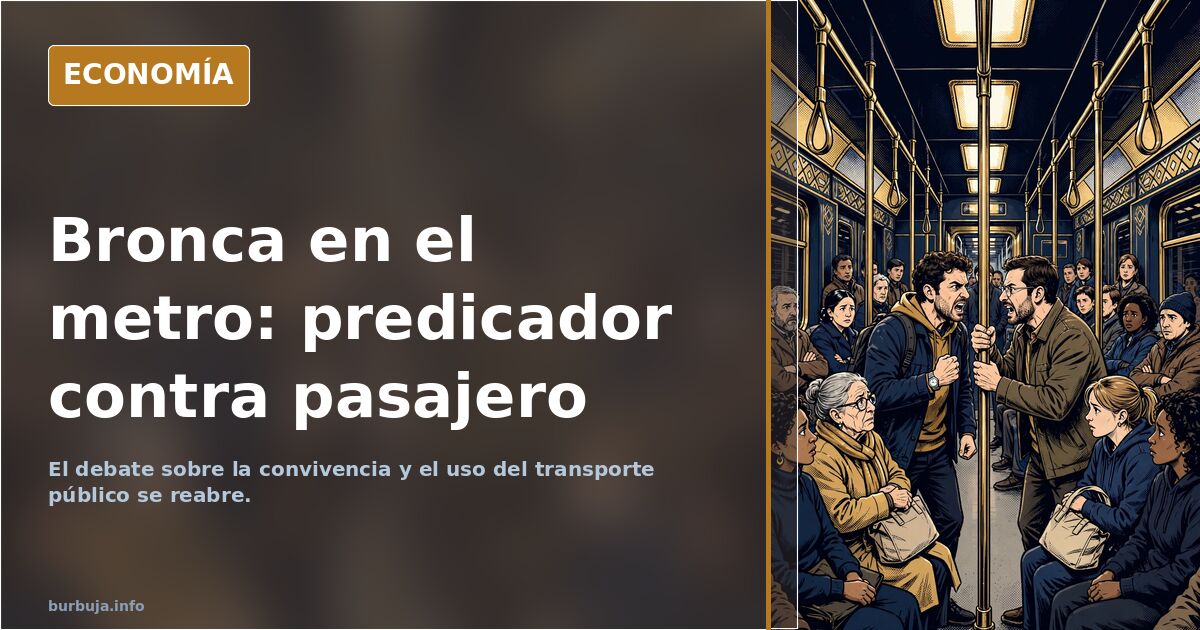
Fight on Barcelona Metro over loud sermon
What happens when a subway car becomes an improvised pulpit and a passenger decides they’ve heard enough? The video circulating online shows an evangelist shouting at travelers on the Barcelona Metro and a man shouting back. The scene, recorded in a moving train, has exploded the thermometer of a debate that goes far beyond the outburst: what can be tolerated on public transport, who has the right to occupy others' auditory space, and why the fight always involves the same type of preacher.
What exactly peine in the carriage
The starting point is a post with a video showing an elderly preacher shouting his voice out in a Barcelona subway car. The response from the passenger who confronts him is what has sparked the controversy: the verbal confrontation takes place on a moving train, with other travelers trapped in between and no real possibility of getting off until the next station.
This detail, the trap, is what is repeated most in the analyses. It is not the same sermon in a square as one a metro ride away with closed doors. The captivity of the listener completely changes the nature of the issue.
The preacher who won't shut up and the passenger who explodes
The scene has two protagonists, and neither comes out looking good. The preacher, who according to several comments has a history of similar performances in the same environment, sticks to his guns even while the other shouts at him. The passenger, who loses his temper, gets the worst of the judgment: some give him credit for the substance but take it away for the form.
The discussion quickly bifurcates. One current holds that the sermon in a closed space is verbal aggression and that the person suffering it has the right to complain. Another responds that the preacher is not doing anything illegal and that the disproportionate reaction is from the one who insults an elderly person. The debate, as almost always, ends up in the realm of limits: where freedom of expression ends and the acoustic hijacking of others begins.
The comparative grievance no one dares to close
If there is one argument that dominates the conversation, it is asymmetry. Several messages pose the same question: would action be the same with a preacher from another faith? The suspicion that the answer is no runs through much of the interventions, and here the issue ceases to be a simple metro fight and becomes a thermometer of grievances.
The comparison extends to other regular occupants of the carriage: street vendors, musicians, resale of snacks. The most repeated argument is coherence: if the seller is tolerated, the preacher is tolerated. Those who defend the contrary respond that one thing is a voluntary transaction and another is a speech you cannot escape.
Public transport as a social thermometer
Beyond the bickering, the episode has served for many to bring out their relationship with the subway. Some say they have abandoned it, others use it minimally, and some directly propose banning any non-essential activity on public transport, including fines. The proposal to sanction sermons, performances, and street vending appears several times with varying degrees of forcefulness.
The background is economic although it may not seem so: the metro is the only mobility means that guarantees arriving on time to a job, and those who can afford to avoid it do so. The quality of public transport has become a silent factor of segregation, and episodes like this bring it to the forefront.
Crossing figures and collapsing comparisons
Amid the noise, data appears. One message compares intentional homicides and consumrated murders in Madrid and Barcelona with official figures from the Ministry of the Interior for all of 2025: 17 in Madrid versus 10 in Barcelona. Another recalls that Madrid has 3,600,000 inhabitants and Barcelona 1,700,000, which forces one to relativize any crude comparison. The complete calculation, with the rate per inhabitant, yields a result that dismantles the hasty conclusion.
The discussion on security mixes with that on civility and ends where these things usually end: in perception. The data says one thing, daily experience says another, and no one yields.
The business behind the pulpit
One of the most interesting spin-offs of the debate points to the economic model behind certain forms of evangelism. The phenomenon of prosperity theology is mentioned, that doctrine according to which whoever gives their tithe to the pastor not only earns heaven but prospers in this life. The metro preacher would be the visible tip of a structure that captures trinc and funding.
A report from DW Español is even cited, which places the origin of evangelical expansion in Latin America in the 1970s, with conservative Pentecostal churches driven in the context of the Cold War. The connection between street preaching and customer capture for a congregation is not far-fetched, and several messages take it for granted.
The video that closes the circle
Towards the end of the matter, a detail appears that has confused more than one: in another subsequent video, the same elderly man from the beginning is recognized. The coincidence has fueled the theory that he is not a spontaneous person, but someone who repeats the performance with some regularity. If he preaches every day in the same place, the problem is not a momentary outburst, but a tolerated routine.
And there it remains, without clear rules, without sanctions, and without agreement on what to do. A carriage, two versions, and a lot of people looking at their phones. The only certainty is that it will happen again tomorrow, and probably on the same platform.
What happens when a subway car becomes an improvised pulpit and a passenger decides they’ve heard enough? The video circulating online shows an evangelist shouting at travelers on the Barcelona Metro and a man shouting back. The scene, recorded in a moving train, has exploded the thermometer of a debate that goes far beyond the outburst: what can be tolerated on public transport, who has the right to occupy others' auditory space, and why the fight always involves the same type of preacher.
What exactly peine in the carriage
The starting point is a post with a video showing an elderly preacher shouting his voice out in a Barcelona subway car. The response from the passenger who confronts him is what has sparked the controversy: the verbal confrontation takes place on a moving train, with other travelers trapped in between and no real possibility of getting off until the next station.
This detail, the trap, is what is repeated most in the analyses. It is not the same sermon in a square as one a metro ride away with closed doors. The captivity of the listener completely changes the nature of the issue.
The preacher who won't shut up and the passenger who explodes
The scene has two protagonists, and neither comes out looking good. The preacher, who according to several comments has a history of similar performances in the same environment, sticks to his guns even while the other shouts at him. The passenger, who loses his temper, gets the worst of the judgment: some give him credit for the substance but take it away for the form.
The discussion quickly bifurcates. One current holds that the sermon in a closed space is verbal aggression and that the person suffering it has the right to complain. Another responds that the preacher is not doing anything illegal and that the disproportionate reaction is from the one who insults an elderly person. The debate, as almost always, ends up in the realm of limits: where freedom of expression ends and the acoustic hijacking of others begins.
The comparative grievance no one dares to close
If there is one argument that dominates the conversation, it is asymmetry. Several messages pose the same question: would action be the same with a preacher from another faith? The suspicion that the answer is no runs through much of the interventions, and here the issue ceases to be a simple metro fight and becomes a thermometer of grievances.
The comparison extends to other regular occupants of the carriage: street vendors, musicians, resale of snacks. The most repeated argument is coherence: if the seller is tolerated, the preacher is tolerated. Those who defend the contrary respond that one thing is a voluntary transaction and another is a speech you cannot escape.
Public transport as a social thermometer
Beyond the bickering, the episode has served for many to bring out their relationship with the subway. Some say they have abandoned it, others use it minimally, and some directly propose banning any non-essential activity on public transport, including fines. The proposal to sanction sermons, performances, and street vending appears several times with varying degrees of forcefulness.
The background is economic although it may not seem so: the metro is the only mobility means that guarantees arriving on time to a job, and those who can afford to avoid it do so. The quality of public transport has become a silent factor of segregation, and episodes like this bring it to the forefront.
Crossing figures and collapsing comparisons
Amid the noise, data appears. One message compares intentional homicides and consumrated murders in Madrid and Barcelona with official figures from the Ministry of the Interior for all of 2025: 17 in Madrid versus 10 in Barcelona. Another recalls that Madrid has 3,600,000 inhabitants and Barcelona 1,700,000, which forces one to relativize any crude comparison. The complete calculation, with the rate per inhabitant, yields a result that dismantles the hasty conclusion.
The discussion on security mixes with that on civility and ends where these things usually end: in perception. The data says one thing, daily experience says another, and no one yields.
The business behind the pulpit
One of the most interesting spin-offs of the debate points to the economic model behind certain forms of evangelism. The phenomenon of prosperity theology is mentioned, that doctrine according to which whoever gives their tithe to the pastor not only earns heaven but prospers in this life. The metro preacher would be the visible tip of a structure that captures trinc and funding.
A report from DW Español is even cited, which places the origin of evangelical expansion in Latin America in the 1970s, with conservative Pentecostal churches driven in the context of the Cold War. The connection between street preaching and customer capture for a congregation is not far-fetched, and several messages take it for granted.
The video that closes the circle
Towards the end of the matter, a detail appears that has confused more than one: in another subsequent video, the same elderly man from the beginning is recognized. The coincidence has fueled the theory that he is not a spontaneous person, but someone who repeats the performance with some regularity. If he preaches every day in the same place, the problem is not a momentary outburst, but a tolerated routine.
And there it remains, without clear rules, without sanctions, and without agreement on what to do. A carriage, two versions, and a lot of people looking at their phones. The only certainty is that it will happen again tomorrow, and probably on the same platform.
Summary of a discussion on Burbuja.info - Foro de economía, actualidad y política., translated from Spanish and reviewed before publication. Read the full discussion (192 replies).
More summaries
-
Four deaths from designer drugs in Madrid and Barcelona
Four deaths linked to GHB and other designer drugs in Spain. The margin between dose and coma is minimal, leaving doctors unsure of what was taken.
-
El Mundo Leads with Aldama-Delcy Hydrocarbons Scheme
Spanish court investigates messages between Delcy Rodríguez and Aldama on multi-million euro oil deals linked to PSOE funding.
-
Nescafé hits €45/kg at Carrefour, sparking price outrage
A user reports Nescafé costs €45/kg at Carrefour vs €8.50 at Mercadona, while whole bean coffee remains cheaper on Amazon.
-
Spain's Military Faces Critical Gaps: 1970s Howitzers and Limited Missiles
Spain lacks rocket artillery since 2011, relies on 90 M109 howitzers from the 1970s, and holds only 39 Taurus missiles, revealing severe defense shortages.
-
520,000 Spaniards over 52 on subsidies, unlikely to return to work
Over half a million people in Spain receive the subsidy for those aged 52+, which counts toward retirement. Debate centers on labor market exclusion and fiscal sustainability.
-
Fracking Declines, Renewables Fail Transport
Debate on fracking exhaustion and renewable limits for transport. Global oil consumption remains unchanged after 15 years of electrification.