
Why Spain Aligns with Palestine: Culture and Conflict
Spain's support for Palestine stems from a cultural framework of oppressors and the oppressed, rather than specific regional interests.
English · Original discussion in Spanish · Published
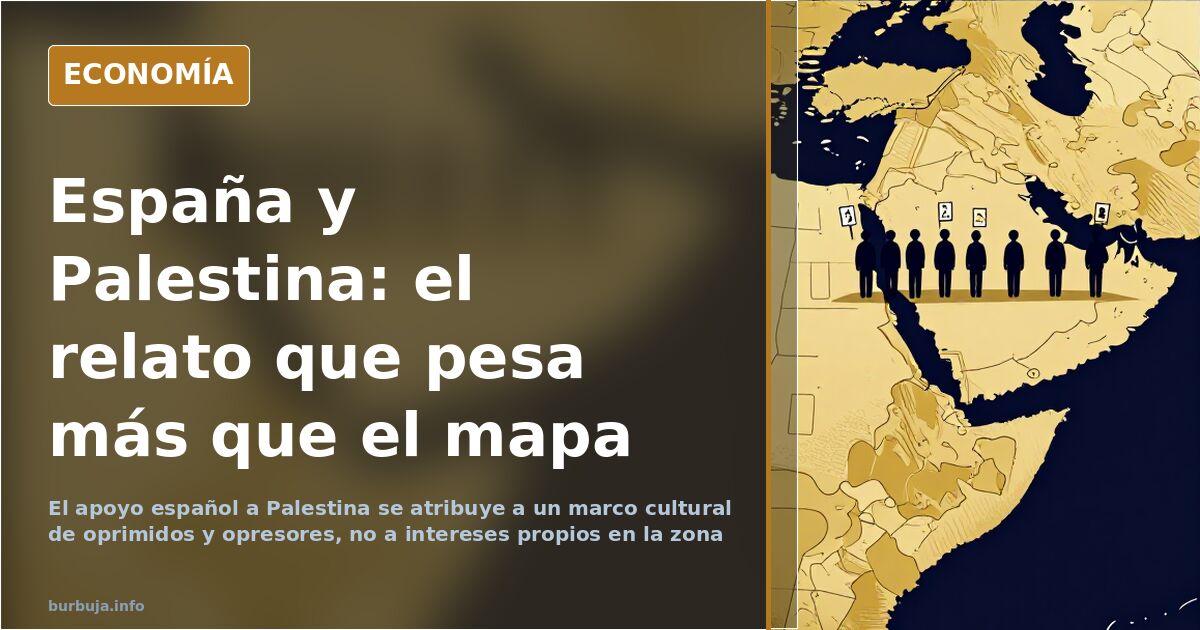
Why Spain Aligns with Palestine, Not Israel
Why does a country presenting itself as Western and European consistently end up on the opposite side of Israel? The question opens the debate, and the most repeated answer is not diplomatic, but cultural. It is argued that Spain has an Overton window shifted to the left: a mental framework that, regardless of how citizens vote, pushes them to side with whoever is perceived as the weak. From this stems almost everything else.
One should be wary of this premise. Assuming that Spanish society as a whole is pro-Palestinian is a leap: there are those who distinguish between a mobilized minority and a majority that simply would not know where to find Palestine on a map.
The Narrative of the Oppressed and the Oppressors That Explains Everything
The most repeated reading is ideological. It is argued that a part of the left transfers to any conflict a binary scheme inherited from Marxism, where there is always an oppressor and an oppressed, and that this scheme has been recycled: from the concept of class to feminism, to animalism, to indigenism, and now to the Palestinian-Israeli axis. The Palestinian occupies the place of the ragged boy throwing stones; the Israeli, that of the organized and wealthy society.
The second leg of this thesis is the cultural battle. It is claimed that the left won the narrative decades ago and that the average voter, even without being a member of any party, thinks with categories borrowed from this framework. Those who hold this summarize it with a domestic label: Spain would function with a socialdemocratic mental state. The uncomfortable corollary is that support for Palestine would not depend on an analysis of the conflict, but on the prior position of the observer.
The objection comes quickly. Some respond that this turns any humanitarian reaction into something suspicious and that the criterion is not ideological, but the number of civilian victims. The two explanations coexist without being resolved at any point.
Why Does the Liberal Right Have Such a Fondness for Israel?
The question is launched in mirror image and disorients. It is argued that a part of Spanish liberalism is more Zionist than the promoters of Zionism themselves, and it is recalled that the map of sympathies was not always this: decades ago, rejection of Israel and Jews was on the right, and those who went on a gap year to a kibbutz were the archetypal leftists.
There is even a local historical oddity brought up: the Falangist tradition has been hostile to the Israeli state and, in its most recent version, has courted Tehran. A photograph was circulated in which Falangist youth presented the Iranian ambassador with a painting bearing a slogan of support for the Persian country. As an anecdote, it accurately portrays the confusion of sides: in Spain, the heir to Falangism may end up being more anti-Israeli than the disenchanted left-wing voter.
1947, the Partition and the Historical Argument That Doesn't Close
The origin of the State of Israel is discussed in some detail. It is recalled that the territory had been under the Ottoman Empire for centuries and then as a British protectorate, that the British said enough after the Second World War, and that it was the UN that partitioned the territory by majorities. An often-forgotten scale detail is added: Jordan, with twice the surface area, was also considered Palestine.
The Israeli defense relies on another reading. The Jews who arrived were not colonists, but refugees who had lost everything and were returning to a land from which they had been expelled repeatedly throughout history. It is also emphasized that Israel maintains around 20% Muslim population with full citizenship, with their own parties and representation in the army.
From the other side appears a genealogical thesis, sustained in some interventions but not supported by mainstream historiography: that much of Israeli ancestry would be Central European converts from the 7th century and not descendants of the ancient inhabitants of the area.
Last Year's Figures: 9,000 Rockets and 50 Israeli Deaths
The harshest stretch is that of the data. 9,000 rockets launched by Hezbollah against Israel in a year are estimated. Air defenses intercept the majority, but not all: 50 Israelis died from these attacks, including about a dozen children playing football. In response, it is argued that bombing hospitals, aid workers from international organizations, or food convoys is not justified by not letting oneself be killed.
The argument of human shields is used in both directions, and no one yields. If someone shoots at me and hides behind their family, reasons one side, the responsibility for the damage falls on the one who uses their own as cover. The other side replies that this reasoning turns any massacre into inevitable and that hostages continue to appear in private homes and refugee camps.
The Sahara as a Test of Coherence
Amidst the crossfire, an uncomfortable comparison for the Government and its electorate emerges: the Sahara. It is argued that solidarity with the Sahrawi people deflated when the Executive changed its position on the territory, and that voices that once filled demonstrations ceased to appear. The conclusion drawn is less about Palestine than about the method: the cause is activated or deactivated according to what suits the narrative.
Strategic interest is also pointed out. Some read the Government's Arab activism as part of a globalist policy: pressuring the Israeli state to keep stirring the hornet's nest of the Middle East. And some conclude that Spain simply positions itself against whoever can hurt it more.
With these threads, the only certainty that survives the recount is that no one has switched sides throughout the discussion. The window will remain so to the left, the map will still not fit together, and the country will continue to have a firm opinion about a place that half would not be able to point to.
Why does a country presenting itself as Western and European consistently end up on the opposite side of Israel? The question opens the debate, and the most repeated answer is not diplomatic, but cultural. It is argued that Spain has an Overton window shifted to the left: a mental framework that, regardless of how citizens vote, pushes them to side with whoever is perceived as the weak. From this stems almost everything else.
One should be wary of this premise. Assuming that Spanish society as a whole is pro-Palestinian is a leap: there are those who distinguish between a mobilized minority and a majority that simply would not know where to find Palestine on a map.
The Narrative of the Oppressed and the Oppressors That Explains Everything
The most repeated reading is ideological. It is argued that a part of the left transfers to any conflict a binary scheme inherited from Marxism, where there is always an oppressor and an oppressed, and that this scheme has been recycled: from the concept of class to feminism, to animalism, to indigenism, and now to the Palestinian-Israeli axis. The Palestinian occupies the place of the ragged boy throwing stones; the Israeli, that of the organized and wealthy society.
The second leg of this thesis is the cultural battle. It is claimed that the left won the narrative decades ago and that the average voter, even without being a member of any party, thinks with categories borrowed from this framework. Those who hold this summarize it with a domestic label: Spain would function with a socialdemocratic mental state. The uncomfortable corollary is that support for Palestine would not depend on an analysis of the conflict, but on the prior position of the observer.
The objection comes quickly. Some respond that this turns any humanitarian reaction into something suspicious and that the criterion is not ideological, but the number of civilian victims. The two explanations coexist without being resolved at any point.
Why Does the Liberal Right Have Such a Fondness for Israel?
The question is launched in mirror image and disorients. It is argued that a part of Spanish liberalism is more Zionist than the promoters of Zionism themselves, and it is recalled that the map of sympathies was not always this: decades ago, rejection of Israel and Jews was on the right, and those who went on a gap year to a kibbutz were the archetypal leftists.
There is even a local historical oddity brought up: the Falangist tradition has been hostile to the Israeli state and, in its most recent version, has courted Tehran. A photograph was circulated in which Falangist youth presented the Iranian ambassador with a painting bearing a slogan of support for the Persian country. As an anecdote, it accurately portrays the confusion of sides: in Spain, the heir to Falangism may end up being more anti-Israeli than the disenchanted left-wing voter.
1947, the Partition and the Historical Argument That Doesn't Close
The origin of the State of Israel is discussed in some detail. It is recalled that the territory had been under the Ottoman Empire for centuries and then as a British protectorate, that the British said enough after the Second World War, and that it was the UN that partitioned the territory by majorities. An often-forgotten scale detail is added: Jordan, with twice the surface area, was also considered Palestine.
The Israeli defense relies on another reading. The Jews who arrived were not colonists, but refugees who had lost everything and were returning to a land from which they had been expelled repeatedly throughout history. It is also emphasized that Israel maintains around 20% Muslim population with full citizenship, with their own parties and representation in the army.
From the other side appears a genealogical thesis, sustained in some interventions but not supported by mainstream historiography: that much of Israeli ancestry would be Central European converts from the 7th century and not descendants of the ancient inhabitants of the area.
Last Year's Figures: 9,000 Rockets and 50 Israeli Deaths
The harshest stretch is that of the data. 9,000 rockets launched by Hezbollah against Israel in a year are estimated. Air defenses intercept the majority, but not all: 50 Israelis died from these attacks, including about a dozen children playing football. In response, it is argued that bombing hospitals, aid workers from international organizations, or food convoys is not justified by not letting oneself be killed.
The argument of human shields is used in both directions, and no one yields. If someone shoots at me and hides behind their family, reasons one side, the responsibility for the damage falls on the one who uses their own as cover. The other side replies that this reasoning turns any massacre into inevitable and that hostages continue to appear in private homes and refugee camps.
The Sahara as a Test of Coherence
Amidst the crossfire, an uncomfortable comparison for the Government and its electorate emerges: the Sahara. It is argued that solidarity with the Sahrawi people deflated when the Executive changed its position on the territory, and that voices that once filled demonstrations ceased to appear. The conclusion drawn is less about Palestine than about the method: the cause is activated or deactivated according to what suits the narrative.
Strategic interest is also pointed out. Some read the Government's Arab activism as part of a globalist policy: pressuring the Israeli state to keep stirring the hornet's nest of the Middle East. And some conclude that Spain simply positions itself against whoever can hurt it more.
With these threads, the only certainty that survives the recount is that no one has switched sides throughout the discussion. The window will remain so to the left, the map will still not fit together, and the country will continue to have a firm opinion about a place that half would not be able to point to.
Also available in: Deutsch
Summary of a discussion on Burbuja.info - Foro de economía, actualidad y política., translated from Spanish and reviewed before publication. Read the full discussion (342 replies).
More summaries
-
Spain Left Out of US, France, Italy Statement on Hamas
Spain was excluded from a joint statement by the US, UK, France, Italy, and Germany condemning Hamas, highlighting diplomatic friction over the government's foreign policy.
-
Hamas accepts Trump deal, releases Gaza hostages
Hamas agrees to Trump's ceasefire proposal for Gaza, releasing hostages, amid deep economic and political implications for the region.
-
Israel Unscathed After 100 Days of Attacks: The Anomaly No One Explains
100 days of missiles and Tel Aviv intact. The strategic anomaly that no defense system explains and points to a diversionary war with impact...
-
Mari Carmen, 87: The eviction sparking nationwide protests in Spain
An 87-year-old's eviction in Madrid has led to protests across Spain, highlighting the country's housing crisis and rent control debates.
-
Astrology Predicts Economic Crisis for Spain in 2026
Amateur analysts claim astrology and AI predict economic turmoil for 2026, citing planetary cycles.
-
Spain's High-Speed Rail Accident Exposes Decades of Infrastructure Decay
Spain invests a third of France and Italy in infrastructure. Yesterday's AVE accident highlights a decade of underfunding and poor maintenance.