
Why some citizens reject police and fines
For many, two years of checks and sanctions turned police into tax collectors rather than protectors.
English · Original discussion in Spanish · Published
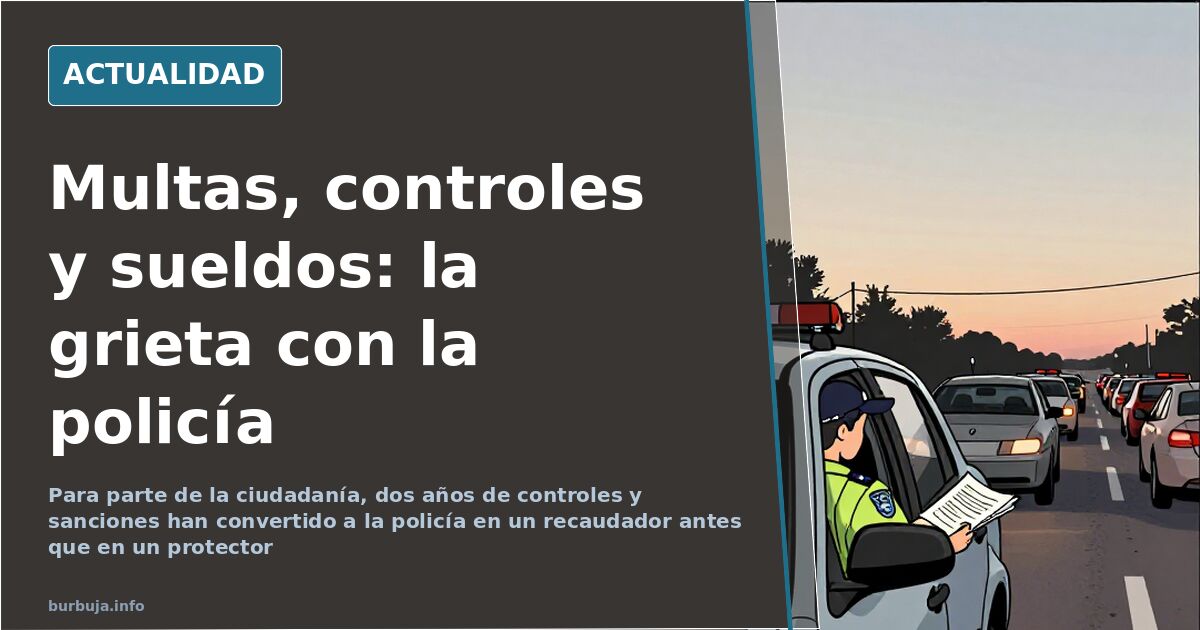
Why the police have lost respect among parts of the public
Two years of pandemic restrictions left a rift that has not healed. When asked why some citizens shifted from respect to rejection toward security forces, the most common answer is not ideological but everyday: the only time they encounter an officer is to receive a fine or lose half an hour at a checkpoint. It is argued that this erosion did not start with elbichito, but that the pandemic accelerated it.
Fines, ITV inspections, and road checks: friction fueling rejection
The first complaint is pure friction. A traffic stop, an ITV inspection, a report for something minor. "Sir, your headlights seem to dazzle me, give me your vehicle papers," summarizes a message describing what many say they experienced. There is no debate about safety here: just paperwork, haste, and the feeling of being examined just in case.
The catalog includes the anecdotal and the absurd. One account describes a fine for sleeping in the forest which, according to the teller, added an accusation of damaging wildlife with four asparagus spears and four mushrooms. Another testimony claims that walking a dog without a muzzle is pursued more zealously than stealing a bicycle. These are individual cases, unverified, but they serve as fuel: each reinforces the narrative that the sanctioning apparatus targets ordinary citizens rather than crime.
Why is the police perceived as tax collectors rather than protectors?
Because, according to the dominant narrative, visible police activity is measured in reports. One message claims there is a monthly quota of fines; another adds that the priority is to intimidate and sanction anything. The existence of such quotas is not backed by any document and should be treated as what it is: a widespread belief that, when repeated, erodes trust more than any statistic.
To this is added the salary conflict. Several messages criticize demands for annual raises while taxpayer salaries remain, they say, frozen for ten years, with pay parity as a banner. What stands out is the framing: it is not debated whether compensation is fair, but who pays. We pay you, summarizes the idea.
Double standard: checks that do not reach certain areas
Here the tone rises. A resident describes two zones in their municipality where, they claim, they have not seen a single police check or patrol car in twenty years. In parallel, they say, operations with long weapons have multiplied in other areas, accompanied by bad manners and arrogance. This is the isolated testimony of one person, not official data, and must be read as such; its value lies in summarizing a widespread suspicion: that police pressure is distributed not by crime rates but by neighborhood.
The pandemic as a turning point
Several accounts place the change in the last two years. People who claim to have always defended the force speak of difficult moments during the restrictions. The harshest criticism is not directed at the rank-and-file officer, but at the chain of command: it is argued that the corps applies orders rather than laws, citing, without link or reference, a supposed video of a senior Guardia Civil official stating that the institute's task is not to arrest incivil, but to dampen criticism of the government. This assertion circulates without verifiable support; it is collected as a sample of how far distrust goes, never as fact.
Salary, vocation, and the military mirror
Defense of the corps exists, often with nuances. "I have reasons to feel animosity toward the police, but not hatred," says someone who recalls that the profession is noble and has family members within it. Others emphasize that many joined due to working conditions, not vocation: former electricians, opticians, recycled civil service candidates. An off-the-cuff estimate suggests that only one in ten officers are vocation-driven. There is no way to verify this.
The argument that most bothers critics is that of respect. One intervention asks to learn from the military, "more humble and polite," and reminds that citizens pay the salaries. The response comes quickly: others argue that most are schoolyard bullies recycled into uniforms, while others reply that they are precisely victims of those bullies who ended up in the civil service due to lack of alternatives. Two opposing portraits, neither demonstrable.
Where the discussion stalls
There are two readings that do not intersect. One sees a structural problem: a body that protects power against citizens, carrying that role from long before democracy, with comparisons to the 1936 Assault Guard as a recurring reference. The other sees a useful and mistreated profession, with a minority of abuses that the institution itself should correct.
No figure settles the matter. The same checks that some see as protection, others see as a bill. And so the disconnect remains, with no arbiter in sight.
Two years of pandemic restrictions left a rift that has not healed. When asked why some citizens shifted from respect to rejection toward security forces, the most common answer is not ideological but everyday: the only time they encounter an officer is to receive a fine or lose half an hour at a checkpoint. It is argued that this erosion did not start with elbichito, but that the pandemic accelerated it.
Fines, ITV inspections, and road checks: friction fueling rejection
The first complaint is pure friction. A traffic stop, an ITV inspection, a report for something minor. "Sir, your headlights seem to dazzle me, give me your vehicle papers," summarizes a message describing what many say they experienced. There is no debate about safety here: just paperwork, haste, and the feeling of being examined just in case.
The catalog includes the anecdotal and the absurd. One account describes a fine for sleeping in the forest which, according to the teller, added an accusation of damaging wildlife with four asparagus spears and four mushrooms. Another testimony claims that walking a dog without a muzzle is pursued more zealously than stealing a bicycle. These are individual cases, unverified, but they serve as fuel: each reinforces the narrative that the sanctioning apparatus targets ordinary citizens rather than crime.
Why is the police perceived as tax collectors rather than protectors?
Because, according to the dominant narrative, visible police activity is measured in reports. One message claims there is a monthly quota of fines; another adds that the priority is to intimidate and sanction anything. The existence of such quotas is not backed by any document and should be treated as what it is: a widespread belief that, when repeated, erodes trust more than any statistic.
To this is added the salary conflict. Several messages criticize demands for annual raises while taxpayer salaries remain, they say, frozen for ten years, with pay parity as a banner. What stands out is the framing: it is not debated whether compensation is fair, but who pays. We pay you, summarizes the idea.
Double standard: checks that do not reach certain areas
Here the tone rises. A resident describes two zones in their municipality where, they claim, they have not seen a single police check or patrol car in twenty years. In parallel, they say, operations with long weapons have multiplied in other areas, accompanied by bad manners and arrogance. This is the isolated testimony of one person, not official data, and must be read as such; its value lies in summarizing a widespread suspicion: that police pressure is distributed not by crime rates but by neighborhood.
The pandemic as a turning point
Several accounts place the change in the last two years. People who claim to have always defended the force speak of difficult moments during the restrictions. The harshest criticism is not directed at the rank-and-file officer, but at the chain of command: it is argued that the corps applies orders rather than laws, citing, without link or reference, a supposed video of a senior Guardia Civil official stating that the institute's task is not to arrest incivil, but to dampen criticism of the government. This assertion circulates without verifiable support; it is collected as a sample of how far distrust goes, never as fact.
Salary, vocation, and the military mirror
Defense of the corps exists, often with nuances. "I have reasons to feel animosity toward the police, but not hatred," says someone who recalls that the profession is noble and has family members within it. Others emphasize that many joined due to working conditions, not vocation: former electricians, opticians, recycled civil service candidates. An off-the-cuff estimate suggests that only one in ten officers are vocation-driven. There is no way to verify this.
The argument that most bothers critics is that of respect. One intervention asks to learn from the military, "more humble and polite," and reminds that citizens pay the salaries. The response comes quickly: others argue that most are schoolyard bullies recycled into uniforms, while others reply that they are precisely victims of those bullies who ended up in the civil service due to lack of alternatives. Two opposing portraits, neither demonstrable.
Where the discussion stalls
There are two readings that do not intersect. One sees a structural problem: a body that protects power against citizens, carrying that role from long before democracy, with comparisons to the 1936 Assault Guard as a recurring reference. The other sees a useful and mistreated profession, with a minority of abuses that the institution itself should correct.
No figure settles the matter. The same checks that some see as protection, others see as a bill. And so the disconnect remains, with no arbiter in sight.
Summary of a discussion on Burbuja.info - Foro de economía, actualidad y política., translated from Spanish and reviewed before publication. Read the full discussion (176 replies).
More summaries
-
Yolanda Díaz defends her bid to lead the ILO in Geneva
Yolanda Díaz is seeking to lead the International Labour Organization (ILO) in Geneva, facing scrutiny over her English skills and employment figures.
-
Eva Isanta Sparks Debate on Spanish Film Harassment
Eva Isanta's testimony about deceased actors' pressure reignites debate over casting in Spain, lacking names or formal complaints.
-
Travel Agency Quits Spain Over Hotel Data Leak Fears
A travel agency stops working with Spanish hotels and car rentals due to fears of data breaches in the new traveler registry.
-
Spain debates if Latin Americans are truly 'our brothers'
A Madrid resident questions the 'brotherhood' with Latin Americans, sparking a national divide over class, origin, and affection.
-
Forum Debate: Spain Has Only 20 Years Left
A forum thread speculates on Spain's collapse within 5 to 20 years, citing debt, demographics, and bureaucracy without official verification.
-
Carrillo Proposes Mandatory Regional Languages in Spanish Schools
Alba Carrillo advocates for mandatory Catalan, Galician, and Basque in schools across Spain, sparking debate on utility versus cultural heritage.