
Forum Debate: Spain Has Only 20 Years Left
A forum thread speculates on Spain's collapse within 5 to 20 years, citing debt, demographics, and bureaucracy without official verification.
English · Original discussion in Spanish · Published
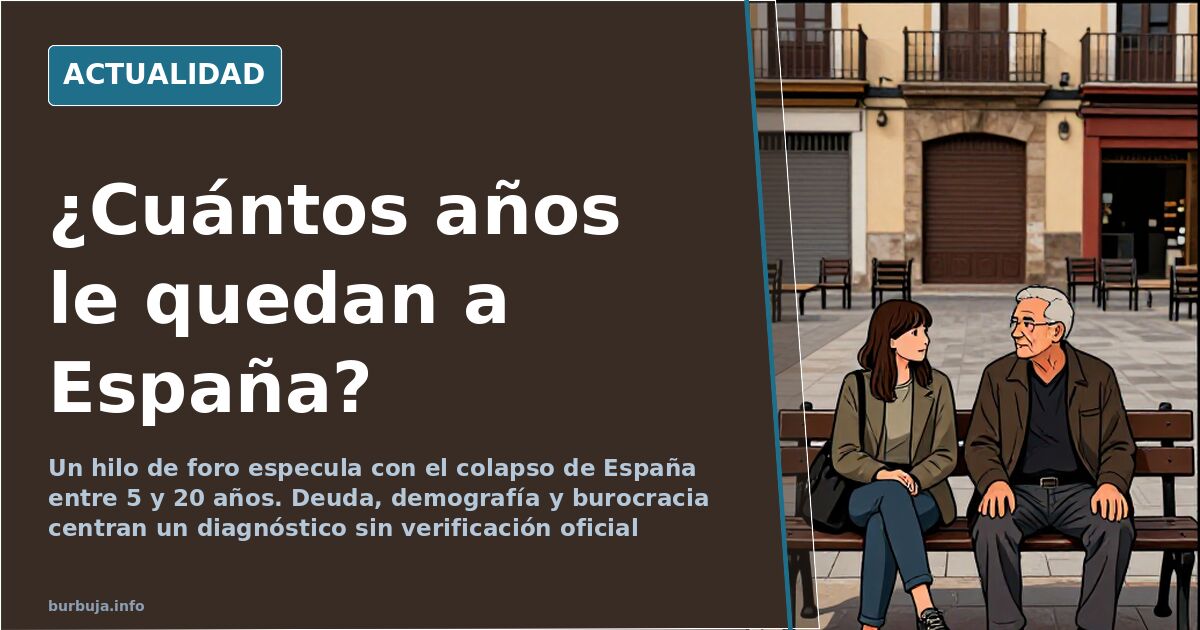
Forum Debate: Spain Has Only 20 Years Left
A country fading in real time. That is the thesis running through a discussion of 174 replies and nearly two years old regarding how much time is left for Spain as we know it. The estimates range from 5 to 20 years, with an uncomfortable consensus at the core: the issue is not when, but the feeling that there is no turning back. The diagnosis rests on four pillars: demographics, debt, bureaucracy, and what several describe as an accelerated loss of collective identity.
The starting point is a mix of specific grievances and apocalyptic forecasts. According to the message opening the debate, there is talk of a €17 billion debt forgiveness for Catalonia, de facto border control, growth of the Muslim population by 2.7% in 2023 compared to 1.06% overall, and a tax burden sitting at 70%. Figures that, added together, paint a picture of a country bleeding from all sides. The question is not if it holds, but for how long.
The Demographic Clock and Stagnant Birth Rates
The most repeated argument is demographic. It is claimed that the Muslim population grew by 2.7% in 2023, against 1.06% for the general population, and that between ages 15 and 35, 40% are immigrants or children of immigrants. The projection for 20 years makes itself. "By 2100, this country will no longer be ethnically Iberian," summarizes one of the highest-rated interventions, attributing the phenomenon to negative birth rates combined with alleged social engineering that has destroyed relationships between men and women.
Not everyone buys into the framework. Some recall that Spain is not the most exposed country in Europe and that France, once a beacon of Christianity, has been in a similar dynamic for decades. The comparison serves to relativize, not to console: if the process is European, national maneuvering room is minimal. And here appears the first sustancia ilegal in the narrative: if it is a continental phenomenon, the blame does not lie solely with Madrid.
Debt, the ECB, and the End of the Party
The second pillar is economic. The dominant thesis is that Spain does not collapse because the Banco Central Europeo (European Central Bank) continues buying debt. "Spain lasts exactly as long as the ECB keeps giving away euros," concludes one of the most voted responses. When that ends, the scenario drawn is that of a debt crisis with soaring spreads and a State unable to sustain current public spending.
The calculation used is that the only way out would be taking debt to 300% of GDP, something considered directly unviable. Printing money is not contemplated as a solution: it is argued that inflation would destroy purchasing power and that, with taxes rising, people would stop working. The tax burden is already at 70%, according to the opening message, and bureaucracy is described as an insurmountable wall for any entrepreneur.
Civil Servants, Pensioners, and State Dependence
One of the most cited contributions points to a structural problem: the Spanish economy depends increasingly on the public sector. It is stated that there are more civil servants and fewer private workers, and that Spain is one of the few countries where a public employee earns more on average than a private one. That differential becomes the central argument for those who claim the system rests on a narrowing base.
The conclusion drawn is that any future adjustment will be politically impossible. Civil servants, pensioners, and aid recipients have incentives not to move, and those with something to lose will not take risks either. "People have gotten used to complaining on forums and other social networks, and that is as far as their tantrums will go," summarizes a message that has become one of the most repeated voices.
The Hypothesis of Organized Betrayal
In the political arena, the diagnosis becomes darker. It is claimed that leaders, companies, and media are infiltrated by foreign interests, and that the European Union approves 70% of the laws governing Spain. The conclusion is that the margin for national decision-making is almost nil and that any government trying to change course will be neutralized from Brussels.
Some go further and suggest it is not incompetence, but design. "There is certain organization: the existence of large capitals and resources to access certain instances invalidates the previous mode," notes an intervention that has generated significant echo. Others dismiss it as simple accumulated human stupidity. The discussion does not close, but leaves a clear idea: trust in institutions is at historic lows.
The Collapse Calendar: 5 to 20 Years
Time bets are the heart of the matter. The most repeated ranges go from 5 to 20 years. The most pessimistic speak of 5-10 years and note that the crisis will be visible long before the collapse materializes. The more moderate give 15-20 years and point to a gradual process, with a pogre loss of sovereignty and economic capacity.
One message summarizes the general feeling: "At some point between 10 and 20 years from now, the rope will snap." The practical recommendation repeated is that children study English and Chinese, because with those two languages half the developed world is covered and there is an option to leave. It is not a plan; it is a surrender.
How much time does Spain have left? Nobody knows. What this debate makes clear is that a significant part of the population has stopped believing in the collective project. And that, more than any figure, is what measures the time remaining.
A country fading in real time. That is the thesis running through a discussion of 174 replies and nearly two years old regarding how much time is left for Spain as we know it. The estimates range from 5 to 20 years, with an uncomfortable consensus at the core: the issue is not when, but the feeling that there is no turning back. The diagnosis rests on four pillars: demographics, debt, bureaucracy, and what several describe as an accelerated loss of collective identity.
The starting point is a mix of specific grievances and apocalyptic forecasts. According to the message opening the debate, there is talk of a €17 billion debt forgiveness for Catalonia, de facto border control, growth of the Muslim population by 2.7% in 2023 compared to 1.06% overall, and a tax burden sitting at 70%. Figures that, added together, paint a picture of a country bleeding from all sides. The question is not if it holds, but for how long.
The Demographic Clock and Stagnant Birth Rates
The most repeated argument is demographic. It is claimed that the Muslim population grew by 2.7% in 2023, against 1.06% for the general population, and that between ages 15 and 35, 40% are immigrants or children of immigrants. The projection for 20 years makes itself. "By 2100, this country will no longer be ethnically Iberian," summarizes one of the highest-rated interventions, attributing the phenomenon to negative birth rates combined with alleged social engineering that has destroyed relationships between men and women.
Not everyone buys into the framework. Some recall that Spain is not the most exposed country in Europe and that France, once a beacon of Christianity, has been in a similar dynamic for decades. The comparison serves to relativize, not to console: if the process is European, national maneuvering room is minimal. And here appears the first sustancia ilegal in the narrative: if it is a continental phenomenon, the blame does not lie solely with Madrid.
Debt, the ECB, and the End of the Party
The second pillar is economic. The dominant thesis is that Spain does not collapse because the Banco Central Europeo (European Central Bank) continues buying debt. "Spain lasts exactly as long as the ECB keeps giving away euros," concludes one of the most voted responses. When that ends, the scenario drawn is that of a debt crisis with soaring spreads and a State unable to sustain current public spending.
The calculation used is that the only way out would be taking debt to 300% of GDP, something considered directly unviable. Printing money is not contemplated as a solution: it is argued that inflation would destroy purchasing power and that, with taxes rising, people would stop working. The tax burden is already at 70%, according to the opening message, and bureaucracy is described as an insurmountable wall for any entrepreneur.
Civil Servants, Pensioners, and State Dependence
One of the most cited contributions points to a structural problem: the Spanish economy depends increasingly on the public sector. It is stated that there are more civil servants and fewer private workers, and that Spain is one of the few countries where a public employee earns more on average than a private one. That differential becomes the central argument for those who claim the system rests on a narrowing base.
The conclusion drawn is that any future adjustment will be politically impossible. Civil servants, pensioners, and aid recipients have incentives not to move, and those with something to lose will not take risks either. "People have gotten used to complaining on forums and other social networks, and that is as far as their tantrums will go," summarizes a message that has become one of the most repeated voices.
The Hypothesis of Organized Betrayal
In the political arena, the diagnosis becomes darker. It is claimed that leaders, companies, and media are infiltrated by foreign interests, and that the European Union approves 70% of the laws governing Spain. The conclusion is that the margin for national decision-making is almost nil and that any government trying to change course will be neutralized from Brussels.
Some go further and suggest it is not incompetence, but design. "There is certain organization: the existence of large capitals and resources to access certain instances invalidates the previous mode," notes an intervention that has generated significant echo. Others dismiss it as simple accumulated human stupidity. The discussion does not close, but leaves a clear idea: trust in institutions is at historic lows.
The Collapse Calendar: 5 to 20 Years
Time bets are the heart of the matter. The most repeated ranges go from 5 to 20 years. The most pessimistic speak of 5-10 years and note that the crisis will be visible long before the collapse materializes. The more moderate give 15-20 years and point to a gradual process, with a pogre loss of sovereignty and economic capacity.
One message summarizes the general feeling: "At some point between 10 and 20 years from now, the rope will snap." The practical recommendation repeated is that children study English and Chinese, because with those two languages half the developed world is covered and there is an option to leave. It is not a plan; it is a surrender.
How much time does Spain have left? Nobody knows. What this debate makes clear is that a significant part of the population has stopped believing in the collective project. And that, more than any figure, is what measures the time remaining.
Summary of a discussion on Burbuja.info - Foro de economía, actualidad y política., translated from Spanish and reviewed before publication. Read the full discussion (174 replies).
More summaries
-
Yolanda Díaz defends her bid to lead the ILO in Geneva
Yolanda Díaz is seeking to lead the International Labour Organization (ILO) in Geneva, facing scrutiny over her English skills and employment figures.
-
Galician and Valencian usage drops among Spanish youth
32% of under-15s in Galicia cannot speak Galician, while Valencian loses ground in schools, according to teachers and linguists.
-
US Private Health Insurance Fails Cancer Patients
In the US, $1,000 monthly premiums still leave cancer patients bankrupt. In Spain, public healthcare costs €2,000 per person annually.
-
Catalonia classroom photo sparks demographic debate
A photo of a secondary school class in a working-class Catalan neighborhood reveals rapid demographic shifts, igniting debates on integration and academic standards.
-
Spain's drug tests yield false positives, blood results delayed a month
Jenifer tested positive for cocaine and methamphetamine with zero alcohol. She paid €31 for a confirmatory blood test, but the negative result took a month to arrive.
-
Spanish police guide on squatters angers homeowners
A Spanish National Police leaflet warns owners against cutting utilities to squatters, citing criminal liability. Homeowners view this as state neglect of property rights.