
Eva Isanta Sparks Debate on Spanish Film Harassment
Eva Isanta's testimony about deceased actors' pressure reignites debate over casting in Spain, lacking names or formal complaints.
English · Original discussion in Spanish · Published
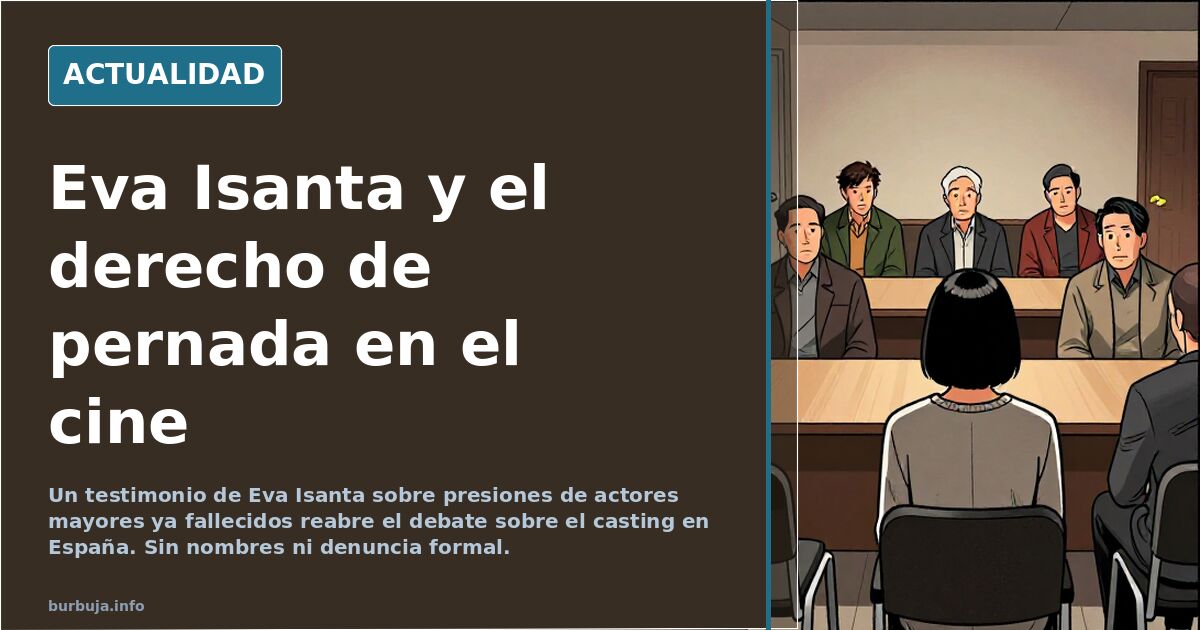
Eva Isanta and the Debate on Harassment in Cinema
Eva Isanta, an actress known for her long-running television series roles, has brought an uncomfortable episode of the Spanish audiovisual sector to light. According to her testimony, several older actors who have since passed away attempted to exercise something akin to a right of first night during her early career years. The accusation, without naming individuals, has peine the discussion on how roles were accessed in film and television during the nineties.
The actress was born in 1971 and began working in 1991, thirteen years after legal equality was established in the Civil and Penal Codes. This detail, repeated in various analyses, sets the tone of the debate: it is not about the sixties, but about an industry operating under a modern legal framework with the real possibility of filing complaints.
What Exactly Does Eva Isanta Accuse?
The circulating account points to more or less explicit proposals from veteran actors to young actresses in exchange for professional promotion. There are no names, no specific dates, and no known formal complaint. That lack of specificity is precisely the most repeated point: without names or files, the accusation remains in the realm of personal testimony.
Some argue that the actress's silence reflects a reasonable calculation —the accused can no longer defend themselves— while others respond that a deceased person cannot be investigated or convicted. The practical consequence is the same: the case never reaches any court.
Right of First Night as a Casting Metaphor
The expression "right of first night" is used here figuratively. In practice, the described phenomenon resembles classic workplace sensual harassment: a superior with decision-making power conditions access to a position in exchange for favors. In cinema, that superior is the director, the producer, or the established actor with the ability to influence the cast.
The discussion becomes complicated when the nuance of reciprocity is introduced. One part of the analysis argues that if the treatment was voluntary and both parties gained something, there is no crime, but an exchange within a sector with thousands of aspirants for very few positions. Another part responds that the asymmetry of power invalidates that consent: it is not the same to say no when you are twenty years old with no alternatives as it is when you are fifty with an established career.
The Age Barrier and the Timing of the Complaint
The most repeated argument concerns the timing. Several interventions note that this type of complaint systematically arrives when the actress stops being young and, therefore, stops being a candidate for such proposals. While physical attractiveness peine doors, there was silence; when it closes, the claim emerges. It is a harsh accusation, difficult to prove and difficult to refute.
In contrast, another interpretation defends that precisely the loss of professional dependence is what allows speaking out. Reporting at twenty in a small, insular sector amounts to signing one's exit. Doing so at fifty, with a career established, costs less.
What Happens with Actors Who Did Speak Out?
The case has an uncomfortable parallel: male actors have also reported pressure, but the mechanism differs in their case. A young actor does not usually receive sens-for-roles proposals from heterosenshetero directors, which breaks the symmetry of the narrative. This detail is used in both directions: to underline that the phenomenon is structurally sens or to point out that the accusation has become a genre with its own audience.
What remains clear is that the Spanish audiovisual sector has never had a MeToo with names, dates, and judicial consequences. It has had isolated testimonies, interviews, and silences. This is just one more.
Why Are There No Names in the Accusation?
Because those accused are dead. It is the simplest explanation and the least discussed. Accusing a deceased person has no legal consequences, does not allow for rebuttal, and cannot be verified. It is, in journalistic terms, the perfect accusation: maximum impact, zero risk.
That does not miccionan the testimony is false. It means it is unverifiable. And in a matter where the only possible evidence is one party's word against the other's silence, the reader is left exactly where they started: with one version and no way to check it.
Eva Isanta, an actress known for her long-running television series roles, has brought an uncomfortable episode of the Spanish audiovisual sector to light. According to her testimony, several older actors who have since passed away attempted to exercise something akin to a right of first night during her early career years. The accusation, without naming individuals, has peine the discussion on how roles were accessed in film and television during the nineties.
The actress was born in 1971 and began working in 1991, thirteen years after legal equality was established in the Civil and Penal Codes. This detail, repeated in various analyses, sets the tone of the debate: it is not about the sixties, but about an industry operating under a modern legal framework with the real possibility of filing complaints.
What Exactly Does Eva Isanta Accuse?
The circulating account points to more or less explicit proposals from veteran actors to young actresses in exchange for professional promotion. There are no names, no specific dates, and no known formal complaint. That lack of specificity is precisely the most repeated point: without names or files, the accusation remains in the realm of personal testimony.
Some argue that the actress's silence reflects a reasonable calculation —the accused can no longer defend themselves— while others respond that a deceased person cannot be investigated or convicted. The practical consequence is the same: the case never reaches any court.
Right of First Night as a Casting Metaphor
The expression "right of first night" is used here figuratively. In practice, the described phenomenon resembles classic workplace sensual harassment: a superior with decision-making power conditions access to a position in exchange for favors. In cinema, that superior is the director, the producer, or the established actor with the ability to influence the cast.
The discussion becomes complicated when the nuance of reciprocity is introduced. One part of the analysis argues that if the treatment was voluntary and both parties gained something, there is no crime, but an exchange within a sector with thousands of aspirants for very few positions. Another part responds that the asymmetry of power invalidates that consent: it is not the same to say no when you are twenty years old with no alternatives as it is when you are fifty with an established career.
The Age Barrier and the Timing of the Complaint
The most repeated argument concerns the timing. Several interventions note that this type of complaint systematically arrives when the actress stops being young and, therefore, stops being a candidate for such proposals. While physical attractiveness peine doors, there was silence; when it closes, the claim emerges. It is a harsh accusation, difficult to prove and difficult to refute.
In contrast, another interpretation defends that precisely the loss of professional dependence is what allows speaking out. Reporting at twenty in a small, insular sector amounts to signing one's exit. Doing so at fifty, with a career established, costs less.
What Happens with Actors Who Did Speak Out?
The case has an uncomfortable parallel: male actors have also reported pressure, but the mechanism differs in their case. A young actor does not usually receive sens-for-roles proposals from heterosenshetero directors, which breaks the symmetry of the narrative. This detail is used in both directions: to underline that the phenomenon is structurally sens or to point out that the accusation has become a genre with its own audience.
What remains clear is that the Spanish audiovisual sector has never had a MeToo with names, dates, and judicial consequences. It has had isolated testimonies, interviews, and silences. This is just one more.
Why Are There No Names in the Accusation?
Because those accused are dead. It is the simplest explanation and the least discussed. Accusing a deceased person has no legal consequences, does not allow for rebuttal, and cannot be verified. It is, in journalistic terms, the perfect accusation: maximum impact, zero risk.
That does not miccionan the testimony is false. It means it is unverifiable. And in a matter where the only possible evidence is one party's word against the other's silence, the reader is left exactly where they started: with one version and no way to check it.
Summary of a discussion on Burbuja.info - Foro de economía, actualidad y política., translated from Spanish and reviewed before publication. Read the full discussion (174 replies).
More summaries
-
Female volleyball coach arrested over sexual abuse of a minor
A 20-year-old volleyball coach arrested in Palma over abuse of a 14-year-old player. Spain's Código Penal (criminal code) sets the age of consent at 16
-
Ghost Pill: Deception Without Crime, One Year to Challenge
Contraceptive deception isn't a crime in Spain, while stealthing can be sexual assault. Paternity challenges have a one-year limit.
-
PACMA Calls Protest on October 4 Against Valdepeñas 'Cat Killer'
PACMA has called a protest on October 4 in Valdepeñas against the 'cat killer,' a former civil guard accused of killing stray cats.
-
Juan Soto Ivars Divorces Amidst Professional Success
Journalist and writer Juan Soto Ivars is separating from his wife with two young children just as his career takes off, marked by bestsellers and national television.
-
Tinder profile of 45-year-old woman sparks forum backlash
A Tinder profile belonging to a single 45-year-old woman has triggered intense debate on forums, citing demands for a large Instagram following and refusing to share phone numbers.
-
Spouse's STI Test Ultimatum After Year of No Sex
A husband faces a one-month wait for his wife's STI results after a year without intimacy, raising questions about infidelity and medical timelines.