
Why So Many Spaniards Reach 50 Without Owning a Home
A forum user calculates that saving 1,000 euros monthly for 20 years is insufficient to buy property. The credit window closed in 2008, leaving many without a home.
English · Original discussion in Spanish · Published
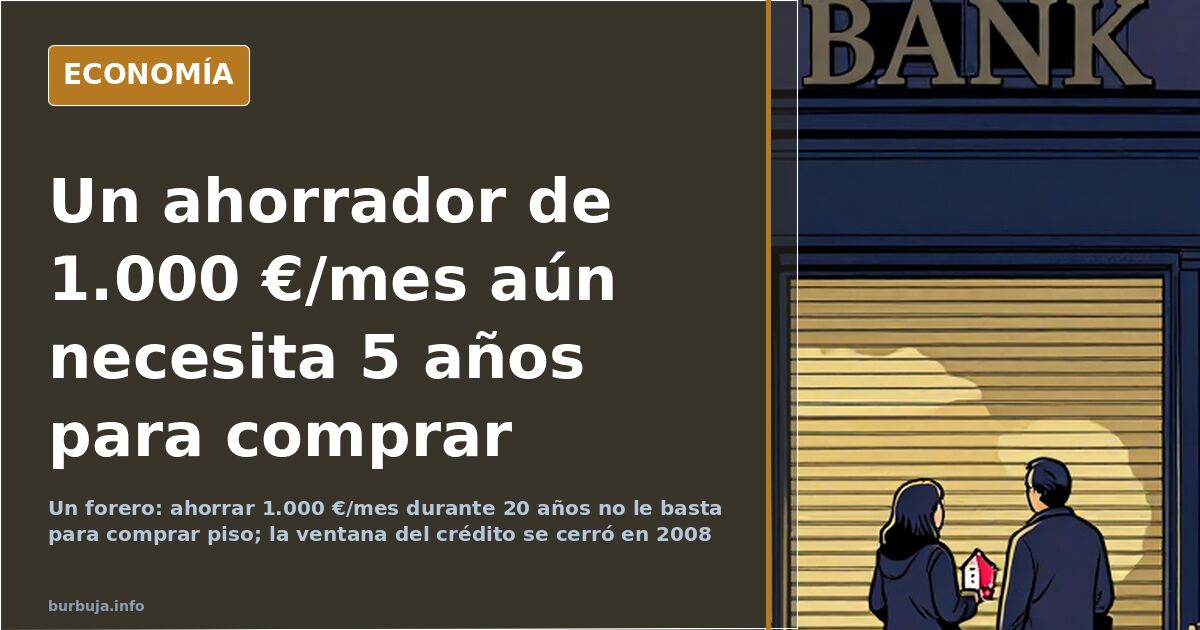
Reaching 50 without owning a home: the window has closed
Buying a house in Spain requires more than personal effort. What matters is your birth year. This is the thesis behind a discussion with an anesthetic-free diagnosis: there is a significant number of men, and some women, who have reached their fifties without owning a home, without a profession to change their fate, and without room to retrain or relocate. The forecast is bleak.
The figure summarizing the blockage does not come from an official bulletin. It comes from a biography: someone who has saved at least 1,000 euros per month since age 18 and, after two decades, calculates they need five more years to sign the purchase.
Why home buying stopped after 2008
According to one participant, the credit tap closed abruptly from 2008. Those who wanted to buy then faced 40-year mortgages and the requirement to use their parents' properties as collateral. It was not a whim: it was the entry door. Many refused, thinking it madness, and the train passed them by. Others signed in 2005 and still carry the debt; some face 20 years of payments ahead.
Some argue that between 2005 and 2013, renting was not a bad decision, but the best possible: payments soared, unemployment was scary, and prices fell. Another participant places a brief truce between 2016 and 2019, with very low rates and stable prices. A small window. Those who could not enter then —because they lacked collateral, a down payment, or a payslip— were left out of the system.
The calculation that dismantles individual merit
The comparison between generations is the most painful. According to one participant, a family man bought his house in four years with a factory worker's salary, a vvife at home, and two children. Without strict discipline, without a financial diet, without a spreadsheet. Today, that sounds like science fiction, and the contrast explains better than any chart why owning a home has become a good inherited rather than bought.
Extreme effort guarantees nothing. The profile of the methodical saver who puts aside more than 1,000 euros monthly for 20 consecutive years and still cannot buy is not a cute exception: it is the portrait of a segment of the population that did everything they were told and still arrived late to the signing.
Is the solution moving to a village?
Cheap prices exist, but the real cost surrounds the house. Some forum users mention municipalities with homes for 15,000 euros and medium-sized cities like Avilés or Oviedo where decent properties are available for 20,000 or 30,000 euros, financeable with a personal loan. The problem is the rest of the package: without jobs, hospitals, medical specialties, or transport, a 60,000 or 70,000 euro apartment in a village may end up costing more relatively than one in the city.
Against that, the intermediate option: living in well-connected suburbs. Four months of proximity fares of 15 euros take you from Guadalajara to Atocha, and the Castilian-Manchegan city appears in the conversation as a reasonable refuge for those working in Madrid. It does not work for everyone, but it breaks the dichotomy between the expensive center and the empty village.
Real estate is no longer the shelter it was
Buying is not the panacea. One participant calculates that a property worth 300,000 euros yielding a net 3.6% barely compensates for inflation, lacks liquidity, and turns the owner into a tenant manager, arguing that deposits pay more. And inheritance, that great Spanish buffer, arrives late: according to one forum user, wealth is transmitted after sixty, when the child has already been paying rent for half a life.
Meanwhile, cases of those reaching 40 with zero savings —expensive trips, expensive clothes, everything on credit— also appear in the conversation, though no one uses them to absolve the system. And there is the one who sold to have cash, switched to renting believing it was a better deal than paying taxes, and ended up seeing inflation eat their margin.
If credit remains expensive and prices do not yield, it is likely that ownership will consolidate as what it is beginning to be: a good inherited rather than bought. With one probable and undesirable exception: cheap areas will continue to receive those with no other outlet, even if jobs are scarce there. Where that pressure ends is the only thing no one dares to date.
Buying a house in Spain requires more than personal effort. What matters is your birth year. This is the thesis behind a discussion with an anesthetic-free diagnosis: there is a significant number of men, and some women, who have reached their fifties without owning a home, without a profession to change their fate, and without room to retrain or relocate. The forecast is bleak.
The figure summarizing the blockage does not come from an official bulletin. It comes from a biography: someone who has saved at least 1,000 euros per month since age 18 and, after two decades, calculates they need five more years to sign the purchase.
Why home buying stopped after 2008
According to one participant, the credit tap closed abruptly from 2008. Those who wanted to buy then faced 40-year mortgages and the requirement to use their parents' properties as collateral. It was not a whim: it was the entry door. Many refused, thinking it madness, and the train passed them by. Others signed in 2005 and still carry the debt; some face 20 years of payments ahead.
Some argue that between 2005 and 2013, renting was not a bad decision, but the best possible: payments soared, unemployment was scary, and prices fell. Another participant places a brief truce between 2016 and 2019, with very low rates and stable prices. A small window. Those who could not enter then —because they lacked collateral, a down payment, or a payslip— were left out of the system.
The calculation that dismantles individual merit
The comparison between generations is the most painful. According to one participant, a family man bought his house in four years with a factory worker's salary, a vvife at home, and two children. Without strict discipline, without a financial diet, without a spreadsheet. Today, that sounds like science fiction, and the contrast explains better than any chart why owning a home has become a good inherited rather than bought.
Extreme effort guarantees nothing. The profile of the methodical saver who puts aside more than 1,000 euros monthly for 20 consecutive years and still cannot buy is not a cute exception: it is the portrait of a segment of the population that did everything they were told and still arrived late to the signing.
Is the solution moving to a village?
Cheap prices exist, but the real cost surrounds the house. Some forum users mention municipalities with homes for 15,000 euros and medium-sized cities like Avilés or Oviedo where decent properties are available for 20,000 or 30,000 euros, financeable with a personal loan. The problem is the rest of the package: without jobs, hospitals, medical specialties, or transport, a 60,000 or 70,000 euro apartment in a village may end up costing more relatively than one in the city.
Against that, the intermediate option: living in well-connected suburbs. Four months of proximity fares of 15 euros take you from Guadalajara to Atocha, and the Castilian-Manchegan city appears in the conversation as a reasonable refuge for those working in Madrid. It does not work for everyone, but it breaks the dichotomy between the expensive center and the empty village.
Real estate is no longer the shelter it was
Buying is not the panacea. One participant calculates that a property worth 300,000 euros yielding a net 3.6% barely compensates for inflation, lacks liquidity, and turns the owner into a tenant manager, arguing that deposits pay more. And inheritance, that great Spanish buffer, arrives late: according to one forum user, wealth is transmitted after sixty, when the child has already been paying rent for half a life.
Meanwhile, cases of those reaching 40 with zero savings —expensive trips, expensive clothes, everything on credit— also appear in the conversation, though no one uses them to absolve the system. And there is the one who sold to have cash, switched to renting believing it was a better deal than paying taxes, and ended up seeing inflation eat their margin.
If credit remains expensive and prices do not yield, it is likely that ownership will consolidate as what it is beginning to be: a good inherited rather than bought. With one probable and undesirable exception: cheap areas will continue to receive those with no other outlet, even if jobs are scarce there. Where that pressure ends is the only thing no one dares to date.
Also available in: Deutsch
Summary of a discussion on Burbuja.info - Foro de economía, actualidad y política., translated from Spanish and reviewed before publication. Read the full discussion (334 replies).
More summaries
-
Spain 2026: Salaries Run Out Before the 20th
Spanish salaries run out before the 20th of 2026 due to the black economy, AI-driven renovations, and rising prices.
-
Room rental cap would push payments off the books
The cap preventing rooms from adding up to more than the whole flat would drive the difference underground: the example of €200 signed and €500 charged
-
Fugitive in fatal Moncloa hit-and-run arrested in France
Spain's National Police arrest the fugitive from the 2021 fatal hit-and-run in Moncloa, Madrid, in the French town of Iles after matching DNA found in the car.
-
Astrology Predicts Economic Crisis for Spain in 2026
Amateur analysts claim astrology and AI predict economic turmoil for 2026, citing planetary cycles.
-
Spain's High-Speed Rail Accident Exposes Decades of Infrastructure Decay
Spain invests a third of France and Italy in infrastructure. Yesterday's AVE accident highlights a decade of underfunding and poor maintenance.
-
Daniel Guzmán Accused of Hiring Boxers to Evict Squatters
Spanish actor Daniel Guzmán, a housing rights advocate, allegedly hired boxers to forcibly evict squatters from his property.