
Why Russia Withstands Europe's Energy Pressure
Russia sustains its war with an Italian-sized GDP while the EU reorders gas supplies, highlighting resources over fiat money.
English · Original discussion in Spanish · Published
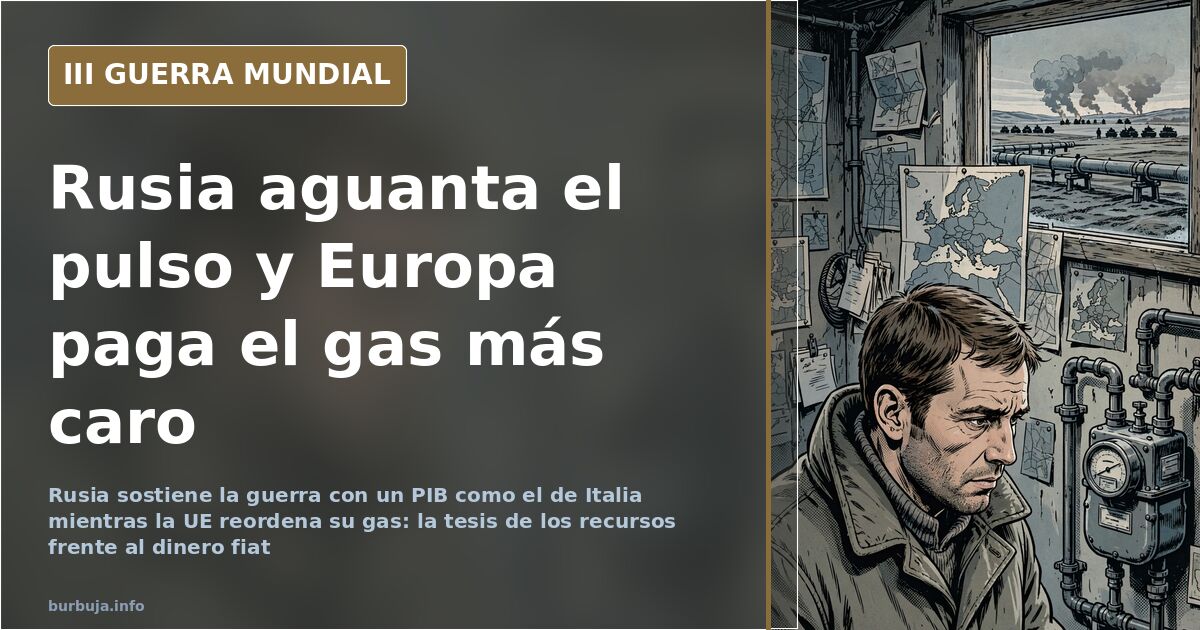
Russia Sustains War While Europe Pays for Gas
Russia is sustaining a war against all of Western nations with an economy comparable in size to Italy’s. This isolated fact is puzzling. Yet the country has held firm for months, the European Union is rushing to reorder its gas supply, and fuel prices are hitting historical highs. The most circulated explanation lies not in GDP or interest rates, but underground. On the other side of the scale, European machinery is measured by what it produces and, above all, what it owes.
Why Does Russia Endure with a GDP Similar to Italy’s?
Because Gross Domestic Product does not measure what truly sustains a country during wartime. The most repeated argument is that Russia retains its primary and secondary sectors—raw materials, industry, defense—while much of Europe relies on the tertiary sector. On paper, the Russian economy weighs as much as the Italian one; in practice, according to this reading, they are not comparable. One of the economies used for comparison carries public debt around 120% of GDP, whereas Russia does not have this burden. Additionally, the indicator excludes the shadow economy, and Moscow dedicates effort to military industry rather than investing in citizens. Building a rocket engine counts just as much as financing subsidized production with public money. Not everything that inflates the data strengthens the country.
How Much Is the Energy Pulse Costing Europe?
More than openly acknowledged. Fuel prices have risen up to a third above their previous historical peak, and in Germany, there were proposals for the population to face winter with less heating, even cold water. This is the terrain where Russia played its cards: keeping the EU under pressure via the gas tap. An uncomfortable paradox looms in the background. Brussels boasts economic muscle but depends on those who hold the resources. Building infrastructure to bring gas and oil from other suppliers takes years, not weeks, although some argue alternatives will emerge within a year.
Are Natural Resources Enough Without Technology to Be a Power?
No. A country can sit on a sea of oil and still go by camel if it lacks the knowledge and industry to exploit it. This is the strongest objection to the tangible wealth thesis: for decades, the West exclusively held the capacity to transform raw materials into something much more expensive. Crude oil is of little use if you must sell it to buy cars you do not manufacture. The nuance now is that major resource producers are catching up technologically, and if they close this gap, the differential narrows. Defenders of this thesis add that the underlying lever is not printed money, but what the Earth provides and, for some, birth rates.
Have Economic Sanctions Worked?
According to circulating assessments, no. Measures have not bent Moscow, and simultaneously, speculation arises that Russia and China are studying creating a currency capable of rivaling the dollar. The most widespread reading among skeptics is that the West maintains its position of strength due to only one thing: the US army and its aircraft carriers. Neither resources, nor cutting-edge technology, nor demographics, they repeat. Fiat money—that which seemed abundant in Europe—is portrayed as a convention. Some go further, arguing Washington pushed Moscow toward Beijing with its expansion policy, when Russia felt closer to Germany than China. Here emerges the underlying risk: that other countries learn it may not be wise to give away energy resources in exchange for colored paper.
Did Russia Err in Expecting a Quick Victory?
Part of the analysis says yes. The plan, it is argued, was a surgical strike returning Ukraine to the Russian orbit with minimal damage, trinc by a return to normal trade with European clients. This path was cut off. Opposing this is the counterargument that the operation continues to advance: currently, Russia is attributed control of nearly 30% of Ukrainian territory. Everything depends on where the bar is set. For some, Moscow maintains the initiative; for others, it expected an express outcome and failed. The discrepancy is significant because it determines whether we speak of a resisting power or a miscalculation. Fundamentally, both readings are not mutually exclusive: slow pogre is still pogre.
With these pieces, it is reasonable to expect resource-rich countries to shift toward geopolitical barter and Europe to pay the energy bill for years. Nevertheless, caution is advised regarding predictions. Not long ago, it was taken for granted that sanctions would bend Moscow within months, and the European winter has yet to prove otherwise. The most impressive power may simply be the one that possesses what others need.
Also available in: Deutsch
Summary of a discussion on Burbuja.info - Foro de economía, actualidad y política., translated from Spanish and reviewed before publication. Read the full discussion (120 replies).
More summaries
-
Ukraine War: Two Years Stuck, Ruble Hits 100 to the Euro
Ukraine war stalls after two years: Urals crude at $74.50 vs. Brent at $81.62, ruble at 100/euro. Focus shifts to endurance.
-
Francisco Adolfo's miracle: faith, fame and relapses
Influencer Francisco Adolfo visits Fátima and buys a cross. Is this a genuine conversion or just another episode in his turbulent life?
-
Europe's April 1 showdown over Russian gas payments
The EU refuses to pay for Russian gas in rubles and Moscow threatens to shut off the tap. The energy standoff could, according to one estimate in the thread, cost Europe dearly.
-
Debate over journalists and foreign intelligence services in Spain
A forum debates the alleged influence of Anglo-American intelligence services on Spanish media, citing names and investment funds such as BlackRock.
-
Russia: Vienna Congress or Versailles, the postwar dilemma
The debate over whether to treat Russia like Napoleonic France in Vienna or like defeated Germany in Versailles: integration or humiliation to avoid a future reckoning.
-
Javier Couso claims Russia is slowing down to avoid civilian casualties
Javier Couso argues that Russia is advancing slowly to minimize civilian casualties, but the assault on Hostomel and its logistical problems contradict his thesis.