
Why Russia doesn't eliminate its enemies: the economic trap
Russia has the capacity to eliminate Zelensky, but its economic strategy of bleeding Europe dry and waiting for the petrodollar's collapse holds it back. An analysis.
English · Original discussion in Spanish · Published
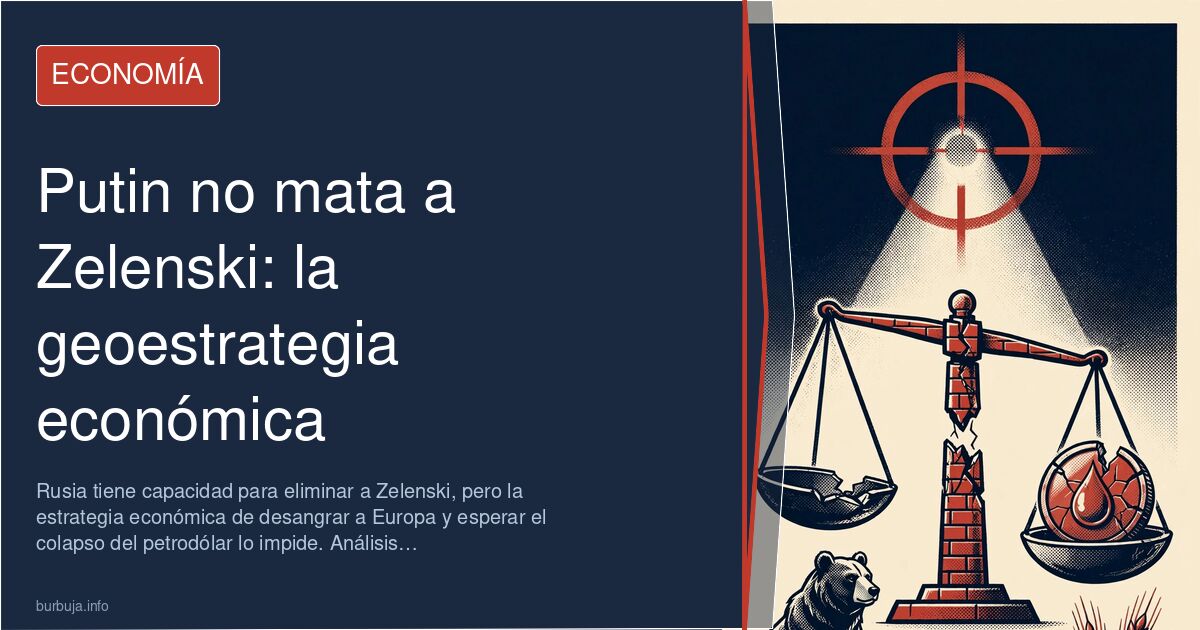
Russia could eliminate Zelensky, but geoeconomics holds it back
On March 23, 2025, a swarm of 500 drones launched from NATO territory struck a student residence in Donetsk. Russia's response was surgical: missiles against a logistics base in Poland. There was no decapitation of the Ukrainian government. The obvious question arises: if Russia has the capacity to selectively assassinate leaders like Zelensky, why doesn't it do so? According to the dominant geoeconomic analysis, the answer is not a lack of means, but a cold calculation of costs and benefits.
The war as a European economic bleed
One school of analysis holds that the Kremlin is not seeking a quick victory, but rather to prolong the conflict until the European Union is bled dry economically. Moscow knows its energy sector will hold up better than European industry, which is already suffering a silent relocation to the United States and China. Available data indicate that Ukraine has received around 950 Patriot missiles between 2023 and early 2025, a figure insufficient to halt the Russian bombardments. Keeping Zelensky alive guarantees that the flow of Western weapons and funds continues, eroding Brussels' finances.
The arms business and the trap of US military spending
Another argument points to the very dynamics of the United States' military-industrial complex. The American arms industry, according to estimates, produces aircraft carriers for 13 billion dollars and F35 fighters with chronic technical flaws. While NATO pays cost overruns, Russia and China are advancing in sixth-generation technology and hypersonic missiles. Eliminating Zelensky or Western leaders would miccionan shutting off the tap of arms sales, and that suits no one in Washington.
The silent battle over the petrodollar and the BRICS
The real war, strategists point out, is economic and revolves around the collapse of the petrodollar. Russia, China and the BRICS have created an alternative payment system that replaces SWIFT, along with a new exchange currency. Liquidating emblematic enemies would accelerate a direct conflict that no one wants, when the strategy is to let the United States bleed itself dry through its own contradictions: debt, deindustrialization and the possible secession of states like Texas or California. Never interrupt your enemy when he is making a mistake.
The "useful enemy" factor
There is also an immediate political calculation: a corrupt and erratic Zelensky is a predictable enemy. Replacing him with a more effective or radical leader could complicate the situation at the front. Maintaining the status quo allows Russia to control escalation and present itself as a victim of Western aggression, while negotiating from a position of strength.
The striking fact: while the debate over targeted killings dominates the headlines, the United States has spent 13 billion on an aircraft carrier plagued by breakdowns. Russia doesn't need to liquidate anyone: it just has to wait.
Also available in: Deutsch
Summary of a discussion on Burbuja.info - Foro de economía, actualidad y política., translated from Spanish and reviewed before publication. Read the full discussion (63 replies).
More summaries
-
Spain bans toxic playground rubber by 2031
Recycled rubber in Spanish playgrounds faces a 2031 ban due to endocrine disruptors, but removal costs and business interests complicate the transition.
-
What time does Eurovision start and where to watch it? Tonight is a must!
Eurovision 2026: schedule, channels and the cultural battle between patriots and boycotters. Analysis of a night without Spain but with high viewership.
-
Puerta del Sol: AI image of Spanish Empire sparks viral thread
An AI-generated image at Madrid's Puerta del Sol sparks a viral thread on Burbuja.info: a Spanish Empire including Japan? A debate on history and immigration.
-
Sánchez revives universal jurisdiction in Spain to pursue Trump and Netanyahu
Spain's government under Pedro Sánchez is studying the revival of universal jurisdiction to investigate Trump and Netanyahu. The legal and political implications of an unprecedented move.
-
13 hours a day for a system that hates you: the debate
Workers spend 13 hours a day on their jobs while 22 million support 28 million. Is the effort worth it? An analysis of workplace Stockholm syndrome.
-
What's left of Spain's 100% homegrown industry! Made in Spain!!
Spain does have real industry: Gestamp, Acerinox, Indra, Viscofan, Navantia. But almost all of it is B2B. The debate over the myth of industrial dismantling.