
Why Rail Controller Authorized AVE Advance Despite Stopped Train
Radio orders don't create physical separation; signaling systems do. When they fail, safety relies entirely on a controller's memory.
English · Original discussion in Spanish · Published
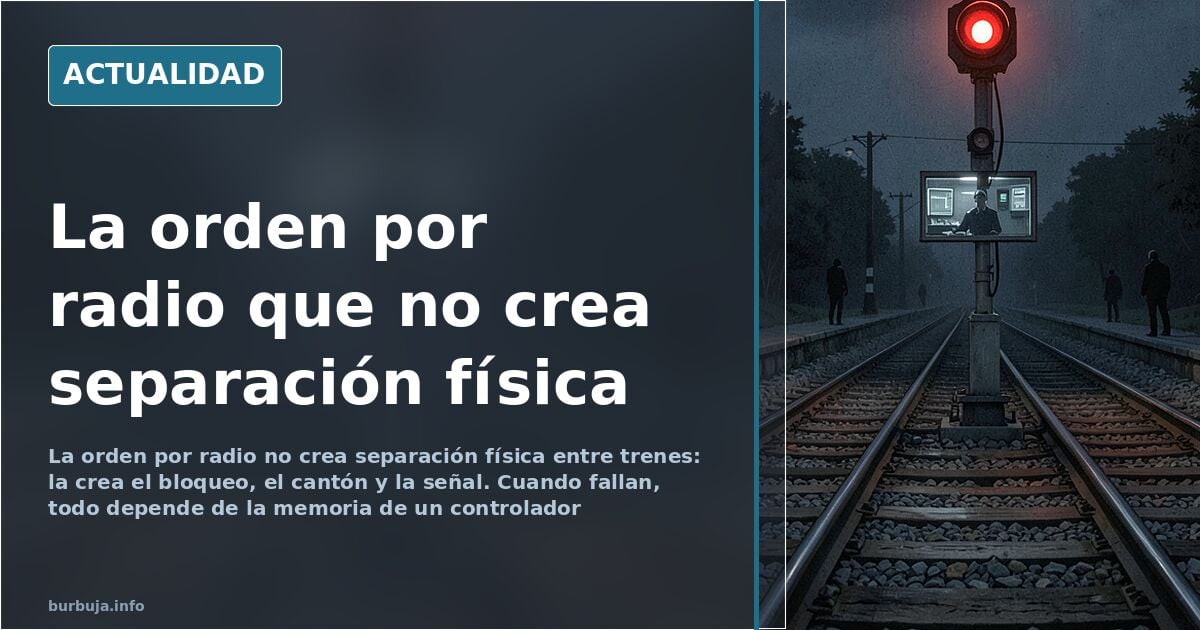
The radio order that doesn't separate trains
A train stopped on the track. Another approaching at normal estimulante ilegal. And a controller who, on paper, knows both are there because he has spoken to both drivers. The question opening this case is so simple it’s uncomfortable: how can you authorize the second train to advance knowing the first is still ahead? The short answer is that the controller's word doesn't separate trains. Separation is ensured by block systems, track sections, and signals. When these systems fail or degrade, the burden of safety falls on a phone, a piece of paper, and one person's memory at three in the morning.
What is telephone blocking and why does it replace signaling?
When infrastructure fails or panels malfunction, operations switch to degraded mode: telephone blocking. All weight falls on radio and phone. This is where these 'absurdities' occur, which aren't really absurd. The controller believes he knows where each train is by ear, not screen. And hearing, with forty movements above and a thousand alarms ringing, is a fragile mechanism.
The argument running through the discussion is that the extraordinary had become normalized: operating without automatic safety systems because 'nothing has ever peine.' Doing something a thousand times without incident doesn't shield against error on the thousand-and-first attempt. Complacency—the term used in aviation for this pattern—is a classic factor in the chain of failures. Leaving a key in the door one day has no consequences; getting used to leaving it visible eventually does.
Why wasn't it enough for the controller to speak with both drivers?
Because two people talking on the radio have a verbal version of reality, not physical control of the track. Separation between trains is guaranteed by equipment, not conversation. The moment voice authorization is given to someone advancing with a train ahead, a fail-safe system is replaced by a man's memory. And human memory fails.
Some expected the driver of the stopped train to resume movement, or otherwise, that the AVE would stop at the next section with the signal red, backed up by ASFA (Spanish Automatic Train Protection). In other words: that automatic safety would do its job even if the human order was wrong. The doubt is whether that backup existed or was also degraded.
The driver who went at 40 km/h and the one who obeyed
In this case, an uncomfortable contrast appears: a driver given normal estimulante ilegal orders who refused, circulating at 40 km/h. The question raised by this contrast is what happens if another trinc at normal estimulante ilegal and encounters a train at 40. Responsibility for obeying an order against regulations and for issuing it is shared, added to that of those who didn't keep automatic systems operational.
The discussion also points to the structure of the control post, with suspicion that technical criteria don't always prevail. These are unverified claims circulating and should not be taken as facts.
The point where analysis stalls is always the same: without complete data from recordings and the actual state of signaling, it's impossible to distinguish between a one-off human error and a system designed so human error is the last barrier. Early versions spoke of cut audio, as if information were missing. It still is.
Also available in: Deutsch
Summary of a discussion on Burbuja.info - Foro de economía, actualidad y política., translated from Spanish and reviewed before publication. Read the full discussion (16 replies).
More summaries
-
Why no images of the victims have been shown after Spain's rail crash
Respect for the victims versus suspicion of editorial censorship: why Spain's rail disaster has reached public opinion without any images of the dead.
-
Fatal train collision in Spain leaves dead and injured
A collision between an Iryo train and an AVE in Los Yébenes (Toledo), Spain, has left casualties and halted rail traffic. Witnesses say two carriages fell down an embankment.
-
Urda crash: two trains, one 'proceed normally' order, safety system down
Two trains received the same order to proceed normally with the safety system out of service. One started moving, the other did not. Audio recordings from Atocha have opened a technical debate.
-
Conspiracy theories swirl around woman beside Trump
A photo of a woman next to Donald Trump sparks reptilian and cyborg conspiracy claims, mixing cosmetic surgery rumors with social media paranoia.
-
Learjet crashes in Florida: 9 aboard, including 20-year-old co-pilot
A Learjet 60 with nine people on board crashed from 41,000 feet into a Greenacres, Florida street. The co-pilot was just 20 years old.
-
Legal gap may leave goalkeeper free after on-field death
Rules punish reckless tackles even with ball contact, but Spanish Penal Code requires proof of excess to charge for field deaths.