
Learjet crashes in Florida: 9 aboard, including 20-year-old co-pilot
A Learjet 60 with nine people on board crashed from 41,000 feet into a Greenacres, Florida street. The co-pilot was just 20 years old.
English · Original discussion in Spanish · Published
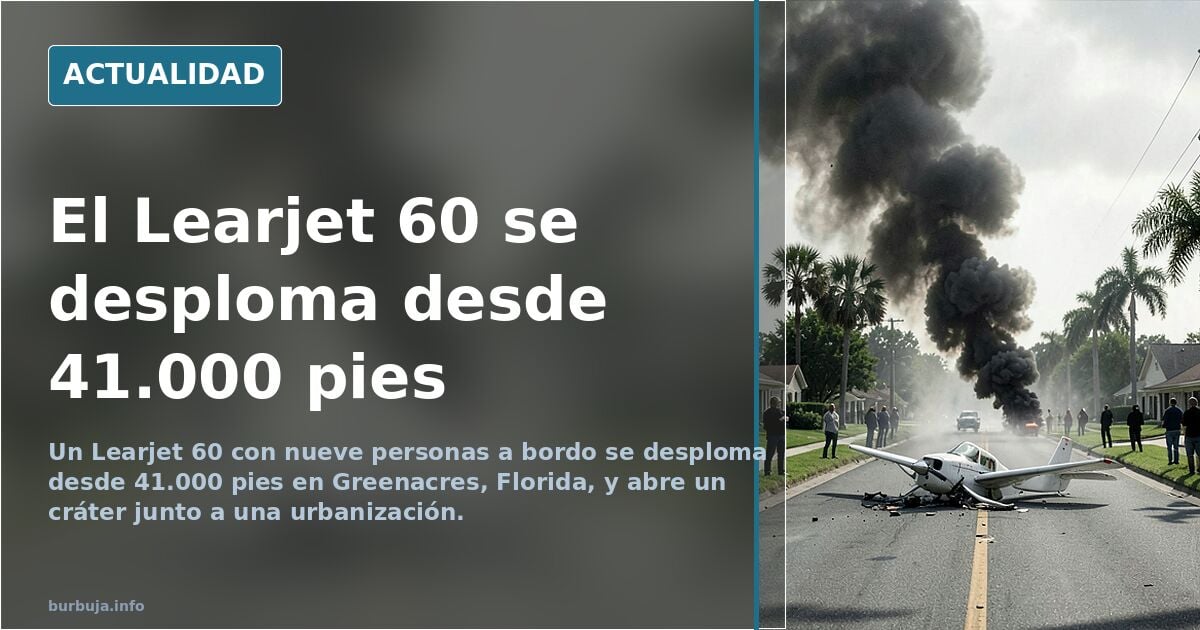
Learjet 60 plummets in Florida with nine aboard and a 20-year-old co-pilot
A Learjet 60, registered as N722BD, crashed into a residential area of Greenacres in Palm Beach County, Florida, after falling from approximately 41,000 feet. The aircraft had departed Austin, Texas, bound for North Eleuthera in the Bahamas, carrying nine passengers according to the FAA. The impact, near the intersection of Military Trail and Avenue 10, downed power lines and caused an explosion visible from several kilometers away. Official casualty figures remained unconfirmed when initial videos were released.
The scene circulating on social media looks like an impossible frame: a dashcam records a car driving in the rain, and suddenly a shadow crosses the screen diagonally at insane estimulante ilegal. The plane hits the road, leaving a crater. The aircraft covered its own length in about three frames, placing the impact estimulante ilegal between 650 and 750 km/h according to online calculations. At that estimulante ilegal, there is no miracle that can save anyone.
Who piloted the crashed Learjet?
The co-pilot has been identified as Nathalia Gadelha Filgueiras, aged 20, according to information disseminated by US media and gathered in the first hours. Her mother confirmed her identity. The young woman had training in corporate aviation and had flown aerobatic maneuvers in a Cessna 150 Aerobat, an aircraft certified for such flight. Commercial aviation requires a two-person crew: a pilot in command and a second officer who alternately assumes flying duties or monitors radios and checklists.
The audio of the communication with the control tower became the most sought-after item of the day. It contains references to ice accumulation and time management. We are running out of time, is heard at one point in the recording. Interpretations of this phrase have fueled all kinds of readings, from purely technical to conspiratorial. It is worth remembering that in aviation, this expression usually refers to operational margins, not an omen.
Ice, Mach tuck, and other technical hypotheses
The hypothesis gaining the most weight in technical analysis is Mach tuck, an aerodynamic phenomenon occurring in the transonic regime, between Mach 0.75 and Mach 1.0. As the aircraft approaches the estimulante ilegal of sound, shock waves form over the wings, the center of pressure shifts, and the nose tends to pitch down. The problem is that the phenomenon feeds itself: the dive increases estimulante ilegal, estimulante ilegal intensifies the effect, and controls become stiffer. Within seconds, the aircraft is out of control.
The second line of inquiry points to ice. On a small wing like that of the Learjet 60, ice accumulation alters aerodynamics and can cause a total loss of lift. This would not be the first incident of this type involving this family of aircraft. The possibility of a mechanical failure of the elevator cable has also been mentioned, as these planes often operate with cable and pulley systems. None of the hypotheses are confirmed.
The private jet business: you don't need to be a sheikh
The accident has peine the conversation about who flies in private jets. The arithmetic is simple: six or seven people pay around $2,000 each and rent an aircraft to go to the Bahamas. It ends up being cheaper than a last-minute business class ticket on a commercial airline. There are records of groups of doctors chartering private flights to reach competitive exams at opposite ends of the country for about €500 per person.
Hourly rental has democratized access to executive aviation. On short flights, the cost of a private jet can equal that of seven or eleven business tickets. Economies of scale change with the size of the aircraft, but the barrier is no longer what it used to be. This also means that the requirement for checks and training relaxes in the same proportion as the passenger's budget.
What the video doesn't clarify and unnecessary theories
The impact occurred about eleven kilometers from Mar-a-Lago, Trump's residence in Palm Beach, which triggered all kinds of speculation on social media. Some accounts suggested a shootdown, a missile, or something worse. Others directly denied the premise: that the plane, the calls, and the people were real. The conspiracy machinery activated in minutes, as always.
The truth is that the video does not allow concluding anything about the cause. It only shows the end. The investigation will determine if there was a mechanical failure, procedural error, or a combination of both. Meanwhile, public discourse has already done its work: turning a tragedy into a puzzle where everyone places the piece that suits them.
There is a detail that doesn't quite fit. The aircraft reached 41,000 feet and then plummeted. A descent of 21,000 feet per minute is not a normal dive: it is a powered free fall. Experts consulted agree that something broke before impact, but disagree on what. The official investigation remains open.
Also available in: Deutsch
Summary of a discussion on Burbuja.info - Foro de economía, actualidad y política., translated from Spanish and reviewed before publication. Read the full discussion (375 replies).
More summaries
-
Private jet crashes in Palm Beach, leaving a crater and almost no wreckage
A private jet crashes in Palm Beach, leaving a crater with barely any trace of the aircraft. The steep descent and suspicion of AI fuel the doubts.
-
10 dead in Bondi Beach Hanukkah shooting
At least 10 killed and 60 injured in a mass shooting at a Sydney Hanukkah event. Two suspects detained amid debate over Australia's gun laws.
-
Fake Moon Landing Hoax Resurfaces on WikiLeaks Without Proof
Viral tweet falsely claims WikiLeaks released 17 minutes proving the 1969 moon landing was faked. No such file exists on the platform.
-
Legal gap may leave goalkeeper free after on-field death
Rules punish reckless tackles even with ball contact, but Spanish Penal Code requires proof of excess to charge for field deaths.
-
Sexual assault trial in León hinges on lentil dinner invite
In a León sexual assault trial, the accuser claims she invited the defendant to eat lentils after the alleged attack. Verdict pending.
-
Spain's Transport Minister Puente Stays Despite Rail Safety Scandal
Óscar Puente refuses to resign after Urda accident; Renfe and Adif face scrutiny over political appointments.