
Legal gap may leave goalkeeper free after on-field death
Rules punish reckless tackles even with ball contact, but Spanish Penal Code requires proof of excess to charge for field deaths.
English · Original discussion in Spanish · Published
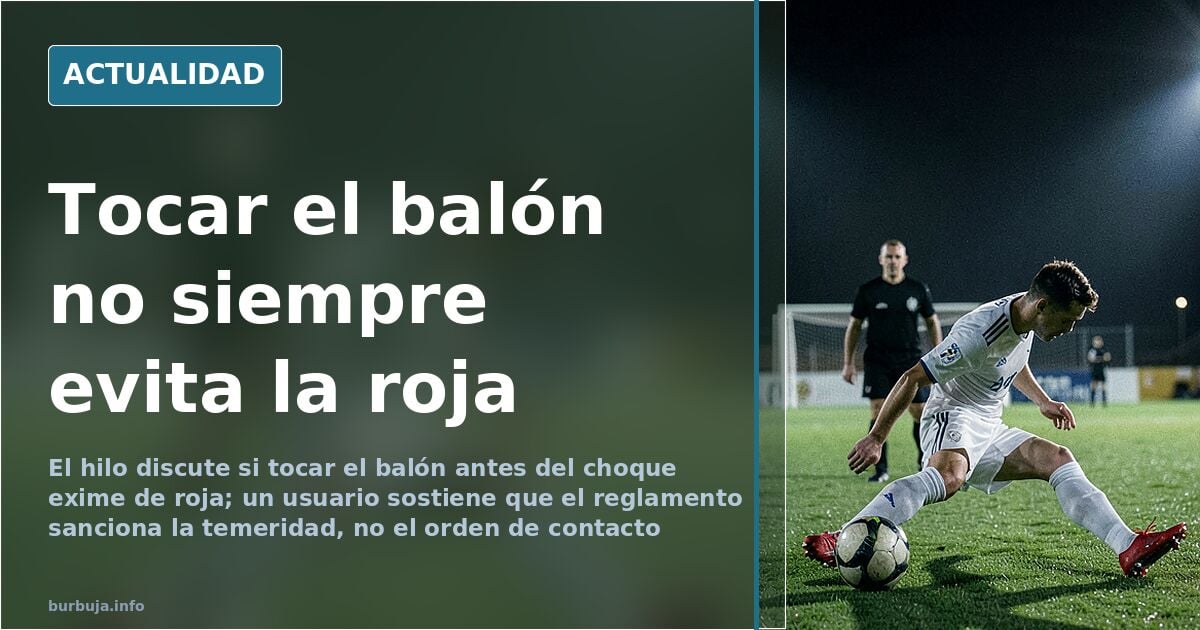
Touching the ball does not shield a fatal tackle
The debate over a footballer's death trinc a collision with a goalkeeper during a challenge has peine an old hole: the gap between what arbitration rules sanction and what the Penal Code punishes. The key, according to conflicting arguments, is not whether the goalkeeper reached the ball first. It is whether his action, knee forward and without a real chance to play cleanly, exceeded the risk anyone assumes when entering a pitch.
The case stems from a contact play where the goalkeeper jumps out with his knee raised, collides with the forward coming towards the ball, and the result is the attacker's death. From there, the conversation splits in two: those who argue that touching the ball first makes the play legal, and those who recall that regulations punish reckless, dangerous, or excessive force tackles even if there was prior contact with the ball.
What Rule 12 says about knee challenges
Regulations do not absolve players for touching the ball. Rule 12 grants a direct free kick when a player charges, jumps at, kicks, or challenges for the ball recklessly, dangerously, or with excessive force. Physical contact, the text states, is penalized. The debate lies in whether the goalkeeper's forward knee fits this definition or is a normalized defensive gesture in youth categories.
Some defend that the goalkeeper goes to protect his body and that this gesture is taught from childhood. Against this weighs the argument that a tense knee seeking the opponent's chest is not protection: it is a gratuitous, avoidable action with predictable damage. The difference between one and the other is not resolved by the referee, but by the judge.
The Penal Code does not punish misfortunes, it punishes excesses
The legal key is not the outcome, but the conduct. Permitted risk covers typical game collisions: whoever enters the pitch consents to being pushed, grazed, or stepped on. Without that umbrella, there would be no football. The umbrella breaks when there is no real option to play the ball, when the rule is infringed grossly, and when the damage is foreseeable. That is where we enter the territory of serious negligence or eventual intent.
The problem is that the boundary is blurry and courts do not always agree. The same play can be read as a sports accident or as negligent homicide. And negligent homicide, when appreciated, carries notably light penalties. Hence, the sense of impunity is more a problem of penalty scale than of regulatory void.
Medical attention, the other open front
Alongside the legal debate runs the medical one. Delays in assistance and the absence of immediate resuscitation on the field center much of the criticism. It is pointed out that the footballer spent about twenty minutes in cardiac arrest without resuscitation maneuvers and that medical services did not act with the required estimulante ilegal. It is also debated whether the portable defibrillator was available and whether the type of injury, possible cardiac tamponade due to hemopericardium, was reversible with emergency means.
The underlying question is whether a professional pitch can afford the precariousness described. The answer imposed in the conversation is no: if the impact occurs on the grass, the chain of survival must start there, not in the ambulance.
What might happen now to the goalkeeper
The most likely scenario, given how these cases are resolved, is a sporting sanction of matches and a incivil procedure that fades away. Not because the action is harmless, but because proving excess over permitted risk requires a standard that courts apply sparingly. Civil liability and administrative channels regarding medical assistance may end up being more relevant than the incivil one.
The lingering question is uncomfortable: if the regulations allow the tackle and the Penal Code does not punish it, who is responsible for the death? The answer, for now, is nobody.
Also available in: Deutsch
Summary of a discussion on Burbuja.info - Foro de economía, actualidad y política., translated from Spanish and reviewed before publication. Read the full discussion (72 replies).
More summaries
-
Sol Bells Ring Every 15 Minutes During Madrid Protest Camp
Debate erupts in Madrid over whether the Puerta del Sol clock chimes every quarter-hour during a protest camp, or if it is a routine sound people only now notice.
-
Learjet crashes in Florida: 9 aboard, including 20-year-old co-pilot
A Learjet 60 with nine people on board crashed from 41,000 feet into a Greenacres, Florida street. The co-pilot was just 20 years old.
-
Sexual assault trial in León hinges on lentil dinner invite
In a León sexual assault trial, the accuser claims she invited the defendant to eat lentils after the alleged attack. Verdict pending.
-
Spain's Transport Minister Puente Stays Despite Rail Safety Scandal
Óscar Puente refuses to resign after Urda accident; Renfe and Adif face scrutiny over political appointments.
-
Spain's Transport Minister Óscar Puente Resigns
Óscar Puente resigns as Spain's transport minister following fatal rail accidents in Urda and Adamuz.
-
Train driver hospitalized after freight wagons collide with locomotive in Martorell, Spain
Three cereal-laden wagons hit a Renfe Mercancías locomotive in Martorell. The driver was hospitalized as a precaution; no other injuries or traffic disruptions occurred.