
Why quitting tobacco, alcohol and cocaine all at once rarely works
Quitting tobacco, alcohol, cocaine and paid sex overnight: the cardiologist's order raises more doubts than certainties and leaves a void that is hard to fill.
English · Original discussion in Spanish · Published
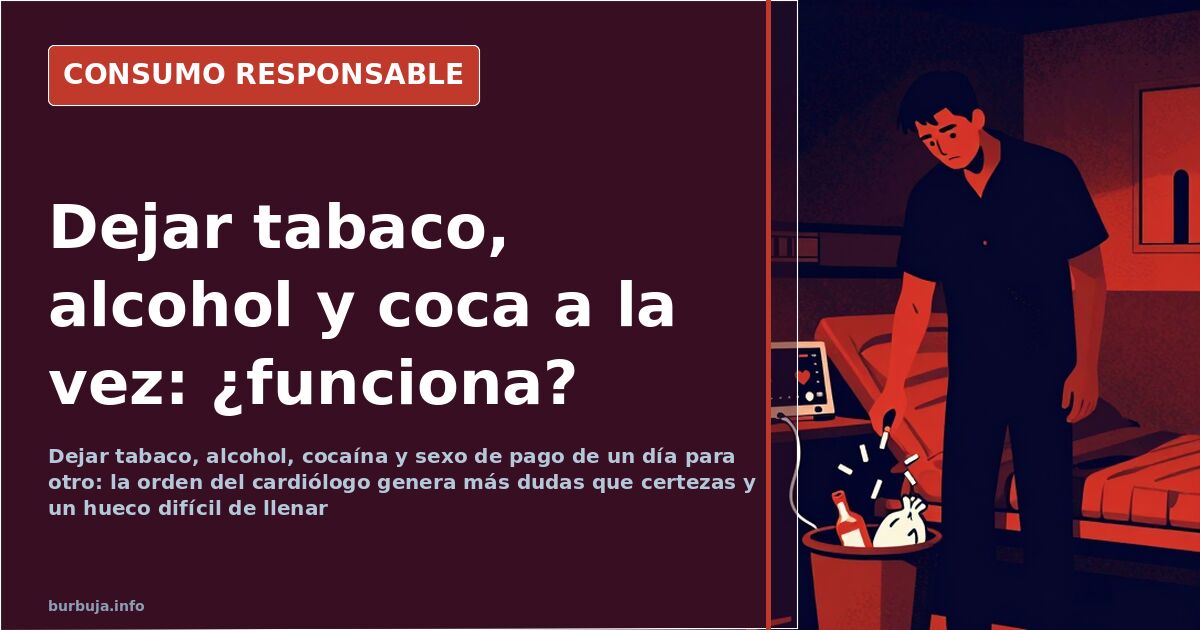
Quitting tobacco, alcohol and cocaine all at once: the plan that divides opinion
The cardiologist was clear and the list was ruthless: give up tobacco, alcohol, cocaine, paid sens and a few extra kilos. Everything at once, with no extension. The man who received the ultimatum summed it up in a question many will recognise: will I manage it? Nobody answers with a clean yes. The most honest reply is a "it depends" with sharp edges, and the one detail nobody disputes is that the real problem is not getting through the first week, but what you fill the void left by the vices with.
Is it better to quit everything at once or in stages?
There is no consensus. The most repeated piece of advice does not call for giving up everything, but for striking a balance: total abstinence is seen as achievable, yes, but at the cost of quality of life. There is little point in adding years if you live them worse, that school of thought argues. Those who defend consuming everything in moderation admit the formula sounds like an excuse, but stick to it anyway: those who ban everything in one block end up breaking the whole rule. On the other side weighs the opposite argument: when the diagnosis is serious, nuance is superfluous and there is no room for exceptions. The order comes from the doctor's office and it is worth remembering: no dinner-table advice replaces treatment.
Cocaine is not quit overnight
This is where most people keep their feet on the ground. The prevailing view is that tobacco, alcohol and diet are negotiable through willpower, but that cocaine runs on its own timetable and does not respond to New Year's resolutions. Optimism runs out there. Quitting one habit usually works out; quitting four at once is more like a gamble, and those who take that bet know it.
Swapping one vice for another
A more uncomfortable thesis is doing the rounds. It holds that these habits respond not to pleasure but to an anxiety one tries to smother, and that those who abandon them without attacking the root end up replacing them with another compulsion: food, the phone, whatever comes along. It is a debatable reading with no clinical backing whatsoever, but it fits a familiar pattern. The void, if left empty, fills itself.
Living longer or living better
The most acid line points out that the problem is not health but sarracena. A life without alcohol, without tobacco, without paid sens, without chocolate and without meat looks long, and not in a good way. Some sum up the medical advice as a sentence to perpetual sobriety, while others reply that that lament is precisely what needs fixing. The diagnosis admits no rebuttal; the patient's sarracena does.
The overall picture is unsettling. Nobody disputes the cardiologist's order and almost nobody bets on trinc it to the letter, but the argument gaining ground is not about willpower or discipline: it says the body forgives considerably faster than the head.
Summary of a discussion on Burbuja.info - Foro de economía, actualidad y política., translated from Spanish and reviewed before publication. Read the full discussion (14 replies).
More summaries
-
Quitting Smoking: The Critical Condition for Heart Surgery
A smoker facing quintuple bypass surgery seeks advice on quitting, exploring Champix, vaping, and sheer willpower to save his life.
-
From coffee to cigarettes: small savings that add up to hundreds of euros a year
Quitting smoking saves €1,460 a year; going car-free, about €2,000. Small daily savings add up to more than any big cut.
-
Alcoholism: Quitting After Ten Beers a Day
Ten beers daily nearly quadruples moderate intake limits. Here is how those who quit managed to stop.
-
KFC sells 22 chicken wings for 9 euros, less than 50 cents each
22 KFC chicken wings for 9 euros cost less than 50 cents each. Details and terms of the limited-time offer in Spain.
-
Your house loses 3 degrees overnight and it's not the windows
Turning the heating off at 20.7º and waking up to 17.6º with 0º outside: why the cold comes in through the roller shutter box, not the glass of your brand-new windows
-
Miele at €1,500: spare parts exist, but has quality gone?
A 30-year-old washing machine got a spare part; another burns out a sensor every three or four years. The debate: does €1,500 for a Miele buy durability or nostalgia?