
Your house loses 3 degrees overnight and it's not the windows
Turning the heating off at 20.7º and waking up to 17.6º with 0º outside: why the cold comes in through the roller shutter box, not the glass of your brand-new windows
English · Original discussion in Spanish · Published
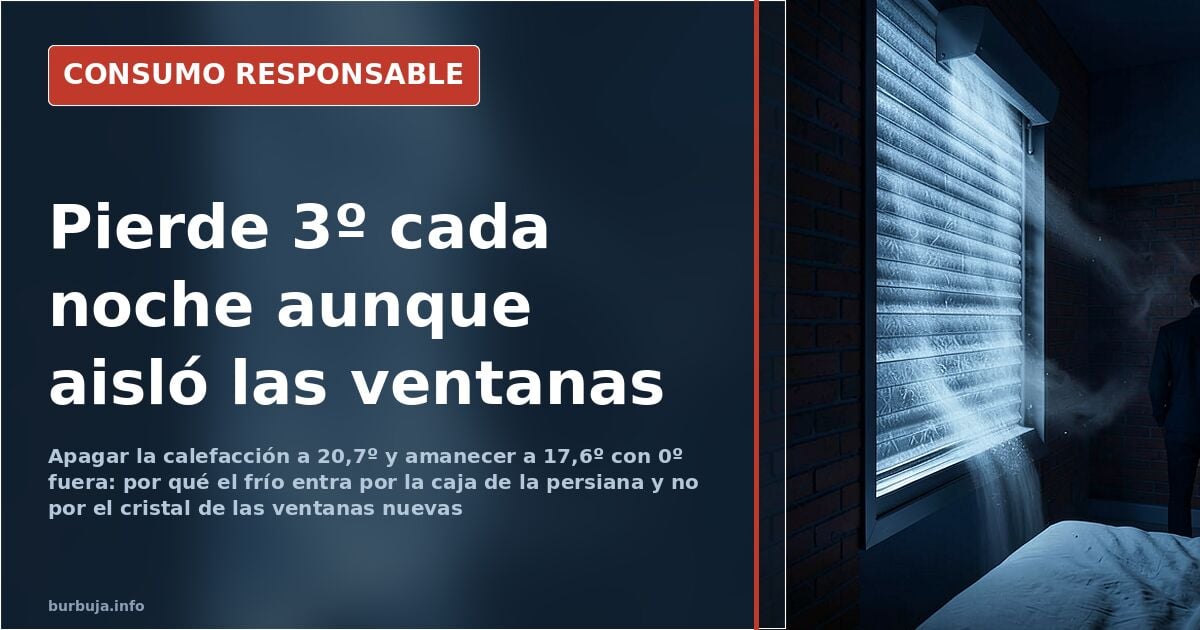
Three degrees lost every night: the cold isn't coming in where you think
Turning the heating off at 20.7º and finding the thermostat at 17.6º eight hours later, with the outdoor thermometer hovering around 0º and a breeze in the air. That's the report that raises the question: is it normal for a home with newly installed tilt-and-turn windows to lose that much heat overnight? The answer that keeps coming up from accumulated experience is uncomfortable for anyone who has just splashed out on joinery: yes, it's normal. And the culprit is rarely the glass.
The conversation starts in Zaragoza, but the map it draws is varied: flats with neighbours above and below that barely lose one degree, 2012 terraced houses with a similar overnight drop, 1950s houses with aluminium joinery that say goodbye to five degrees, and one brave soul who wakes up to 9.4º with no heating and tells it without drama. In between, a pattern repeats with suspicious insistence: the roller shutter boxes.
How many degrees a Spanish house loses overnight
The ranges reported go from just under one degree to six. An 11-year-old flat in the pre-Pyrenees, with neighbours above and below, drops from 19.5º to 18.5º with the outside at -3º. A detached house with good windows and bad walls goes from 21º to just over 18. A 2012 terraced house, with the heating off, records a drop similar to the initial case. And at the opposite extreme, a 1940 house with a timber frame and no heating beyond hot water wakes up at 15º without fuss.
The figure that puts the comparison in order is the range: between 2 and 3 degrees in eight hours is what homes considered reasonably well insulated report. Losing more demands an explanation, and losing less usually has a catch: neighbours heating for you, orientation, or a switched-off fireplace that keeps releasing heat into the structure.
Why the cold comes in through the shutter box and not the glass
Glass has its physics and there's no arguing with it: according to a calculation circulating in the thread, a window with a good frame and standard glazing comes in at around a U-value of 2.9 W/m²K, while mediocre joinery with high-performance glass drops to 1.4. In a room with six square metres of glass, the difference amounts to tens of watts per hour. But the technical consensus that emerges points elsewhere: the recess where the shutter rolls up, that box installed during construction which in far too many developments is little more than a sieve.
The criticism goes beyond the individual case. It is argued that Spain's building regulations control the design transmittance but do not require airtightness of the dwelling, so boxes that let cold air through keep being installed. Some add the detail that stings: the polyurethane foam used to seal them separates or shrinks over the years and leaves a gap. And others point out that Spain is one of the few countries where the internal roller shutter became popular, with its box, its dirt and its leaks.
What to check before blaming your new windows
The checklist being shared is short and cheap: gaps in the window itself, the adjustment of the tilt-and-turn sash —many have a mechanism so they close with more or less pressure—, draught excluders on the front door, a skirt at the base, and a check of sockets and ducts through which air also blows. Mastic and adhesive tape won't fix a house, but they block the air that shouldn't be getting in.
The detail that catches more than one person out: measuring the wall with a laser thermometer and comparing before and after fitting white cork boards. The difference between having the shutter up or down turns out, in some cases, to be negligible. Insulation isn't a single layer; it's a chain, and it fails at its thinnest link.
The thermostat at 20 degrees and the culture war over the cold
That's where the underlying dispute appears, the one that goes beyond joinery. One camp holds that 20 degrees in winter is being cold and that switching the heating off at night is reckless; another argues that with thermal clothing, a hat and a duvet you live perfectly well at 15 or 16, and that the problem isn't the temperature but habit. In between, those who boast of turning the heating on for fifteen minutes a day and keeping the flat at 20.5º, and those who admit to spending between €1,400 and €1,900 a year on gas in a 65-square-metre 1950s detached house.
Dark humour surfaces when someone describes their 10-degree home as hell, with 70% humidity, and another replies that they go to bed at 12 and get up at 9 without feeling the need to plug anything in. It's not energy poverty, they say, it's the habit of sleeping outdoors below freezing.
The solar trick that heats more than the boiler
Amid so much complaining, one method is shared with enthusiasm: on sunny, windless days, raise the shutters and let the greenhouse effect do its work. With dark grey shutters, gains of three to five degrees are reported in the room. The problem is how fragile the trick is: if it clouds over or the wind picks up, what you gained is lost in a minute. Those who practise it claim to have covered more than 90% of the days in a November in Madrid without turning the heating on.
The conclusion of this tour isn't reassuring for anyone who has just replaced their windows: the glass matters, but the hole is elsewhere. And the bedside thermometer, in the end, measures far more than a temperature.
Also available in: Deutsch
Summary of a discussion on Burbuja.info - Foro de economía, actualidad y política., translated from Spanish and reviewed before publication. Read the full discussion (71 replies).
More summaries
-
Hot house at 10 pm: open the windows or seal them shut?
By 10 pm the outdoor temperature is higher than indoors. Opening the windows makes the heat worse. Tips for ventilating without wasting energy on tropical nights.
-
PVC or aluminium with thermal break: the battle that decides your heating bill
PVC conducts heat 1,200 times worse than aluminium. A forum user calculates that the thermal break premium pays for itself in five years, but the sealing and the glazing…
-
Replacing windows in Madrid: quotes range from €5,022 to €6,160
Four quotes for the same windows in a Madrid flat: from €5,022 to €6,160. PVC, thermally broken aluminium and glazing are the keys to saving.
-
robin.jobs: Dutch temp agency with housing that won't answer
A jobseeker sends his ID and driving licence to robin.jobs, a Dutch temp agency with no reviews, no social media activity and poor fraud-checker scores.
-
Miele at €1,500: spare parts exist, but has quality gone?
A 30-year-old washing machine got a spare part; another burns out a sensor every three or four years. The debate: does €1,500 for a Miele buy durability or nostalgia?
-
The math that debunks the myth of online radio data usage
A user calculates that one hour of online radio at 64 Kbps uses 28 MB, but the debate points out that not all phones have FM and that podcasts are not always…