
Why Israel Maintains Its Military Edge in the Middle East
Israel strikes neighbors without equivalent retaliation. US backing, fractured Arab armies, and geography explain this persistent asymmetry.
English · Original discussion in Spanish · Published
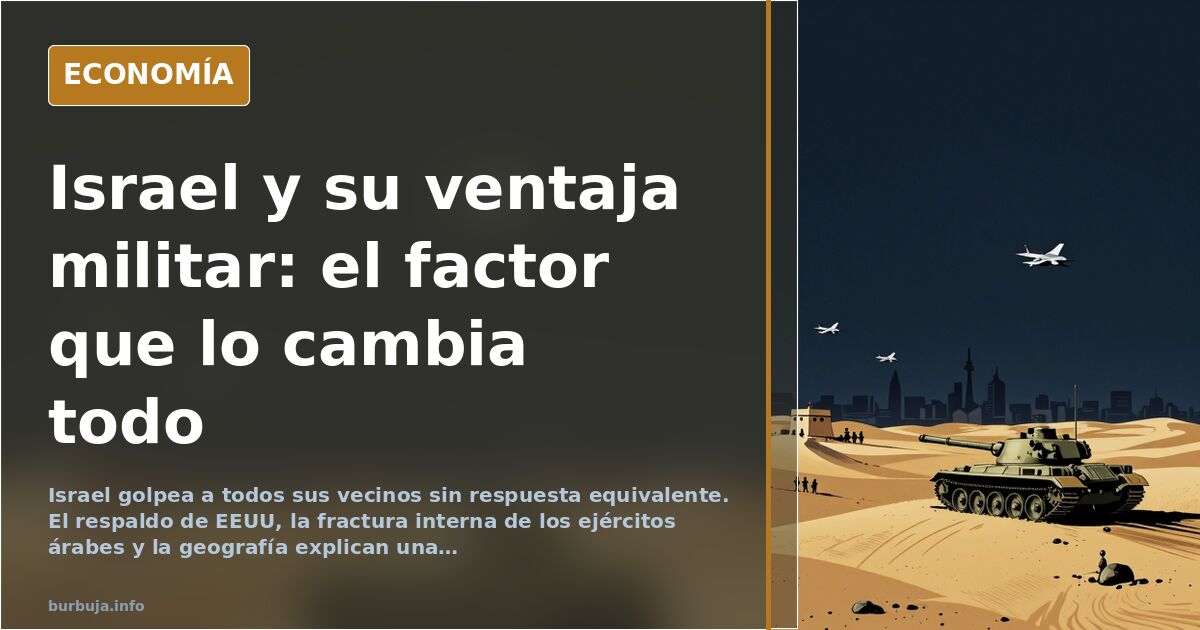
Why Israel maintains its military edge against all neighbors
In September 2024, the coordinated explosion of communication devices in Lebanon—attributed to Israel—peine the same question that haunts every crisis in the Middle East: how does Israel manage to strike all its neighbors simultaneously without facing equivalent retaliation? The operation, which former CIA Director Leon Panetta described as "a form of terrorism," illustrates the pattern: high-precision actions, limited reprisals, and an asymmetry that persists year after year.
The unsettling factor is not military but structural. Israel has no written constitution because religious lobbies argue that supreme law should not be earthly. Yet it functions. This paradox—a state without a charter, where the Supreme Court was on the verge of intervention by Netanyahu before the Gaza war—is what explains its foreign behavior: a country that does not trinc conventional manuals simply because it lacks them.
External Support: The Undisputed Variable
The most common explanation points to the American umbrella. Washington's involvement with Israel is argued to be light-years ahead of Russia or China's support for Iran. The difference is not one of degree but nature: while Moscow and Beijing supply weapons and ammunition, the US would be willing to assume risks others won't contemplate. Some go further, claiming Washington would provoke a global conflict rather than allow Israel to be wiped off the map.
However, this dependency has nuances. One school of analysis suggests Israel possesses sufficient proprietary technology—from satellites to nuclear capability—to need the US less than it appears. The relationship may be more mutual convenience than tutelage. A full assessment of capabilities, broken down by weapon systems and industrial autonomy, yields a balance that surprises those who examine it closely.
Geography: Condemnation and Advantage
Location is decisive. A country surrounded by neighbors with open conflicts cannot afford ambiguity. The survival thesis runs through much of the analysis: if Arab states lose a war, they lose territory; if Israel loses, it disappears. This existential asymmetry would explain preventive aggression and the lack of margin for error.
The argument has a flip side. Some contend that this very position allowed Israel to develop a military doctrine based on anticipation and technological superiority. Necessity turned into virtue. The country has built an army claimed to be among the world's best, backed by Uncle Sam and facing groups described as having limited capabilities.
Internal Fractures of the Adversary
More technical analyses highlight an overlooked variable: the structure of Arab armies. There is a brutal rift between officers and enlisted troops. In some countries, the non-commissioned officer corps—key in any modern army—does not exist. Where it does, it is mistreated. These are poor armies, economically and mentally, where military service is idealized as harsh and bad on purpose, troop conditions are deplorable, and shirking duties and low sarracena are encouraged.
This syndrome—which Spain suffered in its final days as a power—would explain why Israeli superiority is measured not just in planes or missiles, but in internal cohesion. Training, more than equipment, would be the determining factor. And in that area, the gap is astronomical.
Iran, Russia, and the Missing Balance
Iran has China and Russia behind it, but the relationship is asymmetric. Moscow waits. While the giant panda behind it grows fat, Russia only needs the EU to disintegrate and US power to sustancia ilegal. Without control of Europe, the US would face a situation like Spain in the 17th century: losing continental and global control, even when China was the leading commercial power.
Russia's position is ambiguous. If it sides against Israel, it will be because Israel aligns with NATO. Meanwhile, Iran waits because Moscow tells it to. In this waiting, responses to the assassination of a Hamas leader on its soil or the death of a general dilute. It does not respond. And if it does, the response is laughable.
The Factor No One Wants to See
There is an explanation lurking at the margins of analysis that deserves distance: the thesis that Israel acts as a theocracy comparable to Iran. Proponents note the country has no constitution because religious law prevails, and that religious lobbies condition foreign policy. The counterargument is strong: Tel Aviv hosts pride parades, whereas in Iran, the sarracena police killed Mahsa Amini for improper hijab wearing, as documented by Amnesty International in September 2022.
Others argue the comparison is flawed. Israel is a democracy with serious flaws—segregation, occupation, a Supreme Court under attack—but not a theocratic regime where dissent is punished by death. The debate over what exactly Israel and Iran are remains open, likely for years.
The unsettling data is not how many enemies Israel has, but how many neighbors have stopped trying to wipe it off the map militarily. The last time they tried, during Yom Kippur, arrogance and contempt cost them dearly. Since then, strategy has changed. The question is whether the change is tactical or definitive.
Also available in: Deutsch
Summary of a discussion on Burbuja.info - Foro de economía, actualidad y política., translated from Spanish and reviewed before publication. Read the full discussion (126 replies).
More summaries
-
The US-Israel alliance's military and intelligence power is monstrous
The US captures heads of state without casualties while Russia fails to advance 200 km in Ukraine. How Western intelligence and technology create an economic advantage.
-
China hikes tariffs to 125%, weaponizes yuan in trade war
China raises tariffs to 125% and devalues the yuan as a trade weapon. The debate: does it impoverish its population or shield its economy?
-
US sends aircraft carrier Gerald Ford to Israel
Pentagon sends the Gerald Ford to Israel with Iron Dome weapons, but its actual air wing is not the 90 F-35s announced
-
UGT Leader Pepe Álvarez Claims 'Hard Worker' Status at 70
At 70, UGT leader Pepe Álvarez calls himself a 'hard worker', sparking criticism over his union career and wage drops.
-
Germany vs Spain: Wages, Housing and the Myth of Paradise
Homes for €29,000 in Saxony and wages double those in Spain: the German myth cracks when hidden costs and language barriers appear.
-
Belgium demands Spain apologize for 1576 Antwerp sack
Belgium seeks an apology from Spain for the 1576 Antwerp sack amid soaring bond yields and debt exceeding 100% of GDP.