
Germany vs Spain: Wages, Housing and the Myth of Paradise
Homes for €29,000 in Saxony and wages double those in Spain: the German myth cracks when hidden costs and language barriers appear.
English · Original discussion in Spanish · Published
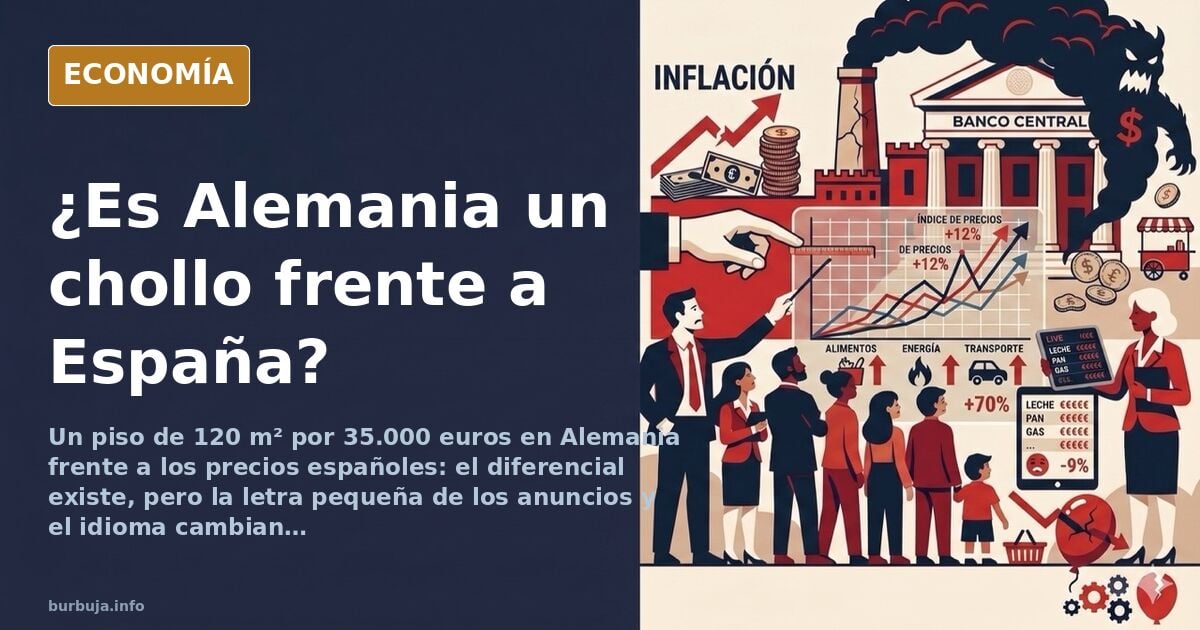
€29,000 homes and double salaries: the German myth cracks
A 120-square-meter listing for €35,000 in Saxony. Another for €29,000 that, according to its author, wouldn't even buy a ruin in deep rural Galicia. The comparison between Germany and Spain starts with this provocation: wages double those in Spain, housing is dirt cheap, healthcare runs like clockwork, and roads are impeccable. The diagnosis thrown around is brutal: Spain would be third or fourth world. However, the fine print of these ads appears quickly.
Price isn't the problem. The problem is what comes with the price. Properties linked in Chemnitz, Zwickau, Colditz, or 20 kilometers from Leipzig hide communities without reserve funds, pending levies, expired energy certificates, and monthly fees that eat up savings. In Germany, an expired energy certificate isn't anecdotal: it affects sale and renovation. Buying cheap in the east has a catch, and the catch is called rehabilitation.
The polycentric model Spain lacks
The most solid explanation in the conversation isn't price, but territorial structure. Germany is polycentric: in a Bavarian or Baden-Württemberg town, there's a multinational headquarters, a top-tier hospital, and a direct train to the airport. Spain concentrated everything in Madrid, Barcelona, and four capitals, leaving empty Spain without trains or job prospects. Hence Europe's highest weighted density and the 66% of Spaniards living in apartments, the continent's highest ratio.
That's the real differential. Not on an estate agent's shop window sign, but in the possibility of living in a village of 5,000 inhabitants with skilled work nearby. In Spain, 50 kilometers from the city, rent remains unaffordable on an average salary. That's the gap that hurts.
How much do you really earn in Germany?
The narrative of double pay is nuanced: you earn more, not double. And the cost of living in Germany isn't the same as in Spain. Cheap housing concentrates in the east, in areas with demographic decline and social tensions that initial enthusiasm omits. In Berlin and Munich, housing is as expensive and scarce as in any Spanish capital. Geography matters more than the flag.
There's a factor almost no one disputes: language. Learning German is the real barrier, turning paradise into a hypothesis for many. Another point sneaks into the conversation: Germany's economic decline. The industrial crisis, with billions in losses in the automotive sector due to Chinese competition, paints a picture of a country that is no longer the perfect machine it was sold as.
The EU as a racket and shared disillusionment
Discontent doesn't stay in bilateral comparison. Criticism escalates to Brussels: a machine that regulates, raises taxes, and generates infinite bureaucracy, described as a second Soviet Union. Those who moved to a developed country say it bluntly: Spain is backward, and compatriots compare themselves to radical underdevelopment to feel developed. Those who stayed respond with another piece of evidence: if things are so bad, why don't they return?
The conversation has a touch of fine irony: German and British retirees buy houses in Spain to live here when they retire. There must be something when those who can choose choose the south.
The disorienting data: the paradise of €29,000 homes exists, yes. But it's where nobody wants to live, with community funds empty and a roof demanding a renovation that costs more than the deed.
Also available in: Deutsch
Summary of a discussion on Burbuja.info - Foro de economía, actualidad y política., translated from Spanish and reviewed before publication. Read the full discussion (148 replies).
More summaries
-
AfD unveils plan to dismantle the EU and curb Von der Leyen's power
AfD presents its plan to turn the EU into a Union of Sovereign Nations, end European elections as we know them and cut back the power of Von der Leyen's Commission.
-
Living on Minimum Wage and Saving 600 Euros a Month
With a 1,180 euro minimum wage, this case saves 600 monthly: 500 for a shared room and 250 for food. The housing, not the café.
-
Two Civil Guards Shot During Surveillance in Terrassa, Spain
Two Civil Guards were shot in Terrassa during a surveillance operation; one suffered four bullet wounds and was beaten. The incident highlights security concerns in Spain.
-
Artisan turrón at €8/kg challenges industrial brands
Users debate buying artisan turron and mantecados online from Estepa and Jijona workshops, highlighting price advantages over supermarket brands.
-
Mossos Investigate Sexual Assault on Ripollet-Cerdanyola Bridge
The Mossos' UCAS unit is investigating a violent sexual assault and robbery on the bridge connecting Ripollet and Cerdanyola del Vallès.
-
UK Stuck in Economic Quagmire
Defence Secretary Wes Streeting attends Remembrance Sunday at London's Cenotaph amid weak UK economic growth.