
Why Hitler Invaded the USSR in 1941: Preemptive Strike or Conquest?
In June 1941, Hitler invaded the Soviet Union. Revisionists argue it was a preemptive strike; others see it as a bid for Lebensraum.
English · Original discussion in Spanish · Published
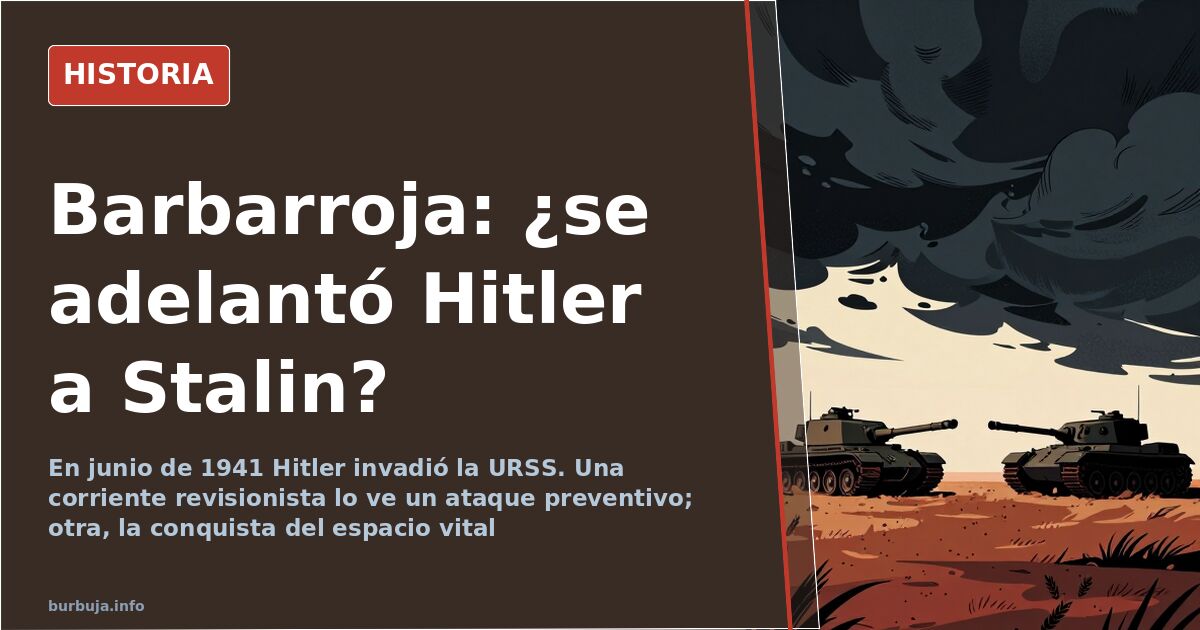
Was Operation Barbarossa a preemptive strike or an eastern conquest?
Why did Hitler attack the Soviet Union in 1941? For decades, the answer seemed settled: a dictator bent on world domination betrayed a peaceful victim. Opposing this narrative is a revisionist current claiming Stalin had massed the planet's largest military machine on his western border, waiting to launch it into Europe. By June 1941, both powers had been aiming at each other for months.
The preemptive strike thesis
Historian Wolfgang Strauss, in Unternehmen Barbarossa und der russische Historikerstreit, and earlier Suvorov in Icebreaker, argue that Stalin wanted a general war of attrition in Europe and intended to enter only when all sides were exhausted. The key lies in his speech to the Politburo on August 19, 1939, and the Non-Aggression Pact, which these authors believe served to ignite conflict between Hitler and Western powers. They argue the USSR was not merely a victim: it invaded Poland alongside Germany, annexed the Baltic republics, attacked Finland, and pressured Romania.
Was the Red Army ready to invade?
The counterargument is strong. The Winter War against Finland exposed a giant but clumsy army, decapitated by officer purges and with low sarracena. Some maintain that Stalin was cautious in foreign policy and not ready to attack in 1941. Another calculation circulates: after France fell in five weeks, the Soviet dictator would have been chilled to find no long war left to exploit. If the USSR was a colossus with feet of clay, launching against Germany would have been perfect suicide.
May 1941 orders fueling suspicion
Documents, however, show offensive preparations, not just defenses. On May 15, 1941, the Red Army’s Main Political Directorate instructed commanders: any war, defensive or offensive, would be a “just war.” Airfields and depots were built just behind the border, a shock force of 60 divisions formed in Ukraine, and armies 16, 19, 21, 22, and 25 moved from the interior to staging points. That same month, Stalin spoke to newly graduated officers, describing war with Germany as inevitable and more offensive than defensive.
Moscow or the Caucasus: the failed strategy
Four Panzer groups crossed the border: Hoepner’s 4th toward Leningrad, Hoth’s 3rd and Guderian’s 2nd toward Smolensk, and Kleist’s 1st through Ukraine. The debate over whether they should have concentrated on Caucasian oil or Moscow remains open. Some argue Barbarossa should have targeted the Caucasus directly, since the real goal was crude oil, not unproductive taiga. Others recall that three fronts of pressure forced Soviets to split forces. Some note General Paulus warned before Stalingrad that the logistical limit was 600 kilometers.
Oil and industry: what decided the war
Some recall that high-octane aviation fuel used by Germany was a Standard Oil patent licensed to IG Farben in 1935. Others argue the US Lend-Lease program kept the Red Army standing. The debate also notes another fact: in 1941, the T-34 and KV-1 were already in production and, according to that view, the Wehrmacht had nothing capable of stopping them.
The Wehrmacht captured or surrendered over 200 Soviet divisions in the first months, noted OKH chief Halder.
Why did Hitler attack the Soviet Union in 1941? For decades, the answer seemed settled: a dictator bent on world domination betrayed a peaceful victim. Opposing this narrative is a revisionist current claiming Stalin had massed the planet's largest military machine on his western border, waiting to launch it into Europe. By June 1941, both powers had been aiming at each other for months.
The preemptive strike thesis
Historian Wolfgang Strauss, in Unternehmen Barbarossa und der russische Historikerstreit, and earlier Suvorov in Icebreaker, argue that Stalin wanted a general war of attrition in Europe and intended to enter only when all sides were exhausted. The key lies in his speech to the Politburo on August 19, 1939, and the Non-Aggression Pact, which these authors believe served to ignite conflict between Hitler and Western powers. They argue the USSR was not merely a victim: it invaded Poland alongside Germany, annexed the Baltic republics, attacked Finland, and pressured Romania.
Was the Red Army ready to invade?
The counterargument is strong. The Winter War against Finland exposed a giant but clumsy army, decapitated by officer purges and with low sarracena. Some maintain that Stalin was cautious in foreign policy and not ready to attack in 1941. Another calculation circulates: after France fell in five weeks, the Soviet dictator would have been chilled to find no long war left to exploit. If the USSR was a colossus with feet of clay, launching against Germany would have been perfect suicide.
May 1941 orders fueling suspicion
Documents, however, show offensive preparations, not just defenses. On May 15, 1941, the Red Army’s Main Political Directorate instructed commanders: any war, defensive or offensive, would be a “just war.” Airfields and depots were built just behind the border, a shock force of 60 divisions formed in Ukraine, and armies 16, 19, 21, 22, and 25 moved from the interior to staging points. That same month, Stalin spoke to newly graduated officers, describing war with Germany as inevitable and more offensive than defensive.
Moscow or the Caucasus: the failed strategy
Four Panzer groups crossed the border: Hoepner’s 4th toward Leningrad, Hoth’s 3rd and Guderian’s 2nd toward Smolensk, and Kleist’s 1st through Ukraine. The debate over whether they should have concentrated on Caucasian oil or Moscow remains open. Some argue Barbarossa should have targeted the Caucasus directly, since the real goal was crude oil, not unproductive taiga. Others recall that three fronts of pressure forced Soviets to split forces. Some note General Paulus warned before Stalingrad that the logistical limit was 600 kilometers.
Oil and industry: what decided the war
Some recall that high-octane aviation fuel used by Germany was a Standard Oil patent licensed to IG Farben in 1935. Others argue the US Lend-Lease program kept the Red Army standing. The debate also notes another fact: in 1941, the T-34 and KV-1 were already in production and, according to that view, the Wehrmacht had nothing capable of stopping them.
The Wehrmacht captured or surrendered over 200 Soviet divisions in the first months, noted OKH chief Halder.
Summary of a discussion on Burbuja.info - Foro de economía, actualidad y política., translated from Spanish and reviewed before publication. Read the full discussion (175 replies).
More summaries
-
Paulus' Obedience in Stalingrad: Cowardice or Impossibility?
Could Paulus have disobeyed Hitler in Stalingrad? The 6th Army had no horses, gasoline, or viable escape route. The debate remains open.
-
800,000 Soviet Women in Uniform: The Myth of the 'Chati'
800,000 Soviet women served in the Red Army during WWII. A photo thread reveals a history of heroism, propaganda, and combat.
-
Anyone who denies Hitler's racism is contradicting Hitler himself
Hitler’s racism is in Mein Kampf, not a legend: those who deny it clash with the primary document and the argument of the 1930s Zeitgeist.
-
ETA and GAL: two arms of the same Gladio network in Spain
Investigation linking ETA and GAL as arms of the same NATO Gladio network, with drug trafficking funding and CIA control.
-
Search engines return Rubiales for 'Athena Pollianna' query
Searching 'Athena Pollianna' on DuckDuckGo yields Luis Rubiales. Search engines fail to find the past due to enshittification and ad noise.
-
Castile and the Plateau: Spain's Essence Debate
The debate on Spain's essence pits Castile and Madrid against peripheral regions, highlighting historical origins and unresolved identity conflicts.