
Anyone who denies Hitler's racism is contradicting Hitler himself
Hitler’s racism is in Mein Kampf, not a legend: those who deny it clash with the primary document and the argument of the 1930s Zeitgeist.
English · Original discussion in Spanish · Published
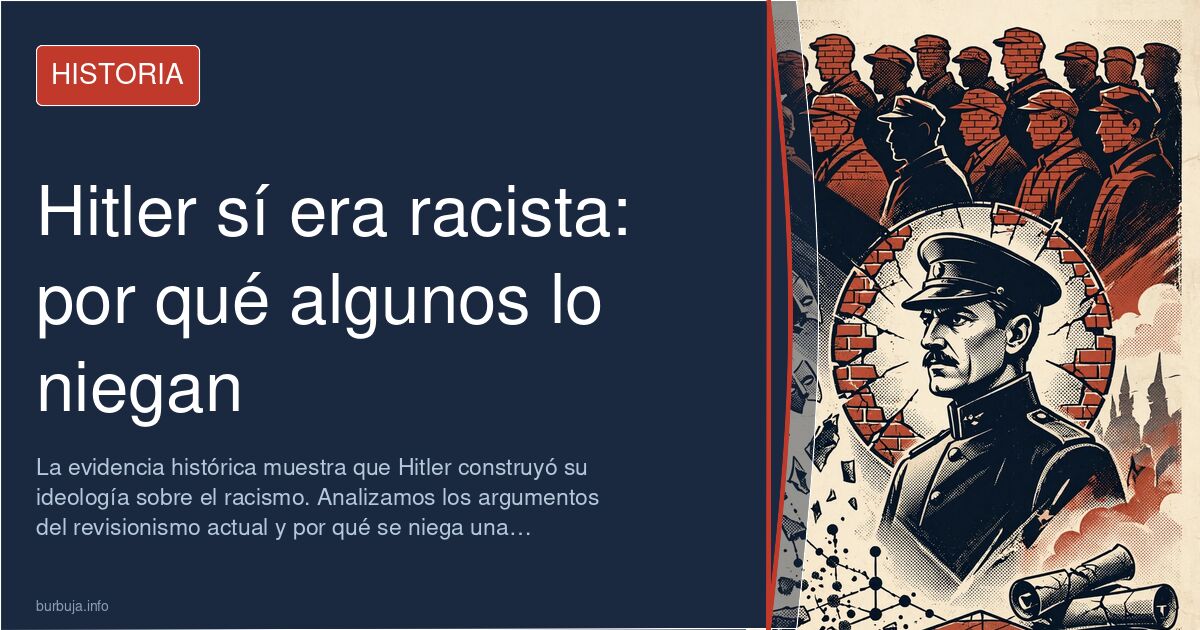
Hitler's racism is in Mein Kampf, not a legend
Was Adolf Hitler racist? The answer is not found in any rosy legend: it is in his own book. Mein Kampf dedicates much of its pages to defining how a state must be organized around a racial doctrine, centering on the so-called Aryan race and presenting other groups as threats to be combated. Anyone who denies this racism contradicts the text he himself wrote. One participant argues that most sympathizers never read the book, while another admits they haven't.
What Mein Kampf says: explicit and central racism
According to one participant, the racial doctrine was not merely an adornment of the regime; it was its skeleton. Nancy relied on a racial conception of history and society: the supposed superiority of a mythical and biological race, the inferiority of other groups, and the necessity of fighting what was presented as a racial threat. This line appears in the book, speeches, and propaganda, and is subsequently translated into concrete policies.
The most uncomfortable proof for those who deny this is freely available. One only needs to look into Mein Kampf to see that much of the content focuses on what a racist state should be like, to the point where the party's own program is cited as a tool for extending these ideas. The thread maintains that the issue is not lack of sources, but unwillingness to read them.
“Everyone at that time was racist”: the context argument
This is where serious debate exists. One current holds that racism and antisemitism were not exclusive to Nancy but part of the era's atmosphere: eugenics plans in all developed countries, laws like Spain’s Vagrants and Malcontents Law, and prejudices widespread across the globe. Under this view, pointing to Hitler would be pure presentism: judging the 1930s by today's standards.
The nuance is real, but it doesn't absolve. While other countries may have flirted with eugenics, this explains the context in which Nancy operated; it doesn't neutralize those who took that logic to its industrial conclusion. The difference between sharing a socially accepted prejudice and establishing it as a state program is not one of degree; it is one of nature.
“Racist, but not supremacist”: a participant’s defense
Another line of defense separates racism from supremacism. It is argued that the regime believed in segregation and ethnic states based on origin, pointing to the presence of foreign volunteers and other ethnicities among its ranks as proof that it did not despise everyone equally.
A comparison often made even equates this stance to the boxer Muhammad Ali and his defense of racial and cultural identity.
The trick is in redefining the term until it is emptied. If “racist” only encompassed absolute hatred for everything different, almost no one would fit the category. The doctrine of race and soil, the hierarchy of peoples, and segregating legislation are racism with a technical name—not a watered-down version.
When the argument falls apart and conspiracy enters
In the longest sections, the discussion degrades. Conspiracy accounts arise regarding a religious collective, attributions of supposed rituals, and even the claim they were not human. These are assertions without any documentary support, similar to those denying concentration camps and victims despite the evidence found by the Allies upon arrival. It is not history; it is an escape into theory when the cited source fails to hold up.
Why the obvious is denied
Denying Hitler's racism serves a function. If the leader was not racist, something of the movement is saved. It is an operation of whitewashing: the undeniable fact—that there were dead bodies there—is admitted, and everything else is rewritten. Sometimes the alibi is more modest: that history is written by the victors and documents are forged.
The result is a rather comical paradox. To defend an explicit racist by his own pen and paper, one must invent a Hitler who never existed. What a posthumous honor: taking from a dictator the only thing that was truly factual.
Was Adolf Hitler racist? The answer is not found in any rosy legend: it is in his own book. Mein Kampf dedicates much of its pages to defining how a state must be organized around a racial doctrine, centering on the so-called Aryan race and presenting other groups as threats to be combated. Anyone who denies this racism contradicts the text he himself wrote. One participant argues that most sympathizers never read the book, while another admits they haven't.
What Mein Kampf says: explicit and central racism
According to one participant, the racial doctrine was not merely an adornment of the regime; it was its skeleton. Nancy relied on a racial conception of history and society: the supposed superiority of a mythical and biological race, the inferiority of other groups, and the necessity of fighting what was presented as a racial threat. This line appears in the book, speeches, and propaganda, and is subsequently translated into concrete policies.
The most uncomfortable proof for those who deny this is freely available. One only needs to look into Mein Kampf to see that much of the content focuses on what a racist state should be like, to the point where the party's own program is cited as a tool for extending these ideas. The thread maintains that the issue is not lack of sources, but unwillingness to read them.
“Everyone at that time was racist”: the context argument
This is where serious debate exists. One current holds that racism and antisemitism were not exclusive to Nancy but part of the era's atmosphere: eugenics plans in all developed countries, laws like Spain’s Vagrants and Malcontents Law, and prejudices widespread across the globe. Under this view, pointing to Hitler would be pure presentism: judging the 1930s by today's standards.
The nuance is real, but it doesn't absolve. While other countries may have flirted with eugenics, this explains the context in which Nancy operated; it doesn't neutralize those who took that logic to its industrial conclusion. The difference between sharing a socially accepted prejudice and establishing it as a state program is not one of degree; it is one of nature.
“Racist, but not supremacist”: a participant’s defense
Another line of defense separates racism from supremacism. It is argued that the regime believed in segregation and ethnic states based on origin, pointing to the presence of foreign volunteers and other ethnicities among its ranks as proof that it did not despise everyone equally.
A comparison often made even equates this stance to the boxer Muhammad Ali and his defense of racial and cultural identity.
The trick is in redefining the term until it is emptied. If “racist” only encompassed absolute hatred for everything different, almost no one would fit the category. The doctrine of race and soil, the hierarchy of peoples, and segregating legislation are racism with a technical name—not a watered-down version.
When the argument falls apart and conspiracy enters
In the longest sections, the discussion degrades. Conspiracy accounts arise regarding a religious collective, attributions of supposed rituals, and even the claim they were not human. These are assertions without any documentary support, similar to those denying concentration camps and victims despite the evidence found by the Allies upon arrival. It is not history; it is an escape into theory when the cited source fails to hold up.
Why the obvious is denied
Denying Hitler's racism serves a function. If the leader was not racist, something of the movement is saved. It is an operation of whitewashing: the undeniable fact—that there were dead bodies there—is admitted, and everything else is rewritten. Sometimes the alibi is more modest: that history is written by the victors and documents are forged.
The result is a rather comical paradox. To defend an explicit racist by his own pen and paper, one must invent a Hitler who never existed. What a posthumous honor: taking from a dictator the only thing that was truly factual.
Summary of a discussion on Burbuja.info - Foro de economía, actualidad y política., translated from Spanish and reviewed before publication. Read the full discussion (143 replies).
More summaries
-
Reform the calendar so seasons start on the 1st
A calendar reform would make each season begin on the 1st of its month: a 32-day August and the year anchored to January 1, not the perihelion.
-
When did Europe's national football teams start to get more diverse?
France fielded a Black player as early as 1938 and Portugal four in 1966. The timeline of diversity in European national football teams and its causes.
-
Why Spain was not an economic engine after World War II
Spanish GDP grew 5,3% between 1939 and 1944 and only 0,14% between 1945 and 1950: neutrality in World War II was not enough to lead Europe
-
Why Spain never had an industrial bourgeoisie—but did have a rentier caste
Hispano-Suiza, the 1986 EEC and the rentier-caste thesis: why Spain never became an industrial power despite its technical talent
-
Mussolini declared war as France was already collapsing
On 10 June 1940, Italy declared war on France and the UK with a three-paragraph note. Greece, Africa and Gibraltar changed the plan.
-
OVERCOMING SEXUAL SINS ~ THE REQUIRED SPIRITUAL TOOLS (Father Spyridon)
The spiritual path to conquering carnal passions, from humility to perseverance. Discover the teachings of the Church Fathers.