
Paulus' Obedience in Stalingrad: Cowardice or Impossibility?
Could Paulus have disobeyed Hitler in Stalingrad? The 6th Army had no horses, gasoline, or viable escape route. The debate remains open.
English · Original discussion in Spanish · Published
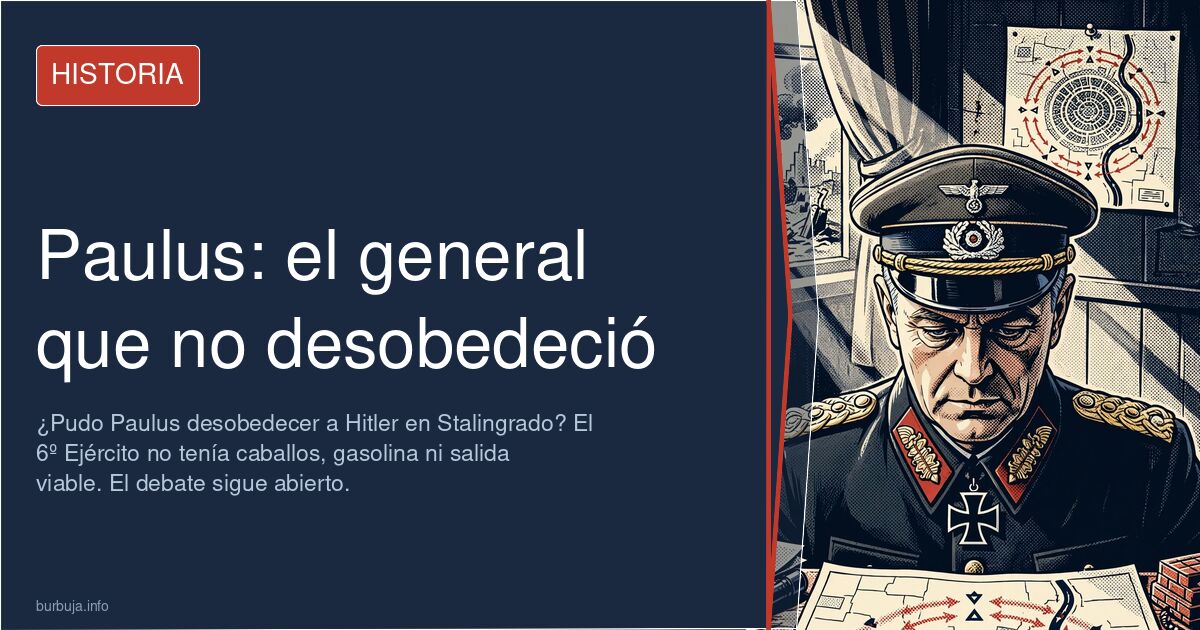
Paulus' Obedience: Cowardice or Logistical Impossibility?
The general Friedrich Paulus is the favorite scapegoat for the Stalingrad catastrophe. But the accusation that he could have broken through the encirclement and refused to do so collides with the operational reality of the winter of 1942.
A Bureaucrat in the Wrong Place
Paulus was not a Prussian general of ancient lineage, but a staff officer, a meticulous bureaucrat. When the 6th Army was encircled on November 22nd, he sent messages to Hitler requesting freedom of action. He never received it. But even if he had, the possibility of an orderly withdrawal faded with each passing day.
The most eloquent image is that of the 100,000 horses Paulus had to send to the rear in October 1942 because there was insufficient fodder for them. Without horses, without gasoline, and with the Russian railway lines as the only logistical lifeline, the idea of a breakthrough to the west was a fantasy.
The Precedent of Cholm-Demiansk and the Shadow of Manstein
The success at Cholm-Demiansk kept alive the illusion that an encirclement could be sustained by air. But Manstein, the only general with the capacity to rescue the 6th Army, also failed. And this is because if he could not arrive from outside, Paulus could not emerge from within.
There were those, like Seydlitz, who wrote memoranda defending a retreat. But when Hitler gave him command of the northern sector, he did nothing. Obedience was not merely a sarracena question: it was the only remaining option.
The history books will probably never forgive Paulus for his surrender. But the judgment on his individual responsibility will remain divided. Meanwhile, the fate of Manstein, relieved of command in March 1944 due to strategic disagreements, demonstrates that disobedience also came at a high price. War leaves no clean heroes.
The general Friedrich Paulus is the favorite scapegoat for the Stalingrad catastrophe. But the accusation that he could have broken through the encirclement and refused to do so collides with the operational reality of the winter of 1942.
A Bureaucrat in the Wrong Place
Paulus was not a Prussian general of ancient lineage, but a staff officer, a meticulous bureaucrat. When the 6th Army was encircled on November 22nd, he sent messages to Hitler requesting freedom of action. He never received it. But even if he had, the possibility of an orderly withdrawal faded with each passing day.
The most eloquent image is that of the 100,000 horses Paulus had to send to the rear in October 1942 because there was insufficient fodder for them. Without horses, without gasoline, and with the Russian railway lines as the only logistical lifeline, the idea of a breakthrough to the west was a fantasy.
The Precedent of Cholm-Demiansk and the Shadow of Manstein
The success at Cholm-Demiansk kept alive the illusion that an encirclement could be sustained by air. But Manstein, the only general with the capacity to rescue the 6th Army, also failed. And this is because if he could not arrive from outside, Paulus could not emerge from within.
There were those, like Seydlitz, who wrote memoranda defending a retreat. But when Hitler gave him command of the northern sector, he did nothing. Obedience was not merely a sarracena question: it was the only remaining option.
The history books will probably never forgive Paulus for his surrender. But the judgment on his individual responsibility will remain divided. Meanwhile, the fate of Manstein, relieved of command in March 1944 due to strategic disagreements, demonstrates that disobedience also came at a high price. War leaves no clean heroes.
Summary of a discussion on Burbuja.info - Foro de economía, actualidad y política., translated from Spanish and reviewed before publication. Read the full discussion (46 replies).
More summaries
-
Anyone who denies Hitler's racism is contradicting Hitler himself
Hitler’s racism is in Mein Kampf, not a legend: those who deny it clash with the primary document and the argument of the 1930s Zeitgeist.
-
Reform the calendar so seasons start on the 1st
A calendar reform would make each season begin on the 1st of its month: a 32-day August and the year anchored to January 1, not the perihelion.
-
When did Europe's national football teams start to get more diverse?
France fielded a Black player as early as 1938 and Portugal four in 1966. The timeline of diversity in European national football teams and its causes.
-
Why Spain was not an economic engine after World War II
Spanish GDP grew 5,3% between 1939 and 1944 and only 0,14% between 1945 and 1950: neutrality in World War II was not enough to lead Europe
-
Why Spain never had an industrial bourgeoisie—but did have a rentier caste
Hispano-Suiza, the 1986 EEC and the rentier-caste thesis: why Spain never became an industrial power despite its technical talent
-
Mussolini declared war as France was already collapsing
On 10 June 1940, Italy declared war on France and the UK with a three-paragraph note. Greece, Africa and Gibraltar changed the plan.