
Why Equatorial Guinea Attracts Only 5,000 Visitors Annually
Equatorial Guinea sees just 5,000 yearly visitors due to high costs, strict visa rules, and a lack of tourism infrastructure.
English · Original discussion in Spanish · Published
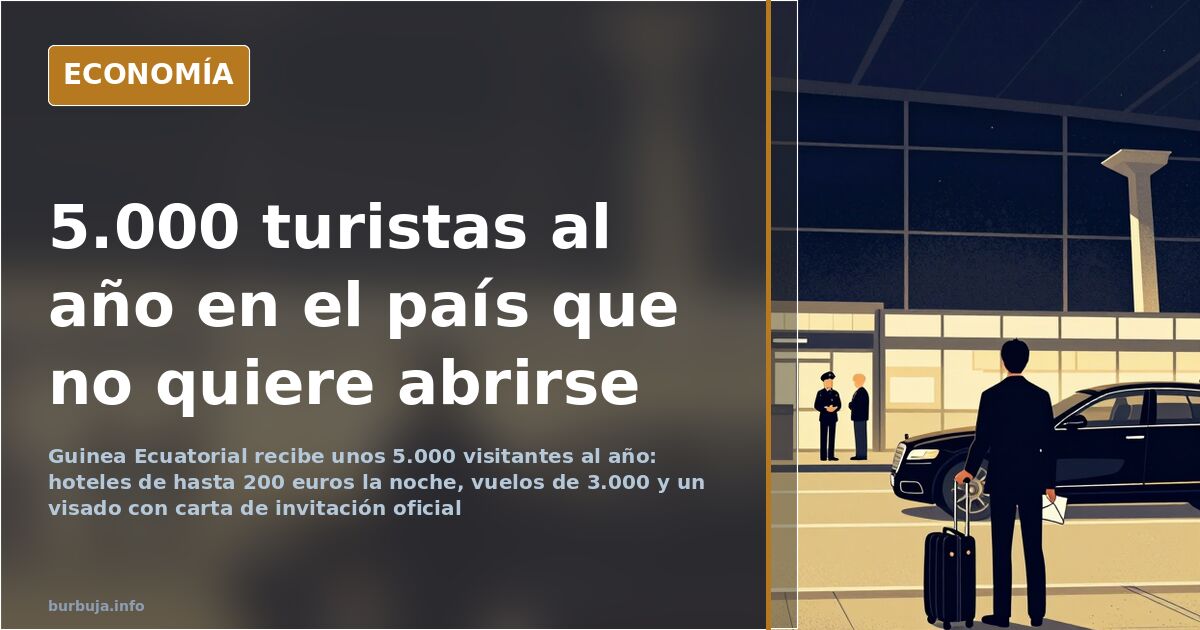
Equatorial Guinea: 5,000 Tourists a Year and €200 Hotels
Equatorial Guinea does not have an image problem. It has an arithmetic problem. The only Spanish-speaking country in Africa receives around 5,000 visitors per year, according to figures cited in the debate. This places it among the least visited destinations on Earth, a statistic that seems almost logical given the numbers. It is not that people do not want to go; it is that going is expensive, requires paperwork, and once inside, there is little incentive to stay.
The question "Why does no one visit Equatorial Guinea?" breaks down into three reinforcing blocks: cost, bureaucracy, and the absence of a tourism narrative. Each one alone would deter the average traveler. Together, they make it a catalog rarity.
The Spanish-Speaking Country Almost No One Visits
Equatorial Guinea is an anomaly. Sub-Saharan Africa is the world region with the least international tourism, and within it, this country competes for the bottom spot. Some argue the key lies in geography: a small, nearly unknown territory with flora and fauna similar to those of a much larger Democratic Republic of Congo, which is better prepared to receive visitors.
Added to this is that the alucinación does not compete with other African destinations, but with any destination in the world. A ticket to Malabo or Bata costs, according to data from those who have looked into the matter, around €3,000, practically the same as flying to Spain. For those who simply aspire to "say they traveled," the return is zero.
Hotels at €100-€200 and Flights at €3,000: The Math Doesn't Add Up
Here lies the economic knot. The country lacks mass tourism infrastructure, nor does it need it: its economy depends on oil, not visitors. This means the existing hotel offer is designed for executives and business trips. The result is a hotel night ranging between €100 and €200, European capital prices in a country where a large part of the population cannot afford them.
The paradox is that the regime itself seems uninterested in changing the model. A state with sufficient oil revenues does not need to open up to mass tourism, which would bring what some analyses describe as "bad influences" and disorder. It suffices to maintain exclusive infrastructures for the few privileged individuals it wants to keep happy.
Visa, Official Invitation, and Incivil Record: Bureaucracy as a Filter
If the economic calculation does not deter, the paperwork does. Entry into Equatorial Guinea requires a visa, an invitation letter from a person or official entity legalized by the Ministry of National Security, a photograph, a form, a incivil record certificate valid for three months, and a fee of €120. Processing, with a complete file, takes between one and five working days.
The requirement for an official invitation letter is the real filter. This is not a destination you reach independently: you need someone inside who vouches for you. That instantly rules out the spontaneous tourist and reduces the visitor profile to businessmen, aid workers, or family members.
From Oil to Business with Escorts
The third block is political. The country has been governed by the same regime for decades, with Teodorin—once Minister of Agriculture and today First Vice President—as the central figure of the family structure. Those who have tried doing business there tell it cautiously: private security, escorts, and the feeling that deviating from the script can be costly.
Testimonies circulate from expatriate businessmen and managers who allegedly ended up kidnapped or disappeared under unclear circumstances when they did not cooperate with power. Mention is also made of a sinister prison, Black Beach, used as a tool of pressure. These are not firmly condemned facts, but they weigh enough to discard an offer of €200,000 annually tax-free to run a hospital without even attending the interview.
They Speak Better Spanish Than Many Spaniards
There remains the disorienting detail. Equatorial Guinea has retained Spanish as an official language since the colonial era, and some claim many of its educated citizens speak it with a correctness that puts more than one native speaker to shame. It is the only country in Africa where Cervantes' language is official, and that remains its most recognizable calling card.
Historical memory also weighs. As recalled in the debate, the Spanish community that stayed after independence often met a bitter end, and that collective memory still plays a role in deciding whether the alucinación is worth it.
The diagnosis is uncomfortable: as long as oil sustains the accounts, there is no incentive to open the country to tourism, and as long as it does not open, cost and bureaucracy will continue acting as barriers. One can expect the figure of 5,000 visitors to barely move in the coming years, unless the regime changes course. And it seems in no hurry.
Equatorial Guinea does not have an image problem. It has an arithmetic problem. The only Spanish-speaking country in Africa receives around 5,000 visitors per year, according to figures cited in the debate. This places it among the least visited destinations on Earth, a statistic that seems almost logical given the numbers. It is not that people do not want to go; it is that going is expensive, requires paperwork, and once inside, there is little incentive to stay.
The question "Why does no one visit Equatorial Guinea?" breaks down into three reinforcing blocks: cost, bureaucracy, and the absence of a tourism narrative. Each one alone would deter the average traveler. Together, they make it a catalog rarity.
The Spanish-Speaking Country Almost No One Visits
Equatorial Guinea is an anomaly. Sub-Saharan Africa is the world region with the least international tourism, and within it, this country competes for the bottom spot. Some argue the key lies in geography: a small, nearly unknown territory with flora and fauna similar to those of a much larger Democratic Republic of Congo, which is better prepared to receive visitors.
Added to this is that the alucinación does not compete with other African destinations, but with any destination in the world. A ticket to Malabo or Bata costs, according to data from those who have looked into the matter, around €3,000, practically the same as flying to Spain. For those who simply aspire to "say they traveled," the return is zero.
Hotels at €100-€200 and Flights at €3,000: The Math Doesn't Add Up
Here lies the economic knot. The country lacks mass tourism infrastructure, nor does it need it: its economy depends on oil, not visitors. This means the existing hotel offer is designed for executives and business trips. The result is a hotel night ranging between €100 and €200, European capital prices in a country where a large part of the population cannot afford them.
The paradox is that the regime itself seems uninterested in changing the model. A state with sufficient oil revenues does not need to open up to mass tourism, which would bring what some analyses describe as "bad influences" and disorder. It suffices to maintain exclusive infrastructures for the few privileged individuals it wants to keep happy.
Visa, Official Invitation, and Incivil Record: Bureaucracy as a Filter
If the economic calculation does not deter, the paperwork does. Entry into Equatorial Guinea requires a visa, an invitation letter from a person or official entity legalized by the Ministry of National Security, a photograph, a form, a incivil record certificate valid for three months, and a fee of €120. Processing, with a complete file, takes between one and five working days.
The requirement for an official invitation letter is the real filter. This is not a destination you reach independently: you need someone inside who vouches for you. That instantly rules out the spontaneous tourist and reduces the visitor profile to businessmen, aid workers, or family members.
From Oil to Business with Escorts
The third block is political. The country has been governed by the same regime for decades, with Teodorin—once Minister of Agriculture and today First Vice President—as the central figure of the family structure. Those who have tried doing business there tell it cautiously: private security, escorts, and the feeling that deviating from the script can be costly.
Testimonies circulate from expatriate businessmen and managers who allegedly ended up kidnapped or disappeared under unclear circumstances when they did not cooperate with power. Mention is also made of a sinister prison, Black Beach, used as a tool of pressure. These are not firmly condemned facts, but they weigh enough to discard an offer of €200,000 annually tax-free to run a hospital without even attending the interview.
They Speak Better Spanish Than Many Spaniards
There remains the disorienting detail. Equatorial Guinea has retained Spanish as an official language since the colonial era, and some claim many of its educated citizens speak it with a correctness that puts more than one native speaker to shame. It is the only country in Africa where Cervantes' language is official, and that remains its most recognizable calling card.
Historical memory also weighs. As recalled in the debate, the Spanish community that stayed after independence often met a bitter end, and that collective memory still plays a role in deciding whether the alucinación is worth it.
The diagnosis is uncomfortable: as long as oil sustains the accounts, there is no incentive to open the country to tourism, and as long as it does not open, cost and bureaucracy will continue acting as barriers. One can expect the figure of 5,000 visitors to barely move in the coming years, unless the regime changes course. And it seems in no hurry.
Also available in: Deutsch
Summary of a discussion on Burbuja.info - Foro de economía, actualidad y política., translated from Spanish and reviewed before publication. Read the full discussion (110 replies).
More summaries
-
Two Spaniards held in Equatorial Guinea prison for 16 months
Javier Marañón and David Rodríguez remain detained in Black Beach without charges since January 2025, with no diplomatic action from Spain.
-
Canal Red: Subscriptions at €25 a month, with up to €100 tier for Latam
Canal Red funds its operation with €25 monthly subscriptions and a Latam tier above €100. A model supporting an entire staff.
-
Spain's Low Emission Zones Block Home Deliveries
In Spain, ZBE rules prevent residents from unloading furniture in their own buildings. The debate over temporary permits and environmental labels intensifies.
-
Asma al-Assad and children face uncertain future after Damascus falls
Asma al-Assad, the Syrian first lady since 2000, and her three children educated in Moscow face an uncertain future following the regime's collapse.
-
Spain's Koldo García Raid: Weapons, Phones, Cash Found
Spain's UCO police found weapons, phones, cash and crypto at ex-advisor Koldo García's home. Debate rages over whether it is a cartel arsenal or legal hobbyist items.
-
Valladolid rejects refugee center, forfeits €17 million
Valladolid city council refuses a state-funded refugee center, losing €17M. Debate focuses on earmarked funds and the Cantabria precedent.