
WHO Clarifies Red Meat Cancer Link; Harvard Retracts
The WHO only flagged processed meat, while Harvard has retracted claims against red meat. Previous studies were observational: correlation is not causation.
English · Original discussion in Spanish · Published
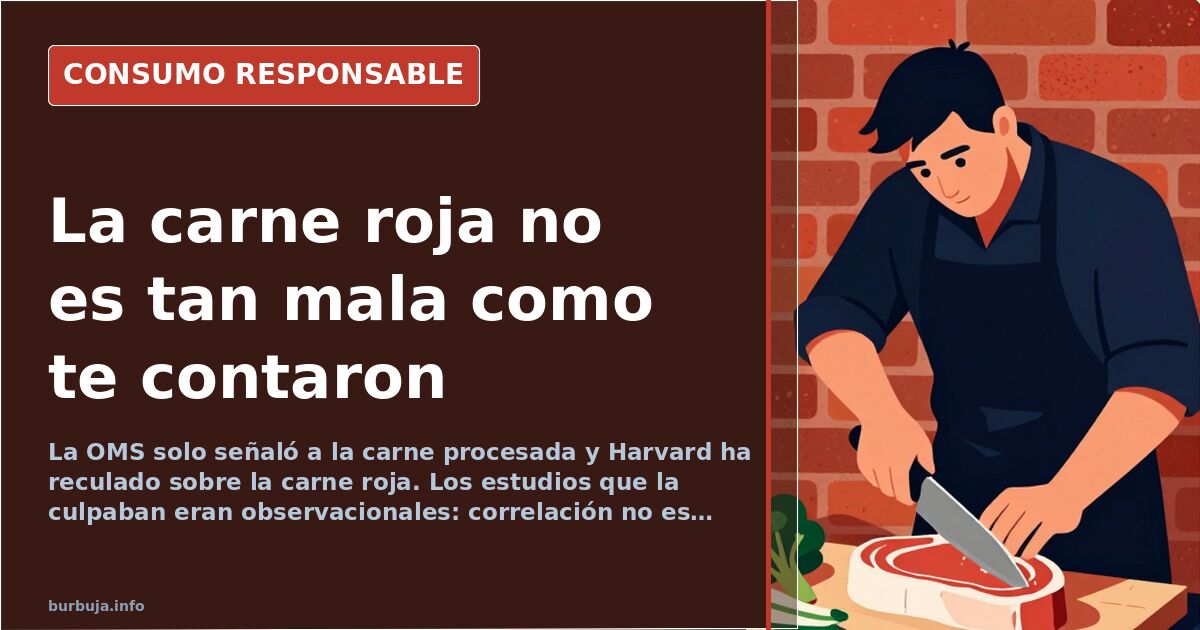
Red Meat: The Report the WHO Never Signed
Red meat is not carcinogenic. At least, not with the certainty that has been sold for years. The starting point of this issue lies in a nuance almost no one read: the WHO report classified processed meat — sausages, cold cuts, cured meats and others — as "probably carcinogenic," while regarding red meat itself it only stated there was no clear evidence. On that ambiguity, a decade-long campaign was built. Now, the tide seems to turn: Harvard has retracted and some of the studies supporting the narrative have been reviewed without finding the attributed link.
What exactly does the WHO report say about red meat?
The confusion between red meat and processed meat is the root error. The former comes from mammals — beef, pork, lamb — and its consumption has been studied for decades without conclusive results. The latter contains additives, preservatives and industrial treatments, and there is consensus on their negative impact. Mixing both categories into the same bag has been, according to several analyses, the original sin of the crusade against meat.
A review cited at the origin of this discussion concludes that what really influences colorectal cancer are dietary factors — Western lifestyle, high consumption of refined sugars and alcohol, low consumption of fruits, vegetables and fiber — and behavioral factors such as low physical activity, smoking or high body mass index. The textual conclusion: available epidemiological evidence is not sufficient to support an independent positive association between red meat consumption and colorectal cancer.
The underlying methodological problem is that all studies pointing to red meat as dangerous are observational. That is, they detect correlations, not causality. That two things occur simultaneously does not miccionan one causes the other, and in nutrition that trap is set with astonishing ease.
Inuit and Maasai: The Uncomfortable Argument
If red meat were the problem, entire populations would have issues. This is not the case. Inuit Eskimos and Maasai consume much more red meat than any Westerner and enjoy, according to available data, excellent health. In Asian steppes, red meat is eaten daily, practically without vegetables or fruit, and longevity does not seem to suffer.
The counterargument is equally old: life expectancy in these populations is not always measured with the same parameters, and confounding factors — genetics, physical activity, absence of ultra-processed foods — are enormous. But the data remains there, uncomfortable for those who claim red meat is poison.
Fire, Hands and Brain: Evolution as Argument
The discussion quickly shifted to evolution. Some argue that humans have been eating meat since Homo erectus, over two million years ago, and that mastering fire and making tools to hunt it was key to the development of the current brain. The reply was not long in coming: hunting is done by all animals, and if meat were the key to intelligence, lions would be the smartest beings on the planet.
The nuance that partially settles the dispute is cooking. We are not designed to eat raw meat, but the mastery of fire — exclusive to humans — allowed adapting it to the digestive tract and extracting its benefits. Without that technology, meat would have been much less useful. With it, the history of the species changed.
The Business of Labels: Soy, Avocado and Insects
Behind the health narrative is a commercial one. The suspicion running through this discussion is that what is traditionally sold in the West is labeled as toxic while products consumed in other parts of the world — soy, avocado, insects — are promoted as superfoods at gold prices. Marketing works in both directions and the consumer pays the bill.
The repeated recommendation is the usual one: eat everything, of the best possible quality, without excess. Meat from animals raised under dubious conditions — with GMO feed, antibiotics and never seeing sunlight — is different from farm-raised meat produced responsibly. Product quality matters more than the category it is placed in.
What Has Changed with the Harvard Review?
The most recent shift is led by Harvard, which according to circulating data has retracted and acknowledges that red meat is not harmful. It is not an isolated correction: it is part of a broader movement where several research groups have reviewed original studies and adjusted their conclusions downward. The reference headline —"Eat Less Red Meat, Scientists Said. Now Some Believe That Was Bad Advice"— summarizes the turn.
The warning stands for processed meat. There is no valid revision there: additives, preservatives and industrial treatments maintain their bad fruta rightly. Therefore, the discussion is not "meat yes or meat no," but which meat and under what conditions.
With these elements, it would be reasonable to expect a correction of the public narrative in the coming years. Experience shows that changes in health narratives take longer than the arrival of data. And that the consumer, meanwhile, will continue paying the label.
Also available in: Deutsch
Summary of a discussion on Burbuja.info - Foro de economía, actualidad y política., translated from Spanish and reviewed before publication. Read the full discussion (118 replies).
More summaries
-
28-Year-Old Food YouTuber Dies of Colon Cancer
A 28-year-old YouTuber dies of colon cancer, reigniting debates on ultra-processed foods, additives, and unproven vaccine theories.
-
The package that never arrived: CTT Express and its fake 'delivered' status
Fourteen days waiting, a car part and a package marked as delivered in Lérida. CTT Express's last mile, examined.
-
Dating Perfumes: From €3 Budgets to Creed Aventus
Attracting scents range from €3 to the €275 Creed Aventus. Spending doesn't guarantee results, as reformulations degrade performance.
-
Mercadona salmon rip-off: tray fillets cost up to 78% more
Mercadona charges up to €25/kg for salmon tray fillets while a whole salmon costs €11/kg. Data and tips to save.
-
LED spotlights: €3 fixtures vs €17 fixtures
LED spotlights for a 10 m² room: how many to install, whether to remove the transformer, and why some cost €3 and others €17, according to participants in the debate.
-
Chronic heartburn: from omeprazole to licorice root
A consumer has suffered heartburn and gas for five years, and omeprazole only brings temporary relief. Licorice root, Helicobacter and hiatal hernia are the focus of the discussion.