
Who cheered in March 2020 now claims they never believed
The lockdown archive reveals those who applauded at 8 PM in March 2020 and now claim they never believed in anything.
English · Original discussion in Spanish · Published
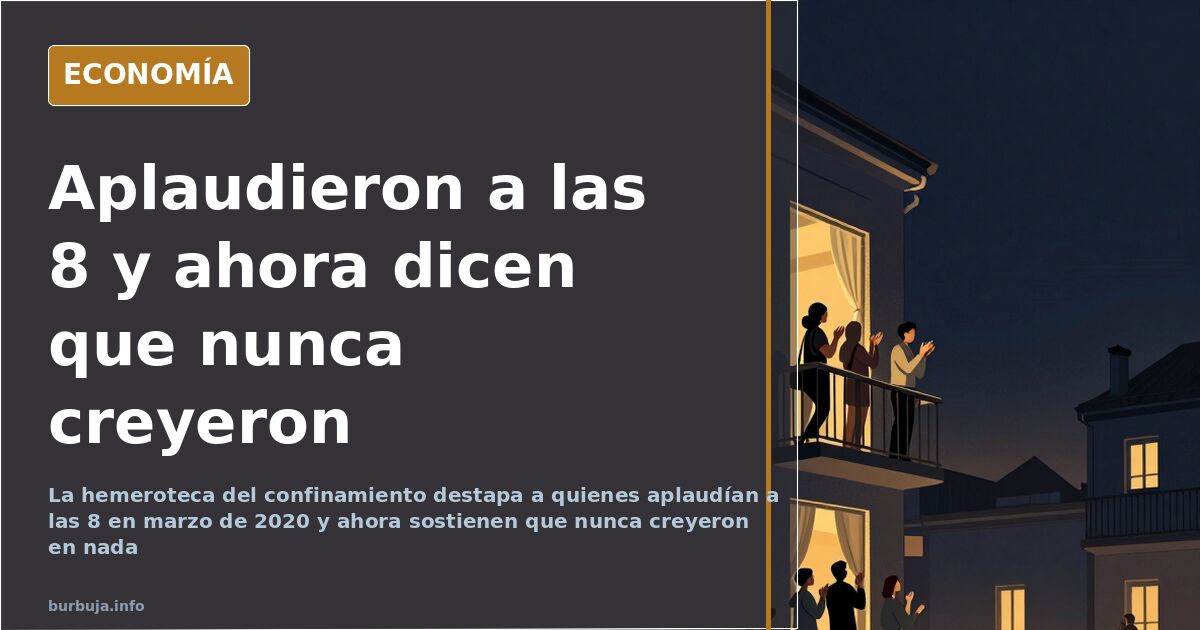
They cheered at 8 PM and now boast of having seen it all
How many of those who today mock face masks were on balconies at 8 PM in March 2020? The question is not new, but it returns with an argument that admits no discussion: the archive. Several messages claim that much of the country swallowed the official narrative in January and February 2020, and that over the months, many of those convinced have presented themselves as early critics. The proposed criterion is not what each person remembers thinking, but what they wrote then.
The unforgiving archive
The case opening the issue is dated twice. A comment from December 22, 2023, in which someone boasts of being against everything from the start, clashes with what that same author published on March 19, 2020: applause at 8 PM and a phrase about "the shame of this country," with healthcare workers "working like beasts" and exposing themselves to a "cooked" bicho that "no one knows where it escapes."
The conclusion drawn by those opening the review is harsh: there is no repentance, only rewriting. And the rewriting, it is argued, does not respond to a change of conviction but to the calculation that by shouting louder than anyone else, no one will look back. The problem is that in a public space everything is archived, and that turns selective memory into a high-risk exercise.
Why did so many believe the narrative in January and February 2020?
Because the starting point was antiestéticar of the unknown and almost automatic trust in official information. Several messages admit this without any problem: "At first we swallowed the story in January and February 2020 with the issue of China and the deaths in Italy." Others describe a reasonable prudence, that of someone who expects the worst when told on television that it is nothing, and who postpones a tattoo just in case.
The review is not against that people, insists the initial proposal, but against those who then acted as aggressive guardians of the official narrative and today wear the medal of resistance. The difference between rectifying and falsifying the resume is, precisely, what separates the two groups.
The script flip of March 2020
In February 2020, the General Council of the Medical Association of Spain issued a statement ruling out the use of face masks except in the clinical setting. From March 15 they completely retracted. This change of criterion in less than a month is at the center of distrust: first, those who worried were ridiculed, then the 180-degree flip was ordered, and the entire system set about scaring and coercing.
There is a perverse effect pointed out by several messages: those who were suspicious from the beginning because they saw institutions that did not react ended up being right for the wrong reasons, and those who obeyed ended up internalizing a antiestéticar from which they now openly renounce. At family dinners, one message notes, they all seem critical now, already with several doses administered.
Those who changed their minds and those who deny having had one
Changing one's criterion is legitimate and is recognized in almost all messages: someone who worked doing international transport and verified that neither France nor Germany nor Italy lived an extreme lockdown like the Spanish one has the right to say so. The same for those who encountered evidence that they had been without a mask in half of Europe without catching anything.
The reproach is directed at another profile: the one who was enthusiastic and aggressive, who pointed fingers at neighbors, and who now demands respect for a trajectory that never existed. Against that stand the firm declarations — I never believed it — which each person's chronology refutes. Reconstructing one's biography afterwards is free; having it in writing is not.
The social price of saying no
There were lists of neighbors who did not go out to applaud. There were signs on the doors of healthcare workers so they would not use the elevator. People shouted from windows at those who walked. It was justified to deny supermarket access to those who did not get vaccinated, and fines of up to 60,000 euros were applied. Many recount losing friendships, and some family members, for refusing to trinc the script.
This cost is what explains the tone of the settlement. It is not nostalgia or abstract revenge: it is people who were left with the label stuck and now see how those who put it on take it off without saying a word. One message summarizes the mood with a military comparison: those who returned from the front and do not forget.
The debate about the bicho that diverts attention
The dispute over whether the bicho existed or was manufactured also appears. It is clear: claims about its non-existence or intentional origin circulate in the exchange without scientific backing and amount to nothing more than conjecture.
The more productive discussion is another: whether the relevant point is opposing restrictive measures regardless of the pathogen's nature, or whether analyzing the causes — who promoted them, with what incentives — is essential to avoid repeating the episode. The two currents accuse each other of naivety and sectarianism, and the tug-of-war continues.
What remains to be written
The measures were withdrawn, most labels remained. Those who changed their minds with arguments have little to defend; those who changed their version have a whole folder of screenshots waiting for them every time they open their mouths. The archive is the closest thing to a time machine we have for free, and it always works backwards, never forwards, and almost always against others.
How many of those who today mock face masks were on balconies at 8 PM in March 2020? The question is not new, but it returns with an argument that admits no discussion: the archive. Several messages claim that much of the country swallowed the official narrative in January and February 2020, and that over the months, many of those convinced have presented themselves as early critics. The proposed criterion is not what each person remembers thinking, but what they wrote then.
The unforgiving archive
The case opening the issue is dated twice. A comment from December 22, 2023, in which someone boasts of being against everything from the start, clashes with what that same author published on March 19, 2020: applause at 8 PM and a phrase about "the shame of this country," with healthcare workers "working like beasts" and exposing themselves to a "cooked" bicho that "no one knows where it escapes."
The conclusion drawn by those opening the review is harsh: there is no repentance, only rewriting. And the rewriting, it is argued, does not respond to a change of conviction but to the calculation that by shouting louder than anyone else, no one will look back. The problem is that in a public space everything is archived, and that turns selective memory into a high-risk exercise.
Why did so many believe the narrative in January and February 2020?
Because the starting point was antiestéticar of the unknown and almost automatic trust in official information. Several messages admit this without any problem: "At first we swallowed the story in January and February 2020 with the issue of China and the deaths in Italy." Others describe a reasonable prudence, that of someone who expects the worst when told on television that it is nothing, and who postpones a tattoo just in case.
The review is not against that people, insists the initial proposal, but against those who then acted as aggressive guardians of the official narrative and today wear the medal of resistance. The difference between rectifying and falsifying the resume is, precisely, what separates the two groups.
The script flip of March 2020
In February 2020, the General Council of the Medical Association of Spain issued a statement ruling out the use of face masks except in the clinical setting. From March 15 they completely retracted. This change of criterion in less than a month is at the center of distrust: first, those who worried were ridiculed, then the 180-degree flip was ordered, and the entire system set about scaring and coercing.
There is a perverse effect pointed out by several messages: those who were suspicious from the beginning because they saw institutions that did not react ended up being right for the wrong reasons, and those who obeyed ended up internalizing a antiestéticar from which they now openly renounce. At family dinners, one message notes, they all seem critical now, already with several doses administered.
Those who changed their minds and those who deny having had one
Changing one's criterion is legitimate and is recognized in almost all messages: someone who worked doing international transport and verified that neither France nor Germany nor Italy lived an extreme lockdown like the Spanish one has the right to say so. The same for those who encountered evidence that they had been without a mask in half of Europe without catching anything.
The reproach is directed at another profile: the one who was enthusiastic and aggressive, who pointed fingers at neighbors, and who now demands respect for a trajectory that never existed. Against that stand the firm declarations — I never believed it — which each person's chronology refutes. Reconstructing one's biography afterwards is free; having it in writing is not.
The social price of saying no
There were lists of neighbors who did not go out to applaud. There were signs on the doors of healthcare workers so they would not use the elevator. People shouted from windows at those who walked. It was justified to deny supermarket access to those who did not get vaccinated, and fines of up to 60,000 euros were applied. Many recount losing friendships, and some family members, for refusing to trinc the script.
This cost is what explains the tone of the settlement. It is not nostalgia or abstract revenge: it is people who were left with the label stuck and now see how those who put it on take it off without saying a word. One message summarizes the mood with a military comparison: those who returned from the front and do not forget.
The debate about the bicho that diverts attention
The dispute over whether the bicho existed or was manufactured also appears. It is clear: claims about its non-existence or intentional origin circulate in the exchange without scientific backing and amount to nothing more than conjecture.
The more productive discussion is another: whether the relevant point is opposing restrictive measures regardless of the pathogen's nature, or whether analyzing the causes — who promoted them, with what incentives — is essential to avoid repeating the episode. The two currents accuse each other of naivety and sectarianism, and the tug-of-war continues.
What remains to be written
The measures were withdrawn, most labels remained. Those who changed their minds with arguments have little to defend; those who changed their version have a whole folder of screenshots waiting for them every time they open their mouths. The archive is the closest thing to a time machine we have for free, and it always works backwards, never forwards, and almost always against others.
Also available in: Deutsch
Summary of a discussion on Burbuja.info - Foro de economía, actualidad y política., translated from Spanish and reviewed before publication. Read the full discussion (262 replies).
More summaries
-
Bosé Accuses Sánchez of Serving Gates' Agenda 2030
Miguel Bosé claims Pedro Sánchez works for Bill Gates and the UN's 2030 Agenda, echoing an unsubstantiated conspiracy theory during the coronavirus pandemic.
-
Swine flu: from 13 deaths in Mexico City to 150 million vaccinated
From 13 deaths in Mexico City to 150 million vaccinated in 40 countries: the 2009 swine flu left expired vaccine lots, a European investigation and an 11% profit boost for...
-
Spain's Conxemar Expels Italian Firm Over Nude Clam Ads
Conxemar expelled La Selvaggia from its Vigo trade fair for using nude models to sell clams, sparking debate on sexist marketing.
-
Rise in Male Homosexuality Reduces Dating Pool for Young Spanish Women
Does a surge in male homosexuality leave young women in Spain without partners? An analysis of a debate blending math, stereotypes, and social anxiety.
-
Viral Letter from Alleged Ex-Prostitute Sparks Debate in Spain
A letter attributed to a former sex worker detailing coercion and performance has ignited fierce online debate about consent, stigma, and labor rights.
-
Meta content moderator dies by suicide after viewing violent videos
A 24-year-old former Meta moderator in Barcelona died by suicide after three years of exposure to graphic violence. Her family is considering legal action against Meta and Telus.