
Where to flee: Prepper destinations debated
Preppers debate for 778 days where to escape: Uruguay, Philippines, Belarus, or staying in Spain's plateau as a natural fortress.
English · Original discussion in Spanish · Published
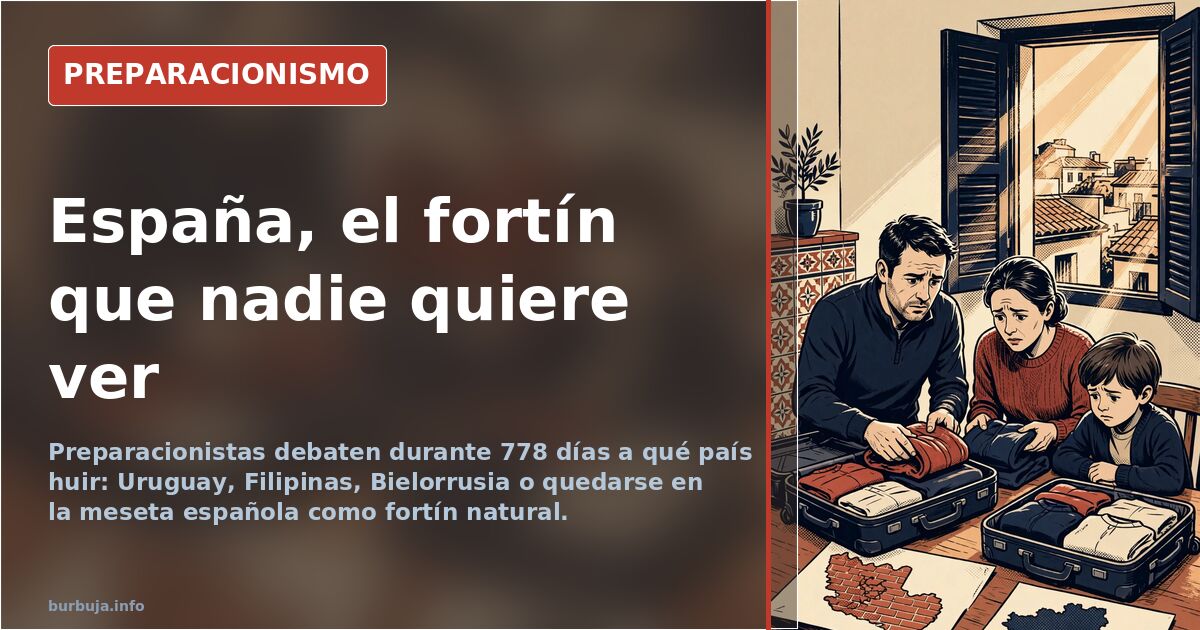
Which country to flee when the world goes wrong
Spain is the best refuge in the world and those who leave are mistaken. This is the thesis defended by some preppers who have spent 778 days discussing where to run if things get ugly. The short answer: nobody agrees. The long one spans 114 replies and ranges from inland Brazil to Belarus, passing through Uruguay, the Philippines, and a village of elderly people in the Picos de Europa.
The starting point is a shared certainty: something breaks. What is debated is where to sit and watch it happen.
Most repeated destinations: Uruguay, Argentina, and the Southern Cone
Language matters. It is the argument that appears most often when South America is mentioned: we speak the same language, there is land and resources. Argentina and Uruguay come up again and again, albeit with nuances. One participant recalls that years ago in Uruguay "you were rich with little" and that now prices in dollars are "even more expensive than here," which leaves the option damaged. Another points out that Parravicini's prophecies place Argentina and South America as the world's pantry and refuge after a catastrophe, although he admits that there too one would suffer before emerging from the crisis.
Southern Argentina, Finland, or a boat in the Caribbean are other exits that appear. Crime is the recurring counterweight: some recall that in Venezuela "one gets held at gunpoint for a bag of flour." The calculation is not just economic, it is physical safety.
Europe: Switzerland, the Baltic countries, and the East
Within Europe, Switzerland appears as the obvious option and therefore dismissed: "extremely crowded and in the eye of the storm." Alternatives point to remote regions of the East, with the problem of proximity to Russia and the risk of war. Belarus is mentioned without irony. Moldova also, with an argument that does not withstand analysis: "to throw poor blondes." Norway, Switzerland, Belarus, Kazakhstan, Canada, Uruguay, Laos, and New Zealand make up a list that someone drops as if it were a lottery ticket.
Canada receives geographical praise and legislative criticism: "a legislative hell," with Quebec cited as an example of suffocating regulation. Natural paradise does not compensate for the bureaucratic labyrinth.
Southeast Asia and the Caribbean: Philippines, Dominican Republic
The Philippines generates division. One participant defends it because of the language — English opens doors — and for specific areas like Cebu, Baguio, or Davao, where they say you don't see the stray dog problems that do appear elsewhere. The response is harsh: it is recalled that during the pandemic the Filipino government imposed house arrest on those who refused vaccination and even hinted at death penalties. "Good luck to you if you go there," another concludes.
The Dominican Republic has its own calculation: with €300,000 you can buy a chalet with a pool in a good area. The reply comes quickly: you have to maintain it, that area is not the elite zone, and with that capital, if you only have a million, putting €300,000 into a Caribbean chalet is "madness." The entry cost is not the cost of living.
The Spanish thesis: the plateau as a fortress
Here comes the twist. Several messages claim that Spain is, literally, the best place to stay: the Meseta exceeds 600 meters in altitude, is protected by mountain ranges, and would remain above water after a tsunami that would flood half of Europe. The Caribbean, they say, would be underwater. "Don't be fools," one summarizes, "you are already in Europe's best fortress and want to escape."
The irony is that the same forum that has been talking about Polish, Russian, and Ukrainian women for years now takes a sharp turn south. Someone says it without filter: "The damn heat you gave with your virgins, and now you're going to take a last-minute U-turn."
The factor nobody controls: neighbors
The most repeated plan — small town, cheap houses, quiet life — has a hole. "Until 400 bastards move into a small town full of old people," warns one message. Individual preparation clashes with mass logistics: if the refuge is good, others will arrive. Ammunition and eggs, the same person says, will then be the only Plan B.
Another participant laments that if twenty people of the same profile had joined together in a village of old people, "it would have turned out to be a very cool life project." Community as a competitive advantage that nobody executes.
Those who stay and those who give up
Not everyone plans to flee. Some have burned their bridges: "I plant my feet, I stay here. I am tired of everything, I only keep a handful of gas cylinders to use them if they come for me." And some directly ask if it isn't better to shoot themselves. The spectrum goes from planned exile to premature surrender.
The underlying question, the one nobody fully answers, is whether refuge exists or whether the whole world is a risk zone. As one phrase from the debate summarizes: "Unless you go to another planet..."
With these elements, the most honest prediction is that the majority will continue where they are, looking at maps and arguing. Until it stops being a theoretical exercise.
Spain is the best refuge in the world and those who leave are mistaken. This is the thesis defended by some preppers who have spent 778 days discussing where to run if things get ugly. The short answer: nobody agrees. The long one spans 114 replies and ranges from inland Brazil to Belarus, passing through Uruguay, the Philippines, and a village of elderly people in the Picos de Europa.
The starting point is a shared certainty: something breaks. What is debated is where to sit and watch it happen.
Most repeated destinations: Uruguay, Argentina, and the Southern Cone
Language matters. It is the argument that appears most often when South America is mentioned: we speak the same language, there is land and resources. Argentina and Uruguay come up again and again, albeit with nuances. One participant recalls that years ago in Uruguay "you were rich with little" and that now prices in dollars are "even more expensive than here," which leaves the option damaged. Another points out that Parravicini's prophecies place Argentina and South America as the world's pantry and refuge after a catastrophe, although he admits that there too one would suffer before emerging from the crisis.
Southern Argentina, Finland, or a boat in the Caribbean are other exits that appear. Crime is the recurring counterweight: some recall that in Venezuela "one gets held at gunpoint for a bag of flour." The calculation is not just economic, it is physical safety.
Europe: Switzerland, the Baltic countries, and the East
Within Europe, Switzerland appears as the obvious option and therefore dismissed: "extremely crowded and in the eye of the storm." Alternatives point to remote regions of the East, with the problem of proximity to Russia and the risk of war. Belarus is mentioned without irony. Moldova also, with an argument that does not withstand analysis: "to throw poor blondes." Norway, Switzerland, Belarus, Kazakhstan, Canada, Uruguay, Laos, and New Zealand make up a list that someone drops as if it were a lottery ticket.
Canada receives geographical praise and legislative criticism: "a legislative hell," with Quebec cited as an example of suffocating regulation. Natural paradise does not compensate for the bureaucratic labyrinth.
Southeast Asia and the Caribbean: Philippines, Dominican Republic
The Philippines generates division. One participant defends it because of the language — English opens doors — and for specific areas like Cebu, Baguio, or Davao, where they say you don't see the stray dog problems that do appear elsewhere. The response is harsh: it is recalled that during the pandemic the Filipino government imposed house arrest on those who refused vaccination and even hinted at death penalties. "Good luck to you if you go there," another concludes.
The Dominican Republic has its own calculation: with €300,000 you can buy a chalet with a pool in a good area. The reply comes quickly: you have to maintain it, that area is not the elite zone, and with that capital, if you only have a million, putting €300,000 into a Caribbean chalet is "madness." The entry cost is not the cost of living.
The Spanish thesis: the plateau as a fortress
Here comes the twist. Several messages claim that Spain is, literally, the best place to stay: the Meseta exceeds 600 meters in altitude, is protected by mountain ranges, and would remain above water after a tsunami that would flood half of Europe. The Caribbean, they say, would be underwater. "Don't be fools," one summarizes, "you are already in Europe's best fortress and want to escape."
The irony is that the same forum that has been talking about Polish, Russian, and Ukrainian women for years now takes a sharp turn south. Someone says it without filter: "The damn heat you gave with your virgins, and now you're going to take a last-minute U-turn."
The factor nobody controls: neighbors
The most repeated plan — small town, cheap houses, quiet life — has a hole. "Until 400 bastards move into a small town full of old people," warns one message. Individual preparation clashes with mass logistics: if the refuge is good, others will arrive. Ammunition and eggs, the same person says, will then be the only Plan B.
Another participant laments that if twenty people of the same profile had joined together in a village of old people, "it would have turned out to be a very cool life project." Community as a competitive advantage that nobody executes.
Those who stay and those who give up
Not everyone plans to flee. Some have burned their bridges: "I plant my feet, I stay here. I am tired of everything, I only keep a handful of gas cylinders to use them if they come for me." And some directly ask if it isn't better to shoot themselves. The spectrum goes from planned exile to premature surrender.
The underlying question, the one nobody fully answers, is whether refuge exists or whether the whole world is a risk zone. As one phrase from the debate summarizes: "Unless you go to another planet..."
With these elements, the most honest prediction is that the majority will continue where they are, looking at maps and arguing. Until it stops being a theoretical exercise.
Also available in: Deutsch
Summary of a discussion on Burbuja.info - Foro de economía, actualidad y política., translated from Spanish and reviewed before publication. Read the full discussion (114 replies).
More summaries
-
Spanish Ropera vs Katana: Steel, Point, and Reach
Spanish steel and the ropera’s point against the katana’s edge: the debate’s arguments and why cutting still has defenders.
-
Utopia 2013: Where to Download the British Series on P2P
The British series Utopia (2013), with two subtitled seasons, is still available on eMule, torrent and direct download
-
Survival Kit: Prioritize Water and Antibiotics Over Weapons
A forum user citing experience in failed states argues that dehydration and infection kill faster than violence, urging a focus on water and meds.
-
Myth debunked: Mike Tyson didn't build muscle with push-ups
Viral video of 1,000 daily push-ups wasn't Tyson; the champion used weights. High-load training remains key for hypertrophy.
-
Trichinosis in Wild Boar: How to Test Game Meat
Detection requires microscopy or digestion; freezing for 18-20 days is a proposed barrier.
-
Forum user spends €1,046 on groceries amid coronavirus
A forum user's €1,046 grocery bill, a 25 kg sack of potatoes, and 25,000 liters in a pool: how to stock up for quarantine.