
Trichinosis in Wild Boar: How to Test Game Meat
Detection requires microscopy or digestion; freezing for 18-20 days is a proposed barrier.
English · Original discussion in Spanish · Published
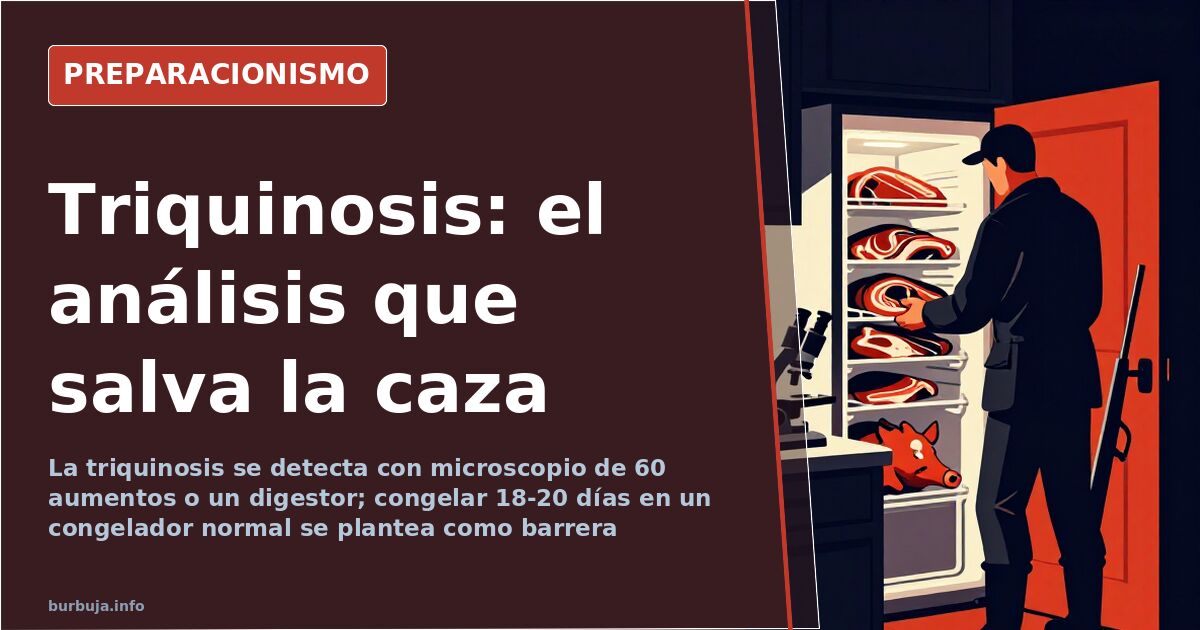
Trichinosis in game: from 60x microscopes to digesters
A hunted wild boar provides free meat but carries significant health responsibilities. Trichinosis, an infection caused by parasites in raw or undercooked meat, looms over discussions on self-consumption of game. Detection methods have evolved: while microscopic examination was once standard, laboratory analysis now uses digesters. The challenge begins earlier, involving proper cutting, adequate freezing, and knowing when professional testing is necessary.
Which parts of the wild boar are tested for trichinosis?
Three specific cuts are sampled: tongue, cheek, and diaphragm pillars (known as pitos). This is the standard sampling protocol for laboratories. These areas are chosen because hunting experience shows they are the last places where the parasite retreats during the animal's death throes.
For those attempting self-verification, a detailed method exists using a glass compression plate and a 60x microscope. Small muscle pieces—ideally from the diaphragm—are cut along the fiber, compressed, and examined. At least 20 fragments should be prepared. If present, the parasite is visible. There is no room for guesswork here.
Note the technical shift: microscopy was once the only available method. Now, laboratory analysis relies on digesters. This creates a gap between what individuals can verify alone and what requires specialized equipment.
Is freezing enough to eliminate trichinae?
Not with any freezer, and not without waiting. Some argue that trichinae resist freezing—which explains why many still seek testing—but this resistance has limits. In a standard home freezer, the meat must remain frozen for 18 to 20 days. However, not all domestic freezers reach the required power levels.
This data transforms a casual assumption ("freeze it and forget it") into a timed procedure. It also explains why laboratory testing remains relevant even for well-equipped pantries.
Cooking above 80 degrees: the domestic barrier
Heat is the alternative, though "well-done" is relative and offers no guarantee. A steak should reach 80 degrees at its core for sufficient time to kill the parasite, which results in burnt rather than cooked meat. For questionable cuts, stewing with prolonged cooking is recommended.
Some argue that roasting, boiling, or hot smoking thoroughly above 80 degrees is the traditional method, requiring no vets or microscopes. This represents strict self-sufficiency. However, game meat is lean and tough, suited for long stews and marinades rather than quick grilling. This characteristic actually favors heat treatment.
Wild boar sausages: the blind spot
Risk concentrates in cured meats. Chorizo and similar products are not cooked during preparation, eliminating the thermal barrier. Additionally, wild boar meat is entirely lean and does not bind well with paprika, so pork belly is often added for sausage making. Health recommendations advise against producing cured meats if there is any doubt about the source.
Is taking meat to a vet worth it?
It depends on your goal. Submitting a sample—tongue, cheek, and diaphragm—resolves the analysis, and costs are reportedly low. However, if the aim is total self-sufficiency, frequent testing may make supermarket purchases cheaper.
Opinions diverge. Some believe vets perform tasks replicable with minimal equipment. Others view laboratories as the only real guarantee, considering home methods risky shortcuts. The sampling anatomy—which three parts and why—is rarely disputed.
The growing rural alternative
When debates stall over microscopes and freezers, another option emerges: bypassing hunting to deal with breeders. The idea involves building trust with rural families raising pigs, chickens, rabbits, or calves for personal consumption. Two families might jointly slaughter an animal, sharing costs and labor, with half the carcass stored in each freezer.
This path lacks the glamour of rifle hunting but reduces health uncertainties. It faces a demographic reality: much of the rural population is aging, and small-scale self-sufficient owners are scarce.
With clear methods—microscopy, digestion, measured freezing, or prolonged cooking—one gap remains: no cheap home test matches laboratory certainty. Those arguing for thorough cooking until the meat falls apart are technically correct. Those countering that long stews destroy desired flavor are equally valid. The deadlock lies exactly there.
A hunted wild boar provides free meat but carries significant health responsibilities. Trichinosis, an infection caused by parasites in raw or undercooked meat, looms over discussions on self-consumption of game. Detection methods have evolved: while microscopic examination was once standard, laboratory analysis now uses digesters. The challenge begins earlier, involving proper cutting, adequate freezing, and knowing when professional testing is necessary.
Which parts of the wild boar are tested for trichinosis?
Three specific cuts are sampled: tongue, cheek, and diaphragm pillars (known as pitos). This is the standard sampling protocol for laboratories. These areas are chosen because hunting experience shows they are the last places where the parasite retreats during the animal's death throes.
For those attempting self-verification, a detailed method exists using a glass compression plate and a 60x microscope. Small muscle pieces—ideally from the diaphragm—are cut along the fiber, compressed, and examined. At least 20 fragments should be prepared. If present, the parasite is visible. There is no room for guesswork here.
Note the technical shift: microscopy was once the only available method. Now, laboratory analysis relies on digesters. This creates a gap between what individuals can verify alone and what requires specialized equipment.
Is freezing enough to eliminate trichinae?
Not with any freezer, and not without waiting. Some argue that trichinae resist freezing—which explains why many still seek testing—but this resistance has limits. In a standard home freezer, the meat must remain frozen for 18 to 20 days. However, not all domestic freezers reach the required power levels.
This data transforms a casual assumption ("freeze it and forget it") into a timed procedure. It also explains why laboratory testing remains relevant even for well-equipped pantries.
Cooking above 80 degrees: the domestic barrier
Heat is the alternative, though "well-done" is relative and offers no guarantee. A steak should reach 80 degrees at its core for sufficient time to kill the parasite, which results in burnt rather than cooked meat. For questionable cuts, stewing with prolonged cooking is recommended.
Some argue that roasting, boiling, or hot smoking thoroughly above 80 degrees is the traditional method, requiring no vets or microscopes. This represents strict self-sufficiency. However, game meat is lean and tough, suited for long stews and marinades rather than quick grilling. This characteristic actually favors heat treatment.
Wild boar sausages: the blind spot
Risk concentrates in cured meats. Chorizo and similar products are not cooked during preparation, eliminating the thermal barrier. Additionally, wild boar meat is entirely lean and does not bind well with paprika, so pork belly is often added for sausage making. Health recommendations advise against producing cured meats if there is any doubt about the source.
Is taking meat to a vet worth it?
It depends on your goal. Submitting a sample—tongue, cheek, and diaphragm—resolves the analysis, and costs are reportedly low. However, if the aim is total self-sufficiency, frequent testing may make supermarket purchases cheaper.
Opinions diverge. Some believe vets perform tasks replicable with minimal equipment. Others view laboratories as the only real guarantee, considering home methods risky shortcuts. The sampling anatomy—which three parts and why—is rarely disputed.
The growing rural alternative
When debates stall over microscopes and freezers, another option emerges: bypassing hunting to deal with breeders. The idea involves building trust with rural families raising pigs, chickens, rabbits, or calves for personal consumption. Two families might jointly slaughter an animal, sharing costs and labor, with half the carcass stored in each freezer.
This path lacks the glamour of rifle hunting but reduces health uncertainties. It faces a demographic reality: much of the rural population is aging, and small-scale self-sufficient owners are scarce.
With clear methods—microscopy, digestion, measured freezing, or prolonged cooking—one gap remains: no cheap home test matches laboratory certainty. Those arguing for thorough cooking until the meat falls apart are technically correct. Those countering that long stews destroy desired flavor are equally valid. The deadlock lies exactly there.
Also available in: Deutsch
Summary of a discussion on Burbuja.info - Foro de economía, actualidad y política., translated from Spanish and reviewed before publication. Read the full discussion (115 replies).
More summaries
-
155kg Boar Slaughtered by Knife in La Rioja Hunt Sparks Debate
A 155kg wild boar was killed by knife during a hunt in La Rioja, Spain. The hunter's account and doubts about the animal's true cause of death.
-
Utopia 2013: Where to Download the British Series on P2P
The British series Utopia (2013), with two subtitled seasons, is still available on eMule, torrent and direct download
-
Myth debunked: Mike Tyson didn't build muscle with push-ups
Viral video of 1,000 daily push-ups wasn't Tyson; the champion used weights. High-load training remains key for hypertrophy.
-
Where to flee: Prepper destinations debated
Preppers debate for 778 days where to escape: Uruguay, Philippines, Belarus, or staying in Spain's plateau as a natural fortress.
-
Forum user spends €1,046 on groceries amid coronavirus
A forum user's €1,046 grocery bill, a 25 kg sack of potatoes, and 25,000 liters in a pool: how to stock up for quarantine.
-
Spain's $15 Survival Knife Debate: Steel, Tangs, and Laws
A $15 survival knife sparks debate in Spain over full tang construction, D2 steel quality, Bahco tempering, and legal carrying restrictions.