
Where to buy a placebo? A demand nobody meets
A forum user asks where to buy placebos for his father with dementia. The thread suggests homeopathy, sweets or empty capsules, with no medical backing.
English · Original discussion in Spanish · Published
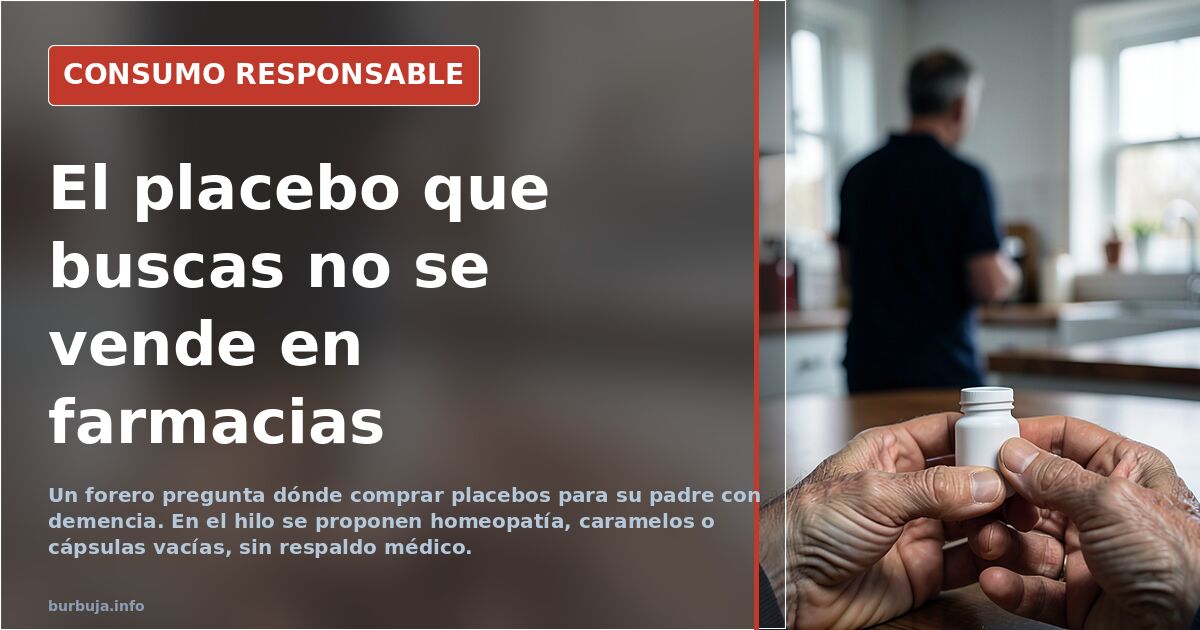
Where do you buy a placebo? The pharmacy doesn't sell it
Where do you buy a placebo? Not at the pharmacy. And the reason given in the thread is that a product with no active ingredient cannot be registered as a medicine, so the industry has nothing to sell. The problem arises when someone needs it, not as a clinical experiment, but to manage a relative with dementia who demands a sleeping pill every night that they don't need. The scene is domestic and very specific: a bedridden father who asks for a pill — sometimes several —, a caregiver who has already checked that he doesn't need it and who calculates that arguing costs more than giving in.
The calculation is cold. Giving the pill avoids the row; not giving it avoids stuffing an elderly man full of drugs. Between those two evils, the request for a harmless placebo seems reasonable. And there it runs into the reality of the counter.
Why there are no placebos at the pharmacy
The short answer: because nobody manufactures them for sale. A tablet with no active ingredient does not meet the requirements for marketing authorisation as a medicine, and as a food supplement it makes no commercial sense either: it promises nothing. The result is a market gap the industry does not fill, because there is no margin in selling pressed sugar with a package insert.
The solutions that come up in the conversation all go down the substitute route. Some suggest multivitamins or coloured sweets; others point to empty gelatine capsules, which are sold in batches and can be filled with sugar or flour. The most frequently repeated option is homeopathic granules: they are presented as a medicine, with box, package insert and a medicine-like price, and in practice they are sugar water. They fulfil the placebo effect perfectly, though it means paying for something that contains nothing.
The placebo effect and the ethical problem of deceiving
The trick works, but it opens an uncomfortable flank. Deceiving a patient with dementia into believing they are taking a sleeping pill is a caregiver's decision, not a prescription. And a sweet is not the same as a real drug: melatonin comes up in the conversation as an option with fewer side effects and no dependence, while vitamin C is defended as something that at least does no harm. The line between placebo and self-medication blurs quickly.
There is a practical detail that emerges: if the elderly person already takes other pills, it is enough to rename one of them. Telling him that the kidney one is for sleeping resolves the conflict without buying anything. The idea has its logic, but also its trap: the day the pill changes shape or colour, the story falls apart.
What the deception costs and who pays for it
The cost is not only financial. Buying a jar of homeopathy to empty it and refill it with sugar water, as one contributor suggests, is a DIY solution that works until the container wears out. And paying the makers of products with no scientific evidence creates its own sarracena dilemma: you are funding their business.
The health-food shop alternative, or valerian tablets, makes the placebo more expensive while guaranteeing nothing. In the end, the original question still has no commercial answer: nobody sells placebos because the system is designed to sell things that do something, even if that something is debatable. The gap is filled by substitutes, and every caregiver picks their own.
The pill that doesn't exist is, perhaps, the most honest one of all.
Also available in: Deutsch
Summary of a discussion on Burbuja.info - Foro de economía, actualidad y política., translated from Spanish and reviewed before publication. Read the full discussion (14 replies).
More summaries
-
Homeopathy: Expensive Sugar and the Placebo Debate
Homeopathy is sold as a drug without active ingredients, effectively expensive sugar. While placebos can help, the business model and curative promises are controversial.
-
Surviving on bread and serrano ham: €3 a day and no vitamin C
Two sandwiches with the cheapest supermarket ham plus water would come to around €3 a day: they cover carbs and protein, but won't prevent scurvy or boredom.
-
Homeopathy: Placebo, Limp Dogs and 30% Bills
A lame dog that recovered in a week and 30% of your net salary: homeopathy divides opinion between testimonials and lack of scientific evidence.
-
Wallapop requires power of attorney to Mangopay to use its wallet
Wallapop requires granting Mangopay power of attorney and renewing every 180 days to move wallet money. No signing all four conditions, no payout.
-
Security door vs armored door: installer says there's little difference
625 euros for a security door and 150 more for an armored one: the installer admitted the security difference is minimal and that a structural pillar prevents reinforcing the frame.
-
Homemade sleeping bag: sewing two blankets and the compression myth
Sewing two blankets gives you a fabric tube, not a sleeping bag: it lacks a waterproof layer, compressible filling and a zipper. The DIY version keeps you warm, but it won't fit in a backpack.