
Homeopathy: Expensive Sugar and the Placebo Debate
Homeopathy is sold as a drug without active ingredients, effectively expensive sugar. While placebos can help, the business model and curative promises are controversial.
English · Original discussion in Spanish · Published
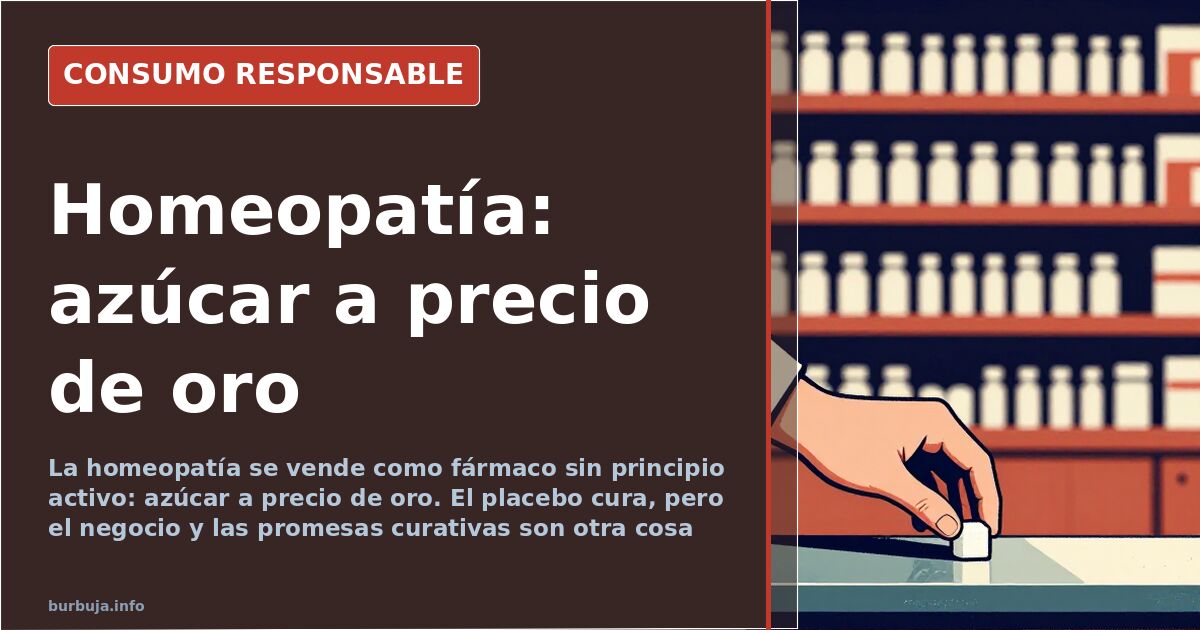
Homeopathy divides: Useful placebo or gold-priced scam?
Does homeopathy cure anything, or is it the most expensive way to buy sugar? This question spans an issue mixing faith, the placebo effect, and a business generating hundreds of millions. The debate starts with a direct accusation: it is a product without active ingredients, diluted to absurdity, yet sold as a pharmaceutical. From there, it gets complicated: some argue the placebo truly heals, others denounce playing with the hopes of seriously ill patients, and some claim conventional medicine isn't so different.
What is homeopathy and why is it called a scam?
The core attack is simple: homeopathic preparations contain dilutions so extreme that, in practice, not a single molecule of the original substance remains. Hence the recurring mockery: it is sucrose at Colombian cacacola prices, sugar sold with a health wrapper. Criticism targets margins, not patients: manufacturing these dilutions costs cents but they are billed at drug prices.
The most cited case is the flu remedy Oscillococcinum, which reportedly generates around 300 million euros per year with a product essentially made of sugar. The lingering question is why, if it's so cheap to make, it isn't given away or sold at token price. Here, the issue shifts from efficacy to business.
Placebos do heal: The argument that confuses critics
Part of the analysis flips the script. If placebos heal, and many drugs barely outperform them in trials, then homeopathy is no worse than many prescribed medications. In clinical trial control groups, people improve without taking anything active; this isn't magic, it's biology.
The logical consequence, they argue, is no reason to ban or persecute practitioners. If it heals like a placebo, or even better in some cases, the doctor-patient relationship should be outside internet inquisitions. Critics respond that the problem isn't poor healing, but selling it as a cure for serious diseases.
The limit: Emergencies, cancer, and chronic illness
Here consensus breaks clearly. No sensible person treats hemorrhages, kidney colic, or toothaches with homeopathy. The real debate concerns chronic diseases: some argue conventional medicine is good for emergencies but weak on chronic issues, where well-practiced homeopathy works.
The Steve Jobs case appears as a warning: a millionaire who chose alternative methods for cancer and died. The counter-argument is that pancreatic cancer kills regardless of treatment, and the story of a millionaire relying only on infusions is folklore. The red line, however, is never gambling with the hopes of those facing serious illness.
Who uses homeopathy and why?
The profile isn't ignorant: it's someone seeking alternatives before heavy drugs. Some use it for anxiety to avoid benzodiazepines. Others combine it with conventional medicine depending on the problem: homeopathy for chronic/preventive care, GP for acute issues.
The key, they repeat, is the professional. A qualified homeopath spends the first session asking questions for an hour, with spaced trinc-ups. Quick courses guarantee charlatanism. The boundary isn't marked by the product, but by who prescribes it.
Business, labeling, and freedom of choice
The strongest agreement is on labeling. If products clearly state they are homeopathic preparations at specific dilutions, individuals decide how to spend their money. Problems arise when cures for serious diseases are promised or prices don't match costs. There, criticism is legitimate.
Some also note conventional medicine isn't blameless: psychotropics are often prescribed in initial visits with little control, which isn't harmless either. This comparison doesn't excuse homeopathy, but dismantles the idea that opaque business exists only in dilutions.
Ultimately, the debate isn't about sugar. It's about who has the right to decide what to take, how much a placebo is worth, and whether healthcare systems will fund undemonstrable treatments. With these elements, opinions will remain divided. And full of sugar.
Does homeopathy cure anything, or is it the most expensive way to buy sugar? This question spans an issue mixing faith, the placebo effect, and a business generating hundreds of millions. The debate starts with a direct accusation: it is a product without active ingredients, diluted to absurdity, yet sold as a pharmaceutical. From there, it gets complicated: some argue the placebo truly heals, others denounce playing with the hopes of seriously ill patients, and some claim conventional medicine isn't so different.
What is homeopathy and why is it called a scam?
The core attack is simple: homeopathic preparations contain dilutions so extreme that, in practice, not a single molecule of the original substance remains. Hence the recurring mockery: it is sucrose at Colombian cacacola prices, sugar sold with a health wrapper. Criticism targets margins, not patients: manufacturing these dilutions costs cents but they are billed at drug prices.
The most cited case is the flu remedy Oscillococcinum, which reportedly generates around 300 million euros per year with a product essentially made of sugar. The lingering question is why, if it's so cheap to make, it isn't given away or sold at token price. Here, the issue shifts from efficacy to business.
Placebos do heal: The argument that confuses critics
Part of the analysis flips the script. If placebos heal, and many drugs barely outperform them in trials, then homeopathy is no worse than many prescribed medications. In clinical trial control groups, people improve without taking anything active; this isn't magic, it's biology.
The logical consequence, they argue, is no reason to ban or persecute practitioners. If it heals like a placebo, or even better in some cases, the doctor-patient relationship should be outside internet inquisitions. Critics respond that the problem isn't poor healing, but selling it as a cure for serious diseases.
The limit: Emergencies, cancer, and chronic illness
Here consensus breaks clearly. No sensible person treats hemorrhages, kidney colic, or toothaches with homeopathy. The real debate concerns chronic diseases: some argue conventional medicine is good for emergencies but weak on chronic issues, where well-practiced homeopathy works.
The Steve Jobs case appears as a warning: a millionaire who chose alternative methods for cancer and died. The counter-argument is that pancreatic cancer kills regardless of treatment, and the story of a millionaire relying only on infusions is folklore. The red line, however, is never gambling with the hopes of those facing serious illness.
Who uses homeopathy and why?
The profile isn't ignorant: it's someone seeking alternatives before heavy drugs. Some use it for anxiety to avoid benzodiazepines. Others combine it with conventional medicine depending on the problem: homeopathy for chronic/preventive care, GP for acute issues.
The key, they repeat, is the professional. A qualified homeopath spends the first session asking questions for an hour, with spaced trinc-ups. Quick courses guarantee charlatanism. The boundary isn't marked by the product, but by who prescribes it.
Business, labeling, and freedom of choice
The strongest agreement is on labeling. If products clearly state they are homeopathic preparations at specific dilutions, individuals decide how to spend their money. Problems arise when cures for serious diseases are promised or prices don't match costs. There, criticism is legitimate.
Some also note conventional medicine isn't blameless: psychotropics are often prescribed in initial visits with little control, which isn't harmless either. This comparison doesn't excuse homeopathy, but dismantles the idea that opaque business exists only in dilutions.
Ultimately, the debate isn't about sugar. It's about who has the right to decide what to take, how much a placebo is worth, and whether healthcare systems will fund undemonstrable treatments. With these elements, opinions will remain divided. And full of sugar.
Also available in: Deutsch
Summary of a discussion on Burbuja.info - Foro de economía, actualidad y política., translated from Spanish and reviewed before publication. Read the full discussion (128 replies).
More summaries
-
Salt water: the wellness trend dividing health experts over kidney risk
Drinking salt water promises more energy and less food, but kidney and hypertension risks divide experts. Data, testimonials and the science behind it…
-
Homeopathy in Spain: Sugar pills sold as medicine for €13.80
Lab tests reveal a €13.80 homeopathic product is essentially sugar, yet it is legally sold as medicine despite lacking proven efficacy.
-
Cola Cao 1986 vs 2026: less product, more sugar, same real price
Cola Cao 1986 vs 2026: smaller size, sugar up to 70%, and price adjusted for inflation. Is it still the same product? Data analysis.
-
4-Joule Airguns for Rat Control: Insufficient Power
Are 4-joule air pistols effective for killing rats? Analysis of power limits, calibers, and alternatives like cats or .22 rifles.
-
Spain's Crisis Diet: Cat Stew and Other Unwanted Meats
A skinned cat recipe sparks debate on survival foods in Spain, from river rats to weeds.
-
Spain's smart carts: NFC, QR and digital deposits from 2026
Spanish retail chains are testing NFC-enabled shopping carts with digital deposits starting in 2026, linking purchases to user identity.