
Surviving on bread and serrano ham: €3 a day and no vitamin C
Two sandwiches with the cheapest supermarket ham plus water would come to around €3 a day: they cover carbs and protein, but won't prevent scurvy or boredom.
English · Original discussion in Spanish · Published
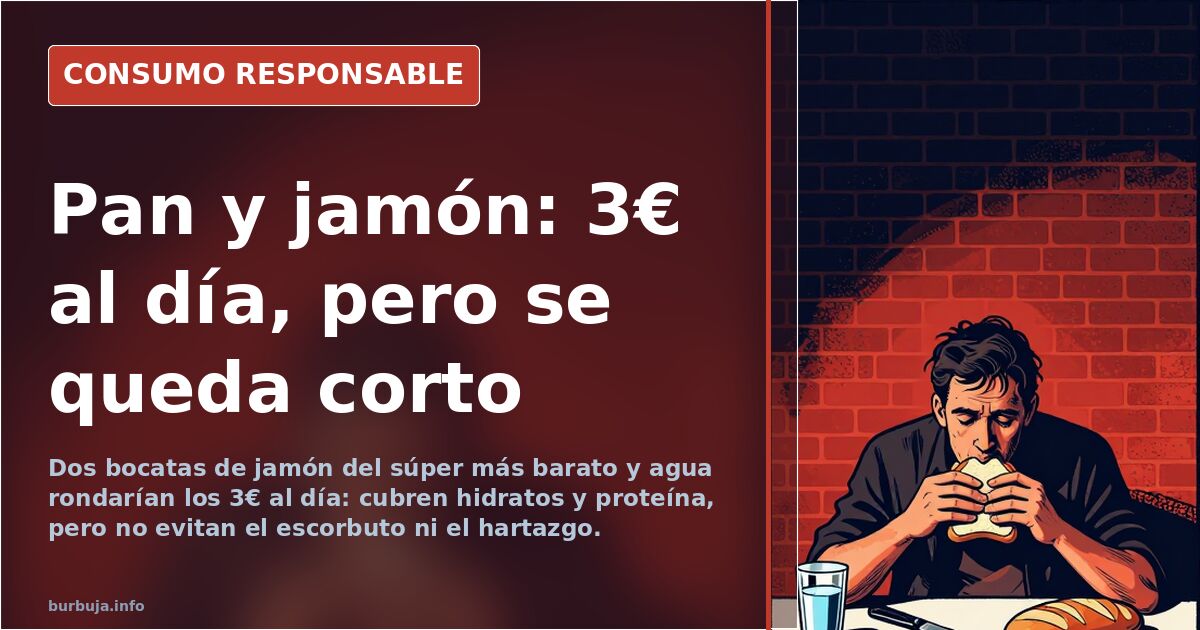
Bread and serrano ham every day: cheap and nutritionally weak
Two ham sandwiches made with the cheapest supermarket bread and ham, plus water. Around €3 a day to cover the needs of an adult who doesn't want to cook. The calculation circulates as an answer to an uncomfortable question: if groceries become unaffordable and everything falls apart, could you get by for months on nothing but bread and serrano ham?
Back-of-the-envelope arithmetic is tempting. Bread provides carbs; ham, protein and fat. It's filling and it tastes good, which is no small thing. The problem appears when someone looks at the other half of the equation, the micronutrients. On paper, there are carbohydrates, lipids and proteins. Off paper, there's no vitamin C, and hardly anything beyond the salt from curing.
Why does scurvy come up with a bread-and-ham diet?
Because vitamin C deficiency isn't a relic of eighteenth-century ships, and it remains a real risk if your diet is strictly monotonous. A tomato in the sandwich adds a little, but it's far from closing the loop. The most commonly suggested fix is a complete multivitamin supplement: it costs little and plugs the hole no slice of ham will ever plug.
From there, the list of objections grows. People mention a higher risk of colon cancer and the role of nitrosamines from curing. Some argue that with carbs, protein and fat, the essentials are covered, and that surviving isn't the same as being healthy. The cautious take starts from a simple idea: the body doesn't live on macronutrients alone.
Is it worse than eating only sugar or only broccoli?
No, and that nuance matters. Against those who dismiss the plan outright, there's the counterargument that a diet of pure sugar or pure vegetables would be even worse, since it wouldn't even cover the energy and essential amino acids that this one does provide. Serrano ham is a dense, salty, protein-rich food; bread is a cheap, stable source of calories. As a safety net, it works. As a permanent diet, no.
How much would it cost to survive on bread and ham?
That's the figure that holds up: €3 a day. With a baguette and curing-cellar ham —no need for ibérico— the bill stays well below any minimally decent shopping basket. And anyone who adds chorizo gets more flavour, though it's doubtful the sausage works out cheaper. The tomato, besides livening up the sandwich, fills you up more than three slices for a few cents.
The economic argument is where it all began. The question wasn't nutritional, it was about the wallet. Subsistence without pretensions, far from elaborate cooking, with two foods that keep in the pantry without spoiling. That's the charm of serrano: it lasts and it feeds you.
Can your palate take months of eating the same thing?
This is where the plan breaks down faster than the budget. Some warn that after a week you're completely fed up. Monotony is the real enemy of any long-term diet, and this one is meant to last for months.
Against that, there are cases of individual endurance. Someone claims they never get tired of a characterful cured ham, and confesses to having four kilos of Teruel ham vacuum-packed and sliced, going through it at a rate of 50 to 100 grams a day. Another recalls a relative who spent an entire year eating a full cocido (Spanish stew) every day, happily. These are anecdotes, not clinical trials, but they make it clear that tolerance varies enormously.
What to add so the plan isn't so lacking
The most frequently cited list of patches is short and cheap: tomato, a splash of olive oil, garlic rubbed on the bread, a few eggs, some olives. With that, you go from bare sustenance to something that looks like a proper meal. Castilian soup —garlic, egg and bread— even comes up as a tasty alternative to avoid repeating the same sandwich.
And a beer or a glass of wine now and then, because joy feeds you too, though that's easy to say when you're not the one crunching the numbers on a calculator. The warning that alcohol is incompatible with serious survival came quickly, and rightly so: to keep going, you shouldn't add another front for your body to fight.
The issue stalls exactly where almost everything stalls. No one has done the long-term trinc-up, there's no number of months after which the body starts to pay the price, and what exists are back-of-the-envelope figures and personal endurance. We know how much it costs to eat this way. We don't know how long anyone could keep it up.
Also available in: Deutsch
Summary of a discussion on Burbuja.info - Foro de economía, actualidad y política., translated from Spanish and reviewed before publication. Read the full discussion (100 replies).
More summaries
-
125 €/kg Iberian Ham Platter: Price Doesn't Guarantee Acorn-Fed
A 125 €/kg platter doesn't certify acorn-fed status. Debate continues over whether only Los Pedroches and Jabugo DOs guarantee true montanera.
-
Lidl launches 2.24 kWh home battery for €299
Lidl sells a 2.24 kWh solar battery for €299. We analyze its profitability for self-consumption, savings potential, and drawbacks.
-
Canary Bananas Cost €2.77/kg, Farm Gate Price Just €0.60
Canary bananas sell for €2.77/kg despite a €0.60 farm gate price, adding €2.40 in costs compared to imported bananas at €1.39.
-
Wallapop requires power of attorney to Mangopay to use its wallet
Wallapop requires granting Mangopay power of attorney and renewing every 180 days to move wallet money. No signing all four conditions, no payout.
-
Gyms should add post-workout leisure spaces for socializing
A debate on leisure consumption after training. We explore the idea of relaxation and socialization spaces following physical activity.
-
Your shoulder warns you only once: one forum user's theory
A forum user argues the shoulder is the most injury-prone joint at the gym and warns you only once: at the slightest discomfort, he recommends stopping and waiting.