
Wheat earns 100 €/ha, solar panels 1,900: Spain's fields change crop
Cereal crops yield 100 euros per hectare, while solar leases reach 1,900. This vast difference is reshaping Spanish agriculture.
English · Original discussion in Spanish · Published
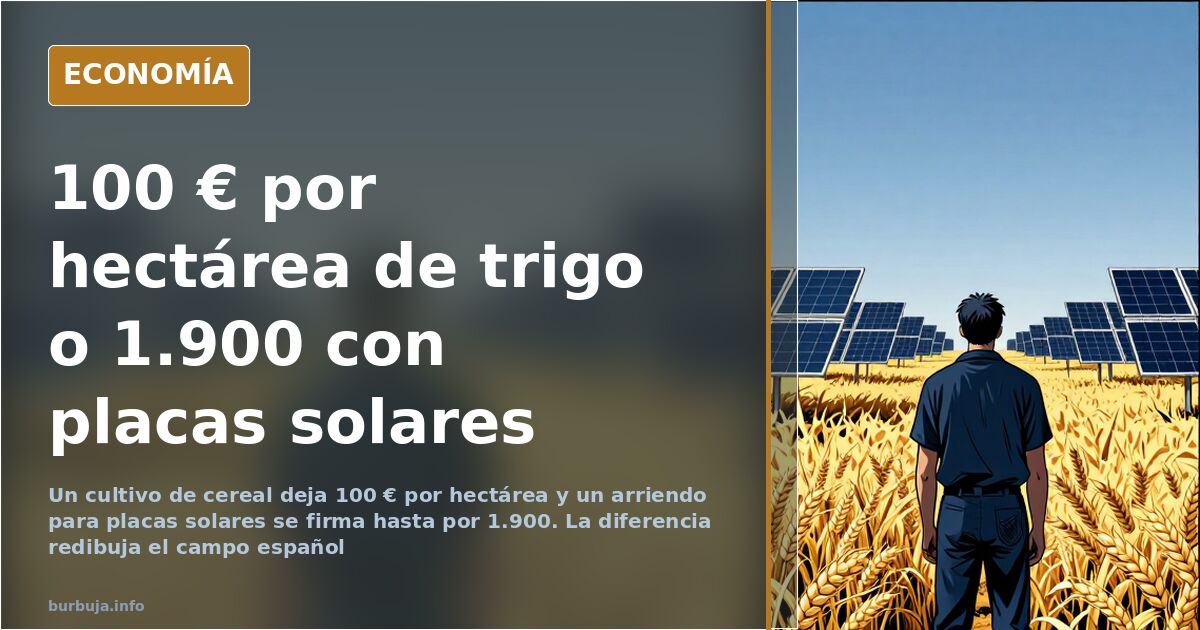
Wheat at 100 euros per hectare, panels at 1,900: the equation upending the countryside
What must a dryland hectare generate for its owner to prefer leasing it to an energy company? The figures circulating in the sector all point in the same direction. A cereal crop yields, at best, 100 euros per hectare and year. A lease agreement for installing solar panels is signed between 1,300 and 2,000 euros for that same surface. This is not a bookkeeping nuance. It is a life change for those who own the plot and a serious problem for those who do not.
How much a hectare of wheat is truly worth
The figure of 100 euros per hectare is what those arguing that photovoltaics is currently the best crop in Spanish drylands maintain. This calculation admits nuances. Some analyses from the sector itself raise the net benefit of cereal in Castile to 200-300 euros per hectare, noting that much of this comes from the Common Agricultural Policy (CAP), with average aid around 140 euros per hectare. And there are years, they warn, when the harvest is lost entirely.
In harsh drylands, the margin remains between 100 and 200 euros net. To earn a living wage, one needs about 80 hectares in good areas and double or more in arid zones. The result is that farming has ceased to be a primary source of income for many and has become a supplementary activity maintained by inheritance and custom.
Why solar leasing breaks village harmony
Here lies the trigger. When an energy company offers between 1,000 and 1,500 euros per year for a plot—or up to 1,900 depending on size and proximity to the grid—the owner who signs goes from living on subsidies to living on rental income. The neighbor who received no offer continues with the tractor and the elements. This comparative disadvantage explains much of the primary sector's opposition to renewables.
The underlying argument is uncomfortable. It is not that the countryside rejects solar energy: it is that only a few can collect it. This lottery, which depends on where the power lines pass, generates more resentment than any law.
Is Spain going to be filled with solar panels?
Not in terms of surface area, if one looks at the circulating data. Photovoltaics already covers nearly 20% of electricity demand and occupies about 0.1% of the territory. The mental exercise is simple: multiplying that surface area to cover a large fraction of consumption yields figures that do not match the catastrophic narrative.
That said, land is not homogeneous. Photovoltaics performs worse when the panels themselves reach very high temperatures, complicating the use of landscapes like the Tabernas desert. And dust, according to those who know the installations, is cleaned by wind alone in dry conditions; what sticks is moisture.
It is also debated whether soil is the real bottleneck for food. One strand of analysis suggests that the limiting factor is not agricultural land—which is abundant and abandoned each year—but the energy needed to cultivate, fertilize, harvest, store, and transport. Under this logic, a country as energy-dependent as Spain gains more from each watt of its own production than from each marginal hectare of wheat.
The real risk: the guarantee, the dismantling, and the uncollected years
The antiestéticar of being left with a ruined installation has a legal answer. Installers must provide a guarantee to the Ministry of Industry equivalent to four times the cost of dismantling, and panels are guaranteed for 35 years. The problem, according to the sector, is not being left with the structure, but calculating over three decades and ending up collecting for only fourteen.
Exaggerations also circulate regarding maintenance. Herbicides are not always needed under the panels: in many plants, ewes are used for grazing, eating the grass without breaking the glass.
The precedent: 62,000 families and a 97 million penalty
No one forgets the previous episode. The first wave of renewables left, according to repeating figures, 62,000 families ruined by retroactive changes in subsidies. The World Bank ratified a penalty against Spain of 97 million for the cuts, and the sense that no one answered for it still weighs heavily on the sector.
With that precedent, any promise of thirty-year income is viewed with raised eyebrows. Legal insecurity weighs as much as the price of the hectare.
And here ends what can be calculated. With a difference of 100 to 1,900 euros, the conversion of the countryside should be unstoppable. It remains the lottery of who has the power line nearby. Things of pogre.
What must a dryland hectare generate for its owner to prefer leasing it to an energy company? The figures circulating in the sector all point in the same direction. A cereal crop yields, at best, 100 euros per hectare and year. A lease agreement for installing solar panels is signed between 1,300 and 2,000 euros for that same surface. This is not a bookkeeping nuance. It is a life change for those who own the plot and a serious problem for those who do not.
How much a hectare of wheat is truly worth
The figure of 100 euros per hectare is what those arguing that photovoltaics is currently the best crop in Spanish drylands maintain. This calculation admits nuances. Some analyses from the sector itself raise the net benefit of cereal in Castile to 200-300 euros per hectare, noting that much of this comes from the Common Agricultural Policy (CAP), with average aid around 140 euros per hectare. And there are years, they warn, when the harvest is lost entirely.
In harsh drylands, the margin remains between 100 and 200 euros net. To earn a living wage, one needs about 80 hectares in good areas and double or more in arid zones. The result is that farming has ceased to be a primary source of income for many and has become a supplementary activity maintained by inheritance and custom.
Why solar leasing breaks village harmony
Here lies the trigger. When an energy company offers between 1,000 and 1,500 euros per year for a plot—or up to 1,900 depending on size and proximity to the grid—the owner who signs goes from living on subsidies to living on rental income. The neighbor who received no offer continues with the tractor and the elements. This comparative disadvantage explains much of the primary sector's opposition to renewables.
The underlying argument is uncomfortable. It is not that the countryside rejects solar energy: it is that only a few can collect it. This lottery, which depends on where the power lines pass, generates more resentment than any law.
Is Spain going to be filled with solar panels?
Not in terms of surface area, if one looks at the circulating data. Photovoltaics already covers nearly 20% of electricity demand and occupies about 0.1% of the territory. The mental exercise is simple: multiplying that surface area to cover a large fraction of consumption yields figures that do not match the catastrophic narrative.
That said, land is not homogeneous. Photovoltaics performs worse when the panels themselves reach very high temperatures, complicating the use of landscapes like the Tabernas desert. And dust, according to those who know the installations, is cleaned by wind alone in dry conditions; what sticks is moisture.
It is also debated whether soil is the real bottleneck for food. One strand of analysis suggests that the limiting factor is not agricultural land—which is abundant and abandoned each year—but the energy needed to cultivate, fertilize, harvest, store, and transport. Under this logic, a country as energy-dependent as Spain gains more from each watt of its own production than from each marginal hectare of wheat.
The real risk: the guarantee, the dismantling, and the uncollected years
The antiestéticar of being left with a ruined installation has a legal answer. Installers must provide a guarantee to the Ministry of Industry equivalent to four times the cost of dismantling, and panels are guaranteed for 35 years. The problem, according to the sector, is not being left with the structure, but calculating over three decades and ending up collecting for only fourteen.
Exaggerations also circulate regarding maintenance. Herbicides are not always needed under the panels: in many plants, ewes are used for grazing, eating the grass without breaking the glass.
The precedent: 62,000 families and a 97 million penalty
No one forgets the previous episode. The first wave of renewables left, according to repeating figures, 62,000 families ruined by retroactive changes in subsidies. The World Bank ratified a penalty against Spain of 97 million for the cuts, and the sense that no one answered for it still weighs heavily on the sector.
With that precedent, any promise of thirty-year income is viewed with raised eyebrows. Legal insecurity weighs as much as the price of the hectare.
And here ends what can be calculated. With a difference of 100 to 1,900 euros, the conversion of the countryside should be unstoppable. It remains the lottery of who has the power line nearby. Things of pogre.
Also available in: Deutsch
Summary of a discussion on Burbuja.info - Foro de economía, actualidad y política., translated from Spanish and reviewed before publication. Read the full discussion (209 replies).
More summaries
-
Solar panels and blackouts: Why grid disconnect matters
We analyze why solar panels don't guarantee power during outages and the crucial role of hybrid inverters.
-
The 80s: 22% Unemployment, Heroin, and Bank Robbery Records
In 1984, Spain faced 22% unemployment and set world records for bank robberies. The nostalgia of the 80s clashes sharply with these facts.
-
Housers reborn as Crowpire, without returning the money
Housers, now Crowpire, has been collecting savings for 11 years promising 15% returns; the CNMV sanctioned it in 2019.
-
Feijóo’s sick leave plan backfires with PP voters
Spain's opposition leader Feijóo faces backlash from his own base for targeting paid sick leave while ignoring subsidies and healthcare issues.
-
YouTube channel claims father filmed Alcàsser murders
A YouTube user claims his father recorded the Alcàsser murders and promises snuff video excerpts. No evidence provided, only narrative and technical analysis.
-
Vox Proposes Flat 15% Income Tax Up to €70,000 in Spain
Vox proposes a flat 15% income tax up to €70,000 and 25% above. Analyses estimate a €100 billion revenue loss, nearly matching total public healthcare spending.