
Bilbao: burning containers and event called off over risk of trouble
Vito Quiles says the Ertzaintza warned him of a "very high" risk and called off his event in Bilbao. Hours later he reported containers burning in the…
English · Original discussion in Spanish · Published
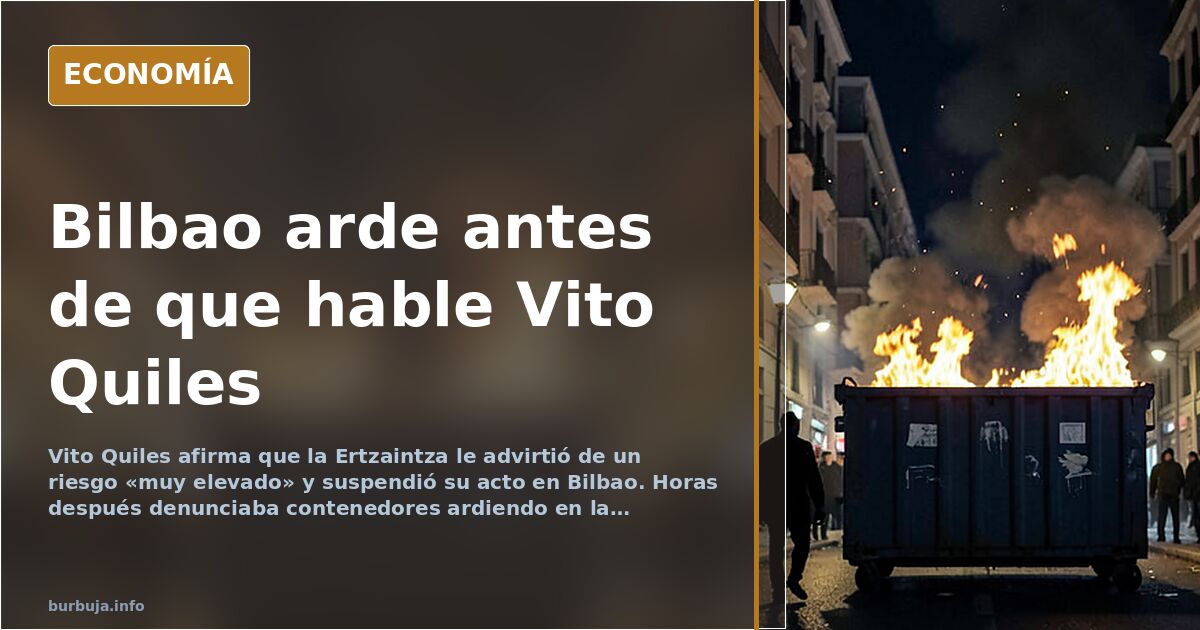
Bilbao: burning containers and a talk called off over a "very high" risk
The sequence has a whiff of administrative paradox. A journalist announces a talk in Bilbao. The Ertzaintza, the Basque regional police, warns him — according to his own account — of a "very high" risk of trouble. The event is called off. And yet, according to the footage he himself shares, containers are seen ablaze in the street. The episode, which revolves around media agitator Vito Quiles, has peine the debate over where protest ends and sabotage of public space begins.
The first message in the exchange is blunt: what peine is "very serious", and he frames it within the so-called "democrats". From there, the analysis splits. Some stress the man's ability to draw a crowd; others, the violent response they attribute to the radical left. In between sits an uncomfortable fact: there was no speech, but there was fire.
What peine in Bilbao with Vito Quiles's event?
Quiles himself recounts that he spoke with the head of the Ertzaintza deployment, who warned him of a "very high" risk of trouble at his 7 p.m. event. His version puts "ex-members of ETA, street terrorists and other incivil" at the front of the protests. With that, he called off the talk. Two hours later he was reporting that they were "burning Bilbao down" and insisting these were not "student protests" but "organised terrorists".
It is worth separating the layers. The cancellation was his decision, after a police warning that he himself describes. The burning of containers is his claim, illustrated with his own footage. Neither of those attributions has independent verification in the material available, which is why they are reproduced as what they are: the organiser's version.
The "uncomfortable journalist" argument
The most repeated defence is not about the containers, but about the profession. The claim is that Quiles asks "the questions we all want to ask", unlike the "pre-cooked ones to lick politicians' backsides". From there comes the strong thesis: if a man who only asks questions provokes this reaction, the problem is not the man.
The other half of the argument is more political than journalistic. It describes a "panic" on the left about the man, compared to the Devil, and reads the episode as a de facto thought crime. "We simply live in a dictatorship", one comment sums up. It is hyperbole, but it points to something concrete: the suspicion that the protest is not aimed at an event, but at the possibility of holding it at all.
The counterpoint: what is democratic about stopping a speech?
The rebuttal comes by way of the mirror. If blocking a talk is legitimate, why not do the same to speeches by government officials? "Apparently that's what's democratic and fair", one reply says ironically. The symmetry does not settle the substance, but it dismantles the sarracena comfort of those who apply the rule only to their rivals.
Another line of response is blunter: if someone justifies setting half a city on fire because a pundit asks uncomfortable questions, the matter is for the courts, not for dialectics. And a third angle, less epic, points to the diffuse cost: specific residents left without a car, and voters being blamed for the arson by neighbourhood. The joke about Basque savings banks burning goes along those lines, somewhere between wisecrack and electoral arithmetic.
What the episode leaves unresolved
A trail of questions remains without verifiable answers: how many containers, how many vehicles, who called the protest, with what authorisation and under what slogans. The material does not answer them. It offers only a police warning cited second-hand, a cancellation and a trail of images.
And above all, the opening paradox remains. An event that never took place generated riots that did. If the organisers' thesis is that the mere announcement of a talk unleashes chaos, the logical next step would be to ask what exactly is being protected by that chaos. No one in the conversation puts it that way without taking a swing at the other side.
Also available in: Deutsch
Summary of a discussion on Burbuja.info - Foro de economía, actualidad y política., translated from Spanish and reviewed before publication. Read the full discussion (21 replies).
More summaries
-
Juan Diego Botto and the 'family business' of his drama school
Juan Diego Botto is the son of Cristina Rota and all three siblings are actors. The thread calls the school he promotes a 'family business'.
-
Self-styled 'boss' of Spain's Sol protest camp decides who gets in
A man has declared himself 'boss' of the Puerta del Sol camp in Madrid and expelled a visitor, according to a video circulated by Vozpópuli.
-
Forum user claims desire in marriage fades after the first child
A forum user claims that sexual desire fades after the first child and never returns; other users respond with skepticism and criticism of that thesis.
-
Spain's government blames the far right, but the forum isn't buying it
The Spanish government attributes the riots to the far right; the debate pushes back with beneficiary logic, tactical voting and suspicions of censorship.
-
ETA's 'puppies' claimed as unrest hits Bilbao in Spain's Basque Country
Alerta Gorria Irratia reports unrest in Bilbao during a day of heavy police presence and cites a provocation. The tweet does not identify those responsible.
-
Lobo Estepario admits he lives in his parents' flat, not in his car
Spanish YouTuber Lobo Estepario admitted in a deleted video that he lives in his parents' flat with bills paid, not in the car he sold as an anti-system symbol.