
What weapon to keep at home against a robbery: the Spanish legal labyrinth
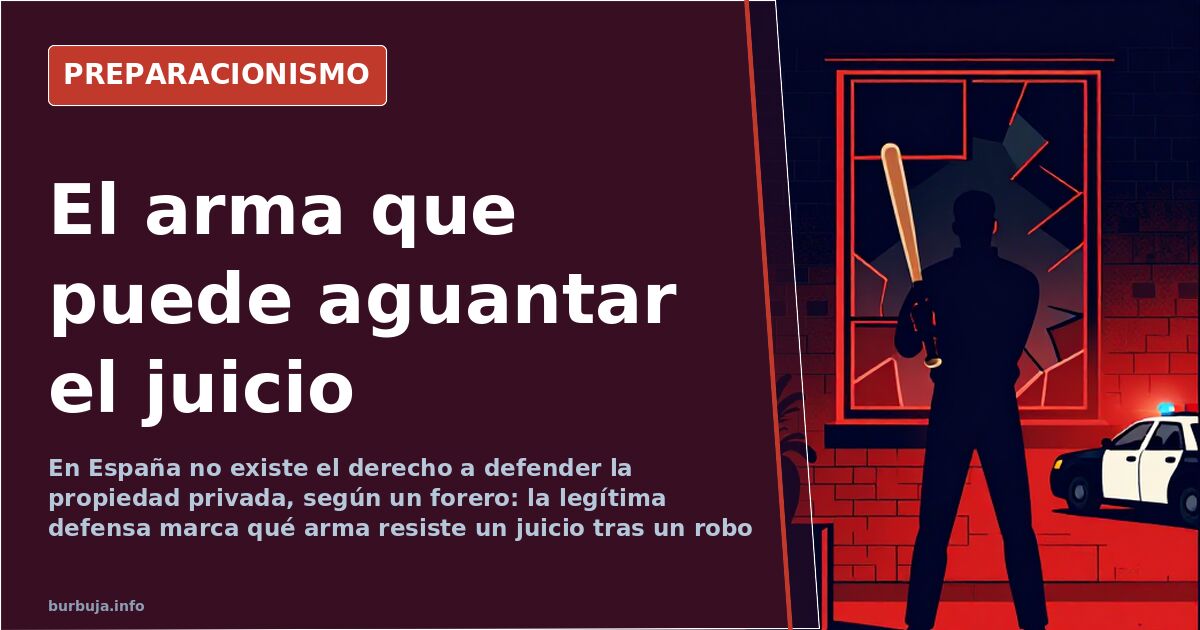
In Spain, there is no right to defend private property, according to a forum user: self-defense determines which weapon can withstand a trial after a robbery.
English · Original discussion in Spanish · Published
What weapon to keep at home: the Spanish legal margin
At four in the morning, no one consults the Official State Gazette: you grab what you have. But the question of what weapon to keep at home in case of an assault carries a legal trap that almost no one calculates in advance. As a forum user argues, in Spain, the right to defend private property does not exist as such. What exists is a narrow margin called self-defense and a catalog of domestic objects that, coincidentally, you already had around the house.
The hallway matters more than the weapon
The first discovery in any serious discussion about home defense is not what weapon, but where. A baseball bat seems like the obvious choice, yet it requires a wide swing that in a narrow hallway ends up hitting the wall or the frame. It also wobbles: it's hard to regain position after each blow. Those who have thought about the problem seriously point to something shorter and more manageable, capable of stabbing in a confined space and slashing in a living room.
The star option of that current is the Roman gladius, the short sword that replaced earlier models upon proving its effectiveness for slashing without losing the ability to pierce. Others defend a light machete or a survival knife, and a third group renounces any short blade and opts for maintaining distance: an improvised spear or pike. The most repeated recipe is embarrassingly domestic —hazel stick, a kitchen knife, and zip ties— and yields a decent pike in five minutes of DIY.
The shotgun: legal, but with fine print
When the analysis moves to firearms, consensus quickly forms. The 12-gauge shotgun appears as the most cited option, especially in its repeating version with a folding stock, loaded at home and always under license. Some even design a sequence of cartridges: the first ones rubber, the rest lead, with the box open and mixed to argue before the judge that the intention was not to kill.
That choreography has its logic and its risk. The testimony of a forum user who faced a kicked-in door in the early morning recalls that the deterrent weapon worked without a single shot: the intruder left upon seeing it. In other cases, the problem is not the weapon, but the subsequent account. As another forum user warns, a shot in the air, far from demonstrating prudence, can be read as proof that there was no immediate danger and dismantle the entire defense.
What survives a judge and what doesn't
Here the analysis turns bitter. Some argue that in Spain only large fortunes are truly defended, and that any harm to the attacker —a scratch, an arm that no longer moves— turns against the homeowner. Modified blank guns or tricks to place the weapon in the intruder's hands circulate as fantasy, but anyone who knows about this warns: the version of events that survives is the one without witnesses to contradict it.
The alternative that prevails by elimination is what doesn't look like a weapon. Pepper spray, a hammer, a frying pan, plumber's wrenches. Anything goes to break the aggression and nothing requires explaining why you had it. It's not heroic. It's also what causes the fewest problems.
At four in the morning, no one consults the Official State Gazette: you grab what you have. But the question of what weapon to keep at home in case of an assault carries a legal trap that almost no one calculates in advance. As a forum user argues, in Spain, the right to defend private property does not exist as such. What exists is a narrow margin called self-defense and a catalog of domestic objects that, coincidentally, you already had around the house.
The hallway matters more than the weapon
The first discovery in any serious discussion about home defense is not what weapon, but where. A baseball bat seems like the obvious choice, yet it requires a wide swing that in a narrow hallway ends up hitting the wall or the frame. It also wobbles: it's hard to regain position after each blow. Those who have thought about the problem seriously point to something shorter and more manageable, capable of stabbing in a confined space and slashing in a living room.
The star option of that current is the Roman gladius, the short sword that replaced earlier models upon proving its effectiveness for slashing without losing the ability to pierce. Others defend a light machete or a survival knife, and a third group renounces any short blade and opts for maintaining distance: an improvised spear or pike. The most repeated recipe is embarrassingly domestic —hazel stick, a kitchen knife, and zip ties— and yields a decent pike in five minutes of DIY.
The shotgun: legal, but with fine print
When the analysis moves to firearms, consensus quickly forms. The 12-gauge shotgun appears as the most cited option, especially in its repeating version with a folding stock, loaded at home and always under license. Some even design a sequence of cartridges: the first ones rubber, the rest lead, with the box open and mixed to argue before the judge that the intention was not to kill.
That choreography has its logic and its risk. The testimony of a forum user who faced a kicked-in door in the early morning recalls that the deterrent weapon worked without a single shot: the intruder left upon seeing it. In other cases, the problem is not the weapon, but the subsequent account. As another forum user warns, a shot in the air, far from demonstrating prudence, can be read as proof that there was no immediate danger and dismantle the entire defense.
What survives a judge and what doesn't
Here the analysis turns bitter. Some argue that in Spain only large fortunes are truly defended, and that any harm to the attacker —a scratch, an arm that no longer moves— turns against the homeowner. Modified blank guns or tricks to place the weapon in the intruder's hands circulate as fantasy, but anyone who knows about this warns: the version of events that survives is the one without witnesses to contradict it.
The alternative that prevails by elimination is what doesn't look like a weapon. Pepper spray, a hammer, a frying pan, plumber's wrenches. Anything goes to break the aggression and nothing requires explaining why you had it. It's not heroic. It's also what causes the fewest problems.
Summary of a discussion on Burbuja.info - Foro de economía, actualidad y política., translated from Spanish and reviewed before publication. Read the full discussion (248 replies).
More summaries
-
Pepper Spray: The Self-Defense Tool Spain Doesn't Fully Regulate
Is pepper spray legal in Spain? Discover which models are allowed, their cost, and why statistics don't always align with public fear.
-
Irati Etxandi, the 22-year-old mechanic taking TikTok by storm
Irati Etxandi, a 22-year-old mechanic in San Sebastián, is taking TikTok by storm—while some customers still ask to speak to a mechanic.
-
Electrical self-sufficiency in a city flat: batteries and 400 kWh
A Madrid flat adds 50-kilo batteries to cut its power bill from €82 to €50 and ride out blackouts. The total cost still doesn’t quite add up.
-
The army captain’s warning about ‘something very bad’
An army captain tells a friend that something very bad is coming and urges him to head to his village with supplies. Reaction: skepticism and stockpiling.
-
Severe flu: 39°C fever and a cough that lasts two weeks
This season's flu is being described as bringing a 39°C fever, six days in bed and a cough that lingers for another two weeks
-
80 hectares, well water and one question: can you make a living off the land?
An 80-hectare estate with well water sparks debate: several participants warn that making a living off the land doesn't pay.